
HIC: Continue to bring truly valuable new projects to Polkadot in a sluggish market!


Over the past year, discussions about "no new projects on Polkadot" have been frequent. But in this special HIC episode of PolkaWorld, we see a more complete reality: those truly willing to dive deep into the ecosystem and continuously seek value can still find teams on Polkadot worth building and investing in.
HIC recently announced new investments, bringing two brand new projects to Polkadot — one from the rapidly growing Web3 gaming ecosystem (N3MUS), and one from the booming Latin American RWA track (Joinn Finance). This is not just the emergence of two new projects, but also represents the re-expansion of ecosystem opportunities as Polkadot is about to enter the Hub phase.
In this conversation:
- HIC shared why they continue to invest even during market downturns,
- why they believe Polkadot's opportunities are returning to the "application layer".
- and how they are reassessing the potential of RWA and Web3 gaming from a global perspective.
No matter if you are cautious about Polkadot's future or are looking for new directions to build, this episode will give you a relatively real and pragmatic perspective.
HIC: Bringing More Innovative Projects into the Polkadot Hub
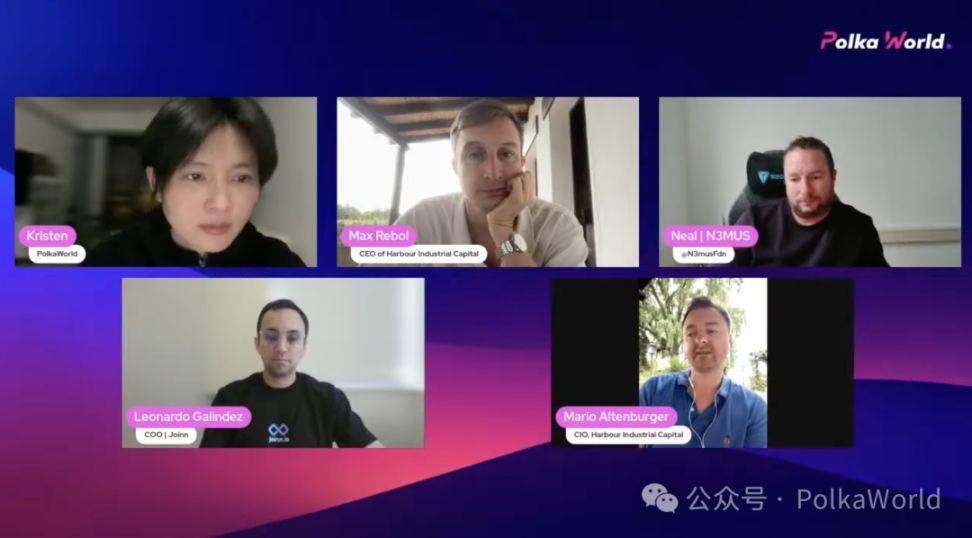
Kristen: Hello everyone, welcome to the PolkaWorld live show. This episode is an exclusive session with HIC, and we've invited them as well as the two projects they've recently invested in. This is really exciting, because usually when people mention Polkadot, they say: "Ah, there are no new projects on Polkadot." So seeing two excellent new projects announced at once, the community is eager to learn more. I'm very glad everyone is here today.
This episode we have Max and Maria from HIC, as well as Neal Peters from N3MUS and Leonardo Galindez from Joinn Finance. Welcome!
Today's discussion will focus on investment opportunities in the Polkadot ecosystem, RWA (Real World Assets), and the gaming track.
First, I'd like to ask Maria or Max to share your thoughts, because it is indeed very difficult to find new projects in the Polkadot ecosystem, but you have now brought two excellent new projects. How did you break this "new project drought"? How did you initially discover these two projects and ultimately decide to invest in them?
Max: I'll start briefly, then hand it over to Mario to add some details — for example, how we accurately identified these projects and why we are so optimistic about them.
First, to respond to your earlier point: Polkadot is indeed going through a tough time right now. Obviously, the token price has been declining, which is not good for anyone, and of course everyone hopes the price will go up. But that doesn't mean we stop building, nor does it mean we stop investing. On the contrary, many of the best opportunities often appear in these more bearish cycles.
From a macro investment perspective in the Polkadot ecosystem, we are now experiencing a fundamental change: Currently, Parity is playing a more central role in the development of the entire Polkadot ecosystem. We can already see very clearly that Parity's leadership wants to take on more proactive building tasks, such as Polkadot App, Proof of Personhood tools, and so on.
But we still firmly believe that third-party developers — like the teams with us today — are equally crucial to the ecosystem. Especially now, as the Polkadot Hub is about to go live, third-party developers continuing to build on Polkadot will encounter huge opportunities.
And don't forget, we are a decentralized ecosystem, with many different participants building and investing. I don't think all future applications in the ecosystem will be run by Parity, not at all. There are still many interesting teams and unique fields in the ecosystem that will continue to thrive on Polkadot.
This is my view on the long-term development of the Polkadot ecosystem. Overall, these two tracks — gaming and user acquisition, and the RWA (Real World Assets) track, especially in Latin America — are both extremely promising and full of exciting opportunities for us. That's why we decided to invest here. But maybe Mario, you can add some more details?
Mario: Good morning, everyone. I'm currently in Argentina, and we've just finished the DevCon and Sub0 events. Leo is actually here too; we just met last week.
For the Polkadot ecosystem, it has been "sentenced to death" countless times. But in German, we have a saying: "Those who are declared dead often live longer."
If you look closely at the underlying layer, we actually have many successful projects. We always like to emphasize this, such as peaq Network, which emerged from this ecosystem. We were among their last batch of investors, and by December last year, they had reached a valuation of 3 billions. So by "unicorn" standards, we have indeed produced quite a few decent projects from the ecosystem, and of course there are many other examples.
So what we always want to emphasize is: there have indeed been very successful cases in Polkadot's history.
But now, as Max said, as we move towards the Hub phase, we are more focused on projects that can build applications directly on the Hub. It's very exciting to be able to bring N3MUS and Joinn Finance into the ecosystem this time. Leo and I met earlier this year in Zurich, and I was immediately very excited about what they were doing. I'll let Leo talk about what Joinn is doing, but we believe their product really has the potential to impact millions of people in Latin America. The cost advantage here is not just about payment or transaction costs, but more importantly, access costs and self-custody solutions. These are all key factors in ecosystem development.
As for N3MUS, what excites us is their ability to attract top game studios to publish games. For us, this is a key factor in making a difference. We've already seen that this is indeed the core driving force of the Web3 gaming track, and this is exactly what the Polkadot ecosystem previously lacked.
For example, FIFA Rivals, which launched earlier this year, already has over one million downloads, and Pudgy Party also has over one million downloads. We see a lot of synergy between N3MUS, Mythical, and other game studios. We believe N3MUS truly fills a key gap in the ecosystem. The entire ecosystem can benefit from this.
The Real Problem RWA Solves Is Not Yield, But Global Accessibility
Kristen: RWA is a market with huge potential. So I'm very curious, what made you choose RWA? What potential did you see? How big do you think this market can get in the future?
Leonardo: RWA is a very broad term, mainly referring to "on-chain tokenized financial assets," which is actually what we are providing. Putting financial assets on-chain is actually a great solution, because it makes assets borderless.
And the reason its potential is so huge is that once assets are on-chain, they become accessible to anyone — this directly opens up a whole new market.
So to answer your question: RWA, that is, on-chain tokenized financial assets, is opening up a whole new accessibility market for emerging markets, and there are billions of dollars in these markets that have not yet truly entered the global financial system.
So what problem does blockchain technology actually solve for RWA? As I just said, the biggest solution is: tokenizing assets and putting them on-chain gives them an inherent "borderless" characteristic.
For example: we will be regulated in a certain jurisdiction, but because the assets are tokenized and on-chain, users from Colombia, Argentina, and Brazil only need to:
- Convert their local currency (such as pesos) into USDC
- Then send USDC to our platform
We will work with local partners to make the entire conversion process very transparent and simple.
This means: one platform can serve global users. For me, this is the most critical value that blockchain brings to tokenized financial assets.
Will more people be able to access RWA? Yes, absolutely. Not just more people, but more people globally.
At the same time, transparency is also higher — you can know where your assets are and their status in real time, 24/7. Putting assets on-chain also means we can provide round-the-clock liquidity for assets that could previously only be traded "nine to five".
For example: if at 3 a.m. you suddenly hear some news or have a bad dream and want to exit your position immediately, you just open our app:
- Sell your tokenized assets
- Immediately withdraw USDC
- Then go back to sleep
Very simple.
Making Web2 Players Fall in Love with Web3: How Does N3MUS Use AI to Drive 80% Monthly Growth in the Gaming Ecosystem?
Kristen: When I opened the N3MUS website, I saw a lot of events and competitions, and the whole ecosystem looked very active. How did you manage to operate such a thriving ecosystem? Do you have any specific data to share? Also, where do these incentives usually come from?
Neal Peters: What we're building at N3MUS is an AI-driven user acquisition and retention platform.
From a B2B perspective, you can think of us as:
- We are responsible for acquiring players
- Then distribute these players to games, game studios, or other platforms that need users
Simply put: wherever users are needed, we bring them there.
Our core advantage is that if you look at the traditional Web2 gaming industry, they do a lot of advertising and marketing, often spending millions of dollars on ads. These companies do manage to attract users, but the day 7 retention rate is only 3%~5% — meaning 95% of marketing spend is almost wasted.
What we want to solve is precisely this 95% of lost users. When players leave a game, the traditional approach is to spend money again on other marketing channels to get them back. But the system we've built can "retain" these users. We make sure they don't "leave the platform," they just "leave a particular game." So we can redistribute them to another game.
Regarding the data you asked about, this is actually our flywheel effect.
Of course, we also lose some players, but definitely not the majority. And every time a new game joins our platform, we bring that game's community with it.
After they join, they see more ongoing events and competitions, so:
- Players keep joining
- Then flow to different games
- They invite more friends to join
- New friends see the competitions and come to the platform
- The flywheel keeps reinforcing itself
Our platform launched last December, with the first competition on December 5. Since launch, our growth has been very rapid:
- Monthly growth rate over 80%, and still increasing
- In October this year, there were 2.7 million game matches on our platform
- November's data is not finalized yet, but is expected to exceed 3.5 million matches
We can clearly see: more and more game studios are joining, and more and more players are flowing into our ecosystem.
We are currently communicating with many Web2 game studios (not limited to the Polkadot ecosystem). Our goal is:
- These studios don't need to integrate Polkadot themselves
- Their competition logic, points mechanism, match result verification, etc., are all run by us on Polkadot
In other words, we "partially Web3-ize" Web2 games, and game studios hardly need to do anything. All these underlying logics are carried by us using Polkadot's technology.
One of the most important capabilities we provide to game studios is the anti-cheat system. Because as long as rewards or money are involved, someone will always want to cheat. So we developed an anti-cheat system deeply integrated with Polkadot, which checks:
- On-chain transactions
- Device fingerprints
- Various behavioral data provided by studios
- And other data points
All anti-cheat related parts also run on Polkadot.
On the business level, we are both B2B and B2C:
- B2B: serving game studios
- B2C: providing fun games and competitions for players
As more Web2 games join, we expect B2C user numbers to grow rapidly in the coming months.
Kristen: So how exactly do you make it easier for Web2 players to join and play games smoothly?
Neal Peters: Honestly, it's very difficult.
For example: when we get a new game, we first let a batch of "game ambassadors" (not necessarily Web3 players, mostly regular gamers) test it.
They provide a complete report, such as:
- How is the onboarding experience?
- Is the guidance clear enough?
- Is the gameplay easy to understand?
We found that 99% of Web3 games require using MetaMask or other wallet tools, which is very unfriendly to Web2 players.
Therefore, we always tell game teams: if you want to get a large number of users, you must hide all blockchain-related parts as much as possible, and not let players feel their existence.
This is one of the most common feedbacks we give.
Web2 players generally hate the word "blockchain"; they think it's a scam. So on our platform:
- All on-chain elements are hidden
- Technical logic is handled by us in the background
- Players just need to "play like a normal game"
This is exactly the key to our success in attracting Web2 players into Web3.
We are about to launch a CS2 (Counter-Strike 2) competition, which is a pure Web2 traditional shooter game. I'm really looking forward to seeing how many Web2 players join our platform through this event. Once we have results, I will definitely share the progress with everyone.
The Real Popularity of Polkadot in Latin America: 90% New Faces, a Venue Full of Web3 Native Questions
Kristen: Yes, we will definitely keep following. Okay, now back to Mario and Max. You are still in Argentina and just attended Sub0. Can you share a bit about this journey? Also, N3MUS is indeed a very good project. Did you discover any new potential at Sub0? Can you share some of your insights or takeaways?
Max: Of course. I'll say a bit first, then hand it over to Mario.
As you said, we are still in Argentina, having just finished some very, very exciting days — even weeks. At Sub0 in Buenos Aires, as well as DevConnect, also held in Buenos Aires.
First, for me personally, this is my first time in Argentina. It is indeed a very interesting country, with a very high rate of cryptocurrency adoption. I think one main reason is that this country has experienced multiple episodes of hyperinflation, so people deeply understand what "sound money" means. Therefore, people here are generally very knowledgeable about cryptocurrency, especially bitcoin, which has very high awareness and recognition here.
Holding DevCon and Sub0 here is actually a very smart strategic choice. The only downside is that it's really far from Hong Kong — almost a 24-hour flight. But I think it's totally worth it.
As for Sub0 itself, as Polkadot's flagship event, I personally think it was great. We saw many familiar faces from the Polkadot ecosystem that we meet at conferences around the world. But more importantly, there were a large number of local talents and developers participating, as well as people from other ecosystems and many local university students.
For us, this is a brand new, very positive perspective, allowing us to observe and screen new developers and projects from the region.
There were also many other wonderful events here. For example, Gavin Wood also came to Buenos Aires and gave a very impressive speech at the University of Buenos Aires, on the topic of Web3 and AI. It wasn't the kind of generic talk you often hear, but rather very deep and unique perspectives. I think there should be a recording, and I recommend everyone to check it out.
In addition, there were other events in Argentina. For example, a few days ago, Polkadot Blockchain Academy (PBA) — with whom we have a close relationship and love to collaborate — held an event in Mendoza, another province in Argentina, in cooperation with a local university, and we also attended. We saw many people here trying to solve some local problems.
For example, just yesterday or the day before, we met a project that is improving transparency in Argentina's construction industry by putting tender contracts on-chain. Because, according to them, this is a very big problem in Argentina (and I believe in other countries as well). But this is a problem that requires local expertise to solve. And when you combine these local problems with the powerful tools of Web3 — such as the concept of "less trust, more truth" — you can build truly valuable new applications.
The value creation of these applications is very easy to understand; it's not some highly speculative token, but truly solving real-world problems.
Just like the two projects on today's livestream: they are both solving real-world problems. This is also the direction we value most in our investment philosophy.
And in Argentina, we see many such people and projects. This is a country very familiar with Web3 and with high acceptance; it's really exciting to be here.
Mario: I think we also need to emphasize that Polkadot has always had a very strong community base in Latin America. There have been excellent Polkadot ambassadors and projects here in the past, always driving ecosystem development. So we really have to pay tribute to the entire community — from Mexico and Brazil to Argentina, this has always been a very strong community.
The project Max mentioned is called Clara, and they also won the Sub0 hackathon, already showing that they are fully capable of realizing their vision.
At the same time, special thanks to PBA (Polkadot Blockchain Academy), who have organized many excellent events here and have a very deep relationship. They took Gavin to many places here, from Buenos Aires to Santiago del Estero in the north. Governments from eight local provinces also participated in related meetings. You can feel that a lot of change is happening in this region.
The vision is clear: put the whole country on-chain to make governance more transparent and efficient. Just like Mandala is doing in Indonesia, local companies in Latin America can absolutely do the same — maybe even collaborate with Mandala in the future.
For example, building a secure but privacy-controllable digital identity system (safe ID), where users hold their own keys, instead of the government directly controlling digital IDs as proposed in the UK (which could even deduct parking fines directly from your account). This new type of ID can access government services while maintaining privacy, which is very important.
This is also consistent with what Gavin often emphasizes: Proof of Personhood.
How to prove "you are a real person and you are yourself" without exposing too much identity information. I think this is crucial. In short, the momentum here is very strong, and we also see several very promising projects. We believe this region has huge growth potential for Polkadot.
Kristen: Hmm, that's great to hear. So, I'd also like to know, what were the participants of this event like? What was their age range? Were they people from the Polkadot ecosystem, or new faces from places like Wall Street?
Max: Regarding Sub0, the organizers actually released some data — about 90% of participants were not from the Polkadot ecosystem. In other words, there were a lot of new attendees this time, which is obviously a good thing.
Mario: The participant structure was also very diverse. As Max said, there were many students; PBA (Polkadot Blockchain Academy) and WebZero both invited quite a few local university students. But at the same time, there were also some very senior government officials and members of academia attending.
You could see some teenagers, 18- or 19-year-old university students, as well as seventy-year-old government officials or university professors — the age range of participants was very wide.
Kristen: That's great, it's wonderful to see new groups pouring into the Polkadot ecosystem.
Disclaimer: The content of this article solely reflects the author's opinion and does not represent the platform in any capacity. This article is not intended to serve as a reference for making investment decisions.
You may also like
The Ripple Effect: How Macroeconomic Shifts Shape the Crypto Landscape
In Brief Anticipated "altcoin season" postponed to 2025 due to macroeconomic factors. ISM Manufacturing PMI data is a key predictor of altcoin market trends. 2025 tests investor patience, with potential positive shifts forecasted for 2026.

Bitcoin mining is experiencing its worst crisis in 15 years!
Yearn Finance Recovers $2.4M After Hack in an Unprecedented Rescue Mission
Crypto Investors Return As ETP End Bearish Streak
Trending news
MoreCrypto prices
More






