
Telegram, the world's largest social platform, launches major update: Your graphics card can now mine TON

Telegram’s ambition for privacy-focused AI
Yesterday, Telegram founder Pavel Durov announced on Twitter that their decentralized privacy computing network, Cocoon, has officially launched.
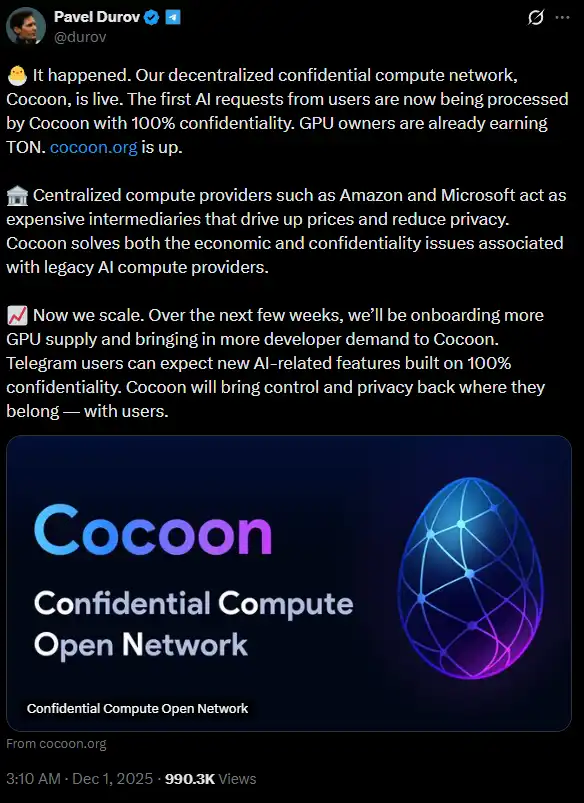
The Cocoon network is composed of three parts:
Client: Initiates work requests to the proxy and pays fees to the proxy once the request is completed.
Proxy: Routes work requests to worker nodes. The proxy is protected by TEE and will select the appropriate node for routing based on the worker node’s device model, load, and reputation. It pays the fees collected from the client to the node, while also taking a certain commission itself. Telegram plans to allow anyone to run their own proxy in the future, making the Cocoon network fully decentralized.
Worker Node: Executes AI inference requests in a TEE-protected virtual machine and receives payment for the client’s request from the proxy after execution is completed.
In other words, anyone can use their own GPU to become a worker node and earn $TON. Cocoon allows GPU owners to contribute AI computing power to the decentralized network on TON. By simply running the Cocoon protocol stack on a TEE-supported GPU server, they can provide private, verifiable AI model execution and transparently receive $TON payments for each processed request.
Pavel Durov stated that some of Telegram’s AI-related features, such as message translation, are already partially supported by Cocoon. He also mentioned in-app features like speech-to-text and summarization, indicating that Cocoon does not lack real-world applications at launch. He believes that Telegram mini-apps will bring more usage demand to the Cocoon network in the future.
Compared to the previously hyped Telegram Gift NFTs in the crypto community, Cocoon is more like a decentralized AI computing network built by combining Telegram’s blockchain and $TON as a payment method, starting from Telegram’s built-in functional needs. It is unlikely to issue a token, so the speculation potential is limited. However, this project may reflect a long-term trend: people are increasingly concerned about privacy issues when exposing data directly to centralized AI giants. In the crypto space, we have already seen more and more privacy projects promoting the slogan of “protecting data sovereignty.” (Related reading: 12 New Projects: An Overview of Solana Officially Named Privacy Projects)
Currently, the total TVL of the Cocoon network has reached about 4,487 TON, with 30 worker nodes, 18 proxies, and 12 clients. This is data from just over one day since the official launch, so it is still very early.
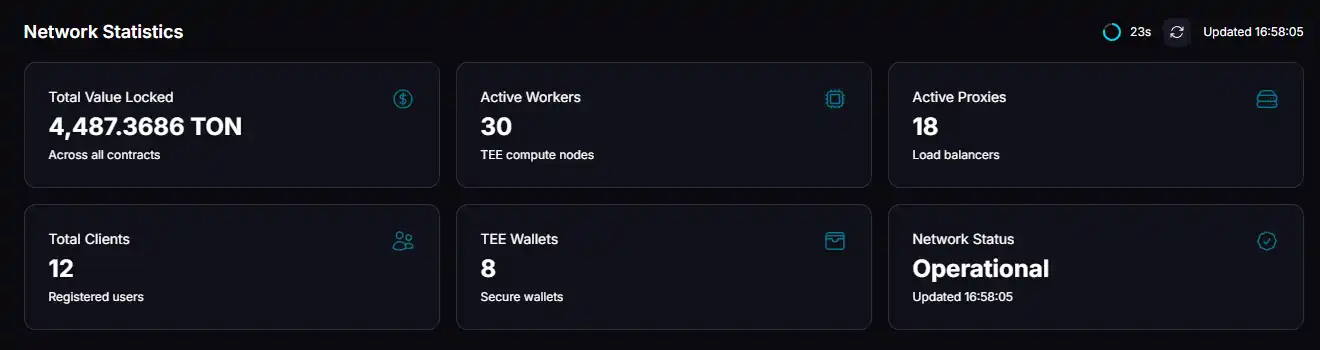
With actual application demand from Telegram’s built-in features and TON incentives, but also reduced token issuance expectations due to the existence of TON incentives, whether the Cocoon network can develop differently from other crypto computing projects in the space remains to be seen over time.
Disclaimer: The content of this article solely reflects the author's opinion and does not represent the platform in any capacity. This article is not intended to serve as a reference for making investment decisions.
You may also like
The Ripple Effect: How Macroeconomic Shifts Shape the Crypto Landscape
In Brief Anticipated "altcoin season" postponed to 2025 due to macroeconomic factors. ISM Manufacturing PMI data is a key predictor of altcoin market trends. 2025 tests investor patience, with potential positive shifts forecasted for 2026.

Bitcoin mining is experiencing its worst crisis in 15 years!
Yearn Finance Recovers $2.4M After Hack in an Unprecedented Rescue Mission
Crypto Investors Return As ETP End Bearish Streak
Trending news
MoreCrypto prices
More






