
Why Stocks Surge Despite Fed Shrinkage

The S&P 500 has climbed 82% in three years even as the Federal Reserve (Fed) reduced its balance sheet by 27%. Markets anticipate a 86% chance of a 25 basis point rate cut this week. Nonetheless, economic stress and talk of Fed leadership changes could make policy directions less clear. Market Performance Surpasses Traditional Liquidity
The S&P 500 has climbed 82% in three years even as the Federal Reserve (Fed) reduced its balance sheet by 27%.
Markets anticipate a 86% chance of a 25 basis point rate cut this week. Nonetheless, economic stress and talk of Fed leadership changes could make policy directions less clear.
Market Performance Surpasses Traditional Liquidity Theories
The equity rally during a period of quantitative tightening has challenged long-standing market beliefs.
BREAKING: The Federal Reserve’s balance sheet fell -$37 billion in November, to $6.53 trillion, to its lowest level since April 2020.The Fed has reduced its assets by -$2.43 trillion, or -27%, during its quantitative tightening (QT) program, which ended on December 1st after… pic.twitter.com/RdmKaBMEVf
— The Kobeissi Letter (@KobeissiLetter) December 7, 2025
Data shared by Charlie Bilello shows the S&P 500 up 82% while Fed assets fell by nearly a quarter.
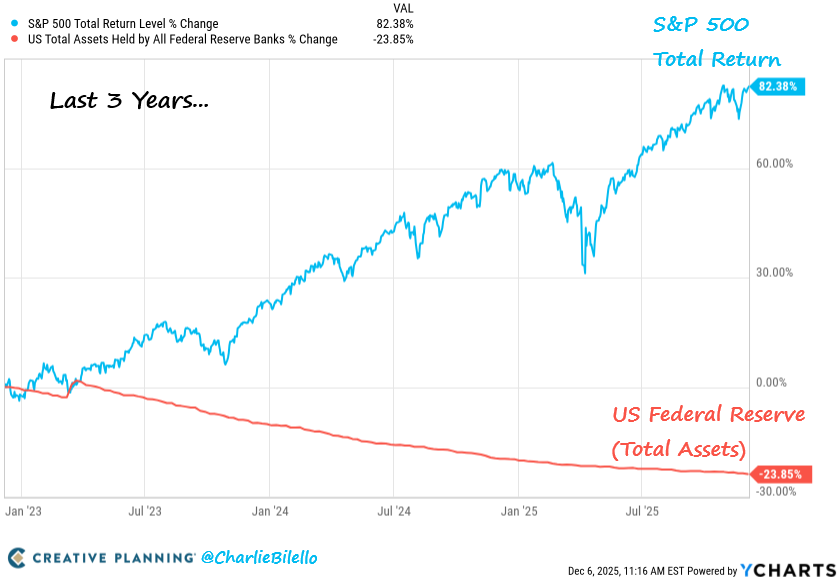 S&P 500 total return versus Federal Reserve total assets over three years.
Charlie Bilello
S&P 500 total return versus Federal Reserve total assets over three years.
Charlie Bilello
This separation suggests that factors beyond central bank policies now influence investor confidence. Analysts highlight alternative liquidity sources fueling the rally:
- Fiscal deficits,
- Strong corporate buybacks,
- Foreign capital inflows, and
- Steady bank reserves offset quantitative tightening.
EndGame Macro explains that markets react to expectations for future policy, not only the current balance sheet levels.
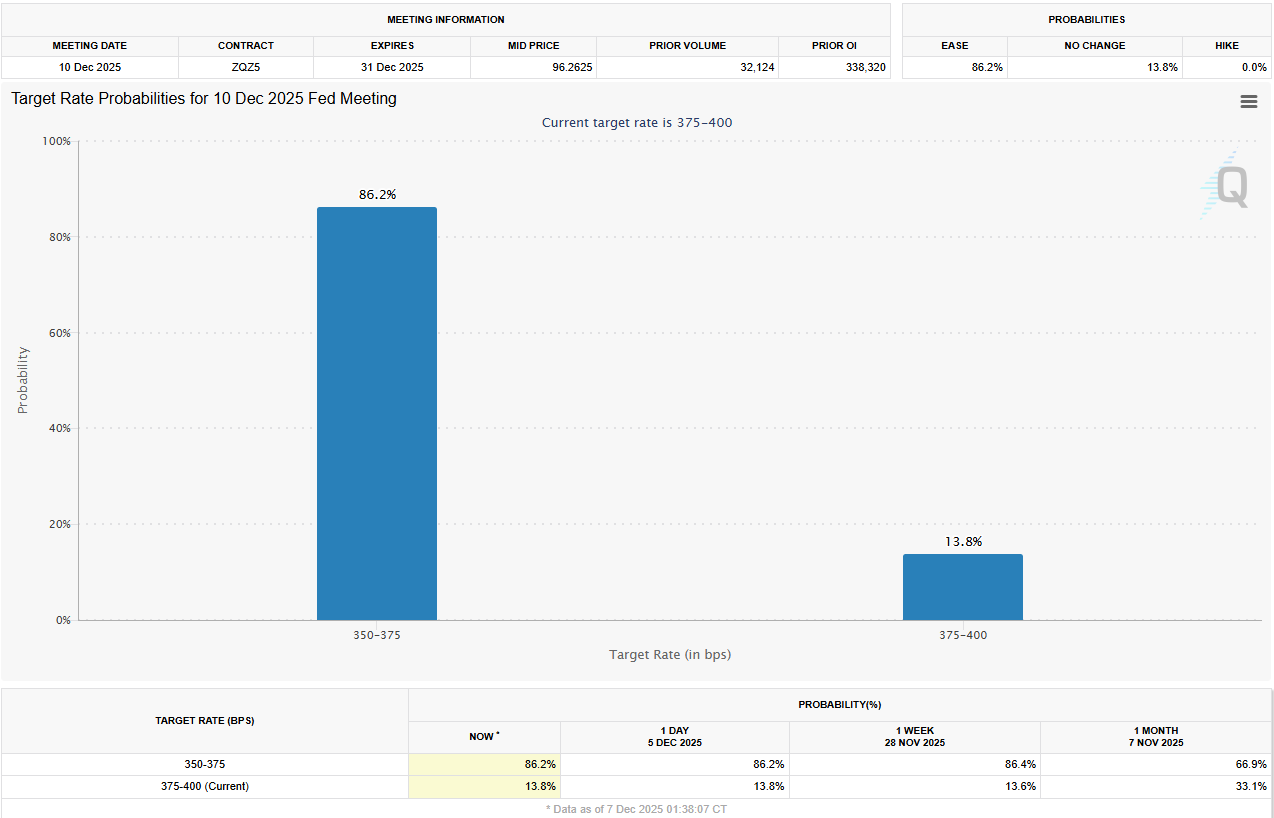 Interest Rate Cut Probabilities. Source:
CME FedWatch Tool
Interest Rate Cut Probabilities. Source:
CME FedWatch Tool
However, gains are concentrated in a handful of mega-cap technology companies. As a result, headline market performance disguises sector weaknesses tied to core economic fundamentals.
Psychological liquidity is also significant. Markets respond to anticipated policy changes, not just current conditions. This forward-looking mindset allows equities to rise even when the Fed holds a tightening stance.
Economic Strains Obscured by Stock Gains
Strong stock performance masks deeper economic stress. Corporate bankruptcies are nearing 15-year highs as borrowing costs rise. At the same time, consumer delinquencies on credit cards, auto loans, and student debt are increasing.
Commercial real estate are being impacted by declining property values and harder refinancing terms. These pressures are not reflected in top equity indices, since smaller companies and vulnerable sectors are underrepresented. The link between index performance and wider economic health is now much weaker.
This split suggests that equity markets primarily reflect large firms’ strength. Companies with solid balance sheets and limited consumer exposure tend to perform well, while others dependent on credit or discretionary spending face headwinds.
This economic divide complicates the Federal Reserve’s task. While major stock indexes suggest easy financial conditions, underlying data reveals tightening pressures affecting many areas of the economy.
Fed’s Reputation Pressured as Rate Cut Nears
Many investors and analysts are now questioning the Fed’s direction and effectiveness. James Thorne described it as bloated and behind the curve, urging less reliance on Fed commentary for market signals.
The Fed is a massive boondoggle.Wall Street still doesn’t get it. The Fed has become a bloated, backward-looking relic, anchored to broken models and bad data. Secretary Bessent sees it clearly, but investors keep treating Powell’s Fed like an oracle instead of the lagging,… https://t.co/kj3dX1vFDS
— James E. Thorne (@DrJStrategy) December 7, 2025
Treasury Secretary Scott Bessent shared pointed criticism in a recent discussion.
“The Fed is turning into a universal basic income for PhD economists. I don’t know what they do. They’re never right … If air traffic controllers did this, no one would get in an airplane,” a user reported, citing Bessent.
These perspectives show rising doubts about the Fed’s ability to forecast economic turns and act quickly. Critics argue that policymakers tend to lag behind markets, fueling uncertainty.
Still, the market expects a 25-basis-point cut this week on Wednesday.
Leadership Uncertainty and Risks for Inflation
Changing leadership at the Federal Reserve adds volatility to policy forecasts. Kevin Hassett leads as the likely replacement for Jerome Powell. Known for his dovish stance, Hassett may bring a looser policy that could raise inflation expectations.
This prospect has moved bond markets. The 10-year Treasury yield has risen as investors weigh whether easier monetary policy under new leadership will push inflation higher. Beyond near-term cuts, markets also price in a broader tone of accommodation.
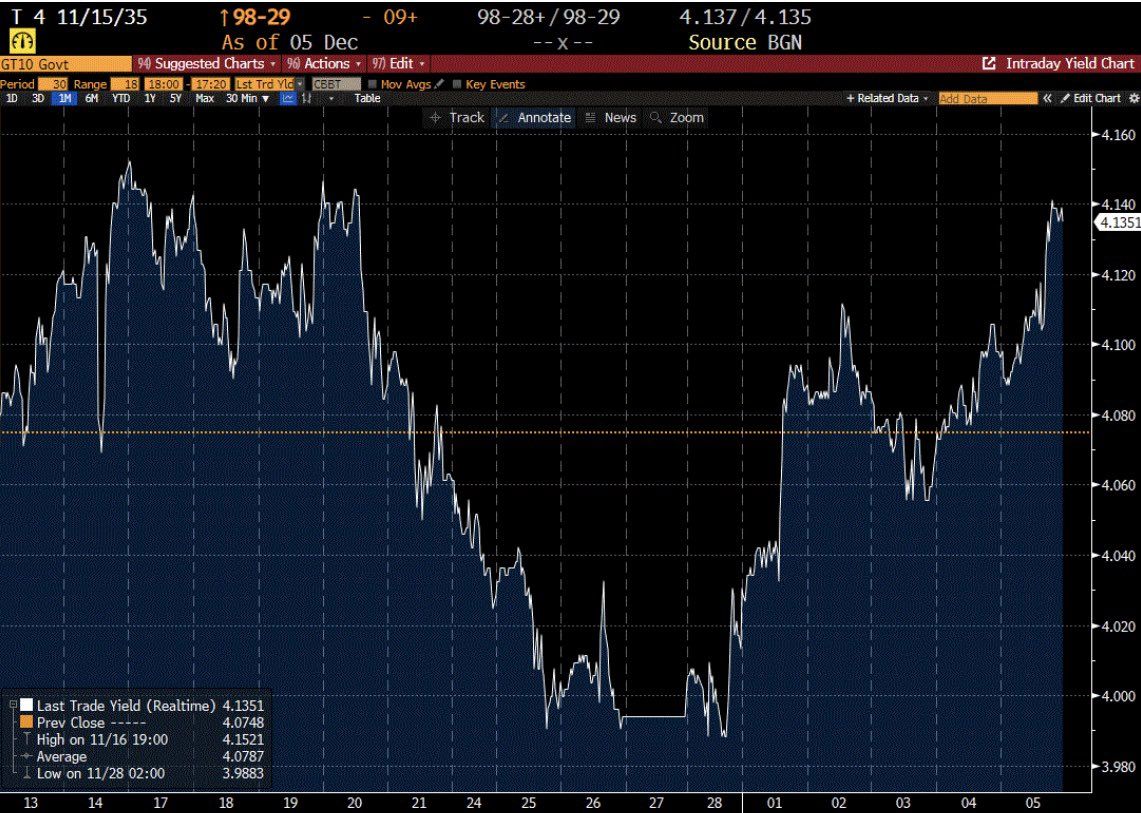 10-year Treasury yield rising amid inflation expectations and leadership speculation.
Gary Black
10-year Treasury yield rising amid inflation expectations and leadership speculation.
Gary Black
Investors expect two additional 25-basis-point rate cuts in 2026, likely in March and June. If Hassett becomes Fed chair as early as February, Powell’s remaining term could see him sidelined.
This transition makes Fed policy guidance less predictable as markets focus on the coming change in leadership.
This uncertainty arises while the Fed tries to manage modest inflation above target and a resilient economy under tighter financial conditions. Mistakes in policy or timing could easily rekindle inflation or cause avoidable economic deterioration.
Historical trends provide some context. Charlie Bilello notes that bull markets usually outlast bears by five times, emphasizing the value of compounding returns over market timing.
Bull markets have lasted 5x longer than bear markets on average.Bulls: +254% over 5 years 🐂Bears: –31% over 1 year🐻Markets spend far more time growing wealth than destroying it. Why interrupting compounding is the biggest risk of all.Video: https://t.co/c6hlNgAwvI pic.twitter.com/FVfbm4Nssa
— Charlie Bilello (@charliebilello) December 7, 2025
The ongoing rally could persist, but concentrated gains, economic stress, and doubts about the Fed’s approach make it unclear if markets can remain this resilient as monetary policy evolves.
Read the article at BeInCryptoDisclaimer: The content of this article solely reflects the author's opinion and does not represent the platform in any capacity. This article is not intended to serve as a reference for making investment decisions.
You may also like
ICP Price Jumps 30%: Exploring the Reasons Behind the Rally and Future Outlook
- ICP token surged 30% in November 2025, driven by ICP 2.0 upgrades and institutional partnerships with Microsoft , Google, and SWIFT. - On-chain data showed 35% higher active addresses but 91% lower token transfers during downturns, highlighting speculative retail activity over organic adoption. - Social sentiment shifted from extreme greed (Nov 10) to cautious optimism as ICP broke below $4.33 support, with technical indicators suggesting potential short-term reversals. - Analysts project $11.15-$31.89 p

Investment Prospects in AI-Powered Training Platforms: A 2025 Overview of Industry Growth and Workforce Needs
- AI integration in education and workforce training has reached a critical inflection point, driven by surging corporate adoption and labor market shifts. - AI-powered platforms are bridging skill gaps through personalized learning, with 77% of companies using AI for training and a $240B global eLearning market projected by 2025. - Labor trends show AI displacing 92M jobs but creating 170M new roles by 2030, while AI-exposed industries grow revenue 3x faster than non-AI sectors. - Academic programs and $1

The Federal Reserve's Change in Policy and Its Effects on High-Yield Cryptocurrencies Such as Solana: Rethinking Risk Management Amidst Shifting Regulations in the Digital Asset Sector
- Fed's 2025 policy shift injected $72.35B into markets, briefly boosting Solana (+3.01%) before macro risks triggered a 6.1% price drop. - EU MiCA and US GENIUS Act regulations drove institutional adoption of compliant platforms, with Solana's institutional ownership reaching 8% of supply. - Fed's $340B balance sheet reduction and SIMD-0411 proposal exposed crypto liquidity fragility, causing 15% market cap decline and 4.7% TVL drop for Solana. - Institutions now prioritize MiCA-compliant stablecoins and

Algo slips 0.52% as Allego unveils app designed to simplify EV charging
- Algo (ALGO) fell 0.52% in 24 hours to $0.1335, with a 60.3% YTD decline, coinciding with Allego's new EV charging app launch. - Allego's app offers real-time pricing, smart routing, and Plug&Charge features to simplify European EV charging across 35,000+ stations. - The app eliminates partner network markups and provides transparent billing, targeting user frustrations with fragmented charging experiences. - As Europe's EV market grows, Allego positions itself as a key infrastructure provider through thi

Trending news
MoreCrypto prices
More





