
JPMorgan Denies Political Motive Behind Crypto Account Closure Tied to Trump

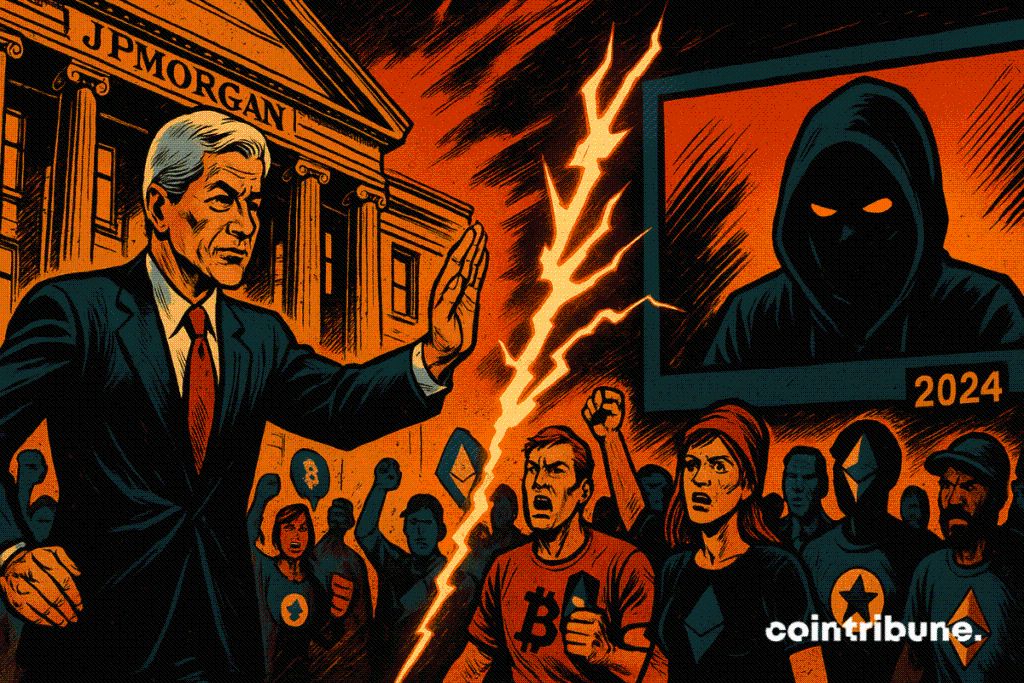
Crypto account closures reignite controversy between financial institutions and conservative figures. JPMorgan is indeed accused of targeting pro-Trump users. Its CEO, Jamie Dimon, firmly rejects this version.
In brief
- JPMorgan denies targeting crypto actors for political or ideological reasons.
- Jamie Dimon calls for reform of debanking rules deemed unclear and unfair.
Crypto and account closure: accusations rain down on JPMorgan
Several personalities in the crypto sector denounce the closure of their bank accounts by JPMorgan, without clear justification.
- The CEO of Strike Jack Mallers claims, for example, to have lost access to his personal funds.
- Trump Media, headed by Devin Nunes, mentions a similar blockage.
- The same scenario on the crypto platform ShapeShift.
These incidents revive fears of a new “Operation Chokepoint”. Some administrations use this controversial method to restrict access to crypto banking services.
Jamie Dimon, JPMorgan CEO, categorically rejects these allegations during an interview with Fox News.
The debate actually touches a sensitive point: the neutrality of banks in the face of the rise of digital assets. More precisely referring to the massive debanking that raises the question of possible financial censorship hidden behind vague compliance rules.
Crypto, Trump and regulation: Jamie Dimon’s strong defense
Jamie Dimon affirms he has been advocating for 15 years to reform the rules that push banks to close accounts on mere suspicion or media reporting. He thus calls for a clarification of the financial regulation standards imposed on banks.
Dimon reminds that JPMorgan never delivers information to authorities without a subpoena. However, he accuses the political climate of turning banks into easy targets. For him, the problem comes from the law (and not the intentions of the institution).
The crypto community therefore fears an abusive use of these procedures, seen as a barrier to decentralized finance. In a context where digital wallets are gaining popularity, each incident fuels distrust toward traditional actors.
In any case, the war between crypto supporters and traditional banks seems far from settled. Regulation will have to decide between control and innovation, before a real gap grows between two visions of finance.
Disclaimer: The content of this article solely reflects the author's opinion and does not represent the platform in any capacity. This article is not intended to serve as a reference for making investment decisions.
You may also like
The Growing Influence of Artificial Intelligence on Universities and Preparing Tomorrow’s Workforce
- AI integration in higher education drives academic program expansion, with 2.5% undergraduate and 3% graduate enrollment growth in 2024. - Universities invest $33.9B in generative AI to modernize curricula and partner with industries , addressing 58% workforce readiness gaps. - AI-driven tools boost student retention (52% adoption) and project 1.5% U.S. GDP growth by 2035 through automation in key sectors. - Challenges persist: 71% academic integrity concerns and 52% training gaps highlight risks in AI a

The CFTC-Sanctioned Transformation in Clean Energy Trading
- CFTC's 2025 withdrawal of carbon credit derivatives guidance creates regulatory uncertainty but sparks innovation in blockchain/AI solutions. - OBBBA's 2026 construction deadline accelerates solar/wind project cancellations while preserving tax credit transferability mechanisms. - Battery storage, geothermal, and hydrogen emerge as resilient sectors amid market shifts, supported by IRA tax credits and OZ modernization. - Investors prioritizing domestic supply chains and third-party certified projects gai

Aligning university programs with new technology sectors to pinpoint areas with strong investment potential
- Higher education is redefining curricula to align with AI, quantum computing, green energy, and biotech sectors, addressing urgent talent gaps. - Green energy apprenticeships (e.g., ACE Network) and biotech-AI hybrid training programs are scaling rapidly to meet workforce demands. - Quantum computing initiatives like Connecticut's $1B QuantumCT plan highlight trillion-dollar investment potential in talent development and infrastructure. - AI ethics integration and edtech platforms for real-time labor mar

Tight Range Emerges: PEPE Trades at $0.054368 With 4.1% Weekly Decline and Key Levels in Focus

Trending news
MoreCrypto prices
More





