Last updated:
November 27, 2024 18:30 EST

Crypto miners in the nation will soon have to pay taxes of 13% or 15% on their annual revenues

Russian Lawmakers have approved the government’s crypto tax bill, meaning industrial Bitcoin miners will soon have to pay levies on their revenues.
The media outlet Komsomolskaya Pravda reported that the State Duma voted in favor of proposed amendments to the Russian Tax Code in the bill’s second and third readings.
The bill will now head to the Russian Senate for approval before President Vladimir Putin signs it into law.
Considering the speed of the Duma’s actions, it is likely both of these steps will be completed in the coming days.
The bill specifies that crypto miners must pay a flat rate of 13% on their earnings if they make up to 2.4 million rubles ($21, 210) per year from their operations.
If they make more than this, they will have to pay at a rate of 15%, the bill’s text states.
The bill is also groundbreaking in a legal sense, as it officially recognizes crypto as a form of “property” for the first time.
In the past, Russian courts have struggled with crypto-related cases, with judges unsure how to classify “public” blockchain-powered tokens.
The bill also includes a clause that specifies that miners do not need to pay value-added tax (VAT) when mining tokens and selling them on crypto exchanges .
However, the bill specifies that miners must report on their operations to the Federal Tax Service (FTS).
Those who fail to do so can be fined up to 40 thousand rubles ($354), the text of the bill states.
Russia’s crypto mining legislation is rolling out at a rapid pace ever since Putin signed the nation’s first crypto mining “legalization” law in August this year.
That law came into effect on November 1, and the government has since followed up with decrees temporarily banning mining in regions suffering from energy shortages in winter months.
The FTS recently said that some 150 firms have already submitted applications for operating permits.
The tax body said that it expects more companies to submit permit requests in the near future.
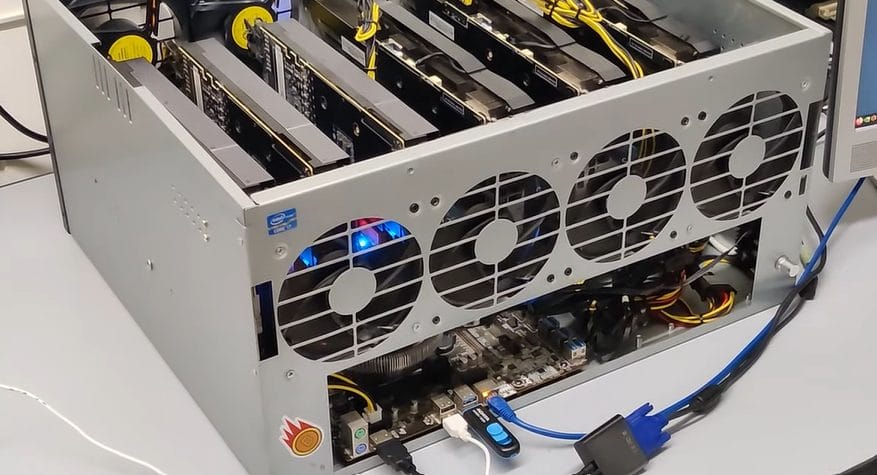 A Russian crypto miner showcases his home mining setup. (Source: PC Boyarin/YouTube/Screenshot)
Earlier this week, Lenta reported that there has been a sharp rise in Russians buying crypto mining hardware in recent weeks.
The media outlet wrote that “industry sources” claimed that “in the second and early third quarters of FY2024, Russians were buying only “about 30 rigs per week.”
But in September this figure rose quickly to 200. And since the start of November, miners have been buying a total of 600 rigs per week.
The Moscow-based mining hardware firm Mining Group stated that the “excitement” of recent months had sent prices spiraling upward “by 10%-15% percent.”
Alexander Peresichan, the CEO of the software solution developer Tehnobit, said that the “profitability of Bitcoin mining” remains high in Russia. Peresichan said:
“After the Bitcoin halving event in the spring of 2024, the cost of mining in Russia rose to approximately $40,000. In the Irkutsk region, it is cheaper, at around $35,000, if you are lucky enough to find a free and profitable ‘connection.’ But there are none of these left.”
Irkutsk is Russia’s Bitcoin mining capital. However, it has also become a hotbed of illegal mining , which power firms say is taking its toll on the wider Siberian power grid.
Disclaimer: The content of this article solely reflects the author's opinion and does not represent the platform in any capacity. This article is not intended to serve as a reference for making investment decisions.
Decoding VitaDAO: A Paradigm Revolution in Decentralized Science

Mars Morning News | ETH returns to $3,000, extreme fear sentiment has passed
The Federal Reserve's Beige Book shows little change in U.S. economic activity, with increasing divergence in the consumer market. JPMorgan predicts a Fed rate cut in December. Nasdaq has applied to increase the position limit for BlackRock's Bitcoin ETF options. ETH has returned to $3,000, signaling a recovery in market sentiment. Hyperliquid has sparked controversy due to a token symbol change. Binance faces a $1 billion terrorism-related lawsuit. Securitize has received EU approval to operate a tokenization trading system. The Tether CEO responded to S&P's credit rating downgrade. Large Bitcoin holders are increasing deposits to exchanges. Summary generated by Mars AI. The accuracy and completeness of this summary are still being iteratively improved by the Mars AI model.

The central bank sets a major tone on stablecoins for the first time—where will the market go next?
The People's Bank of China held a meeting to crack down on virtual currency trading and speculation, clearly defining stablecoins as a form of virtual currency with risks of illegal financial activities, and emphasized the continued prohibition of all virtual currency-related businesses.