
USDC Issuer Circle Stumbles on Neutral Rating From Compass Point

USDC issuer Circle slipped 5.5% early Tuesday as Compass Point, the equity research arm linked to the middle-market investment bank of the same name, initiated coverage with a neutral rating.
Compass Point gave the company's shares—which trade on the New York Stock Exchange under the CRCL ticker—a $205 price target. The stock opened at $238.46, or 9.4% lower than its Monday closing price of $263.40.
The stock has since struggled to pull even with its Monday close.
Compass Point reasoned that although USDC technology and liquidity give it long-term advantages, Circle is so far limited to crypto players as distribution partners.
Circle's USDC distribution partner list is long, but is indeed limited mainly to fellow crypto firms. Its main partner has always been Coinbase, which co-founded USDC through the Centre Consortium in 2018 and receives 50% of interest earned on the reserves backing the U.S. dollar-backed stablecoin.
Late last year, Circle entered into a strategic partnership with Coinbase's largest competitor. "Binance will make USDC more extensively available across their full suite of products and services," the company wrote in a December blog post.
But the company has had to pull support from some networks. Last February, the company cut support for USDC on Tron, citing "risk management" concerns.
USDC also recognizes crypto exchanges Bybit, Bitget, and Bitstamp as on- and off-ramp providers.
Research analysts Ed Engel and Joe Flynn reasoned that the stock trading at over 100 times EBITDA, or earnings before interest, taxes, depreciation, and amortization, makes them think investors are using it to bet on the future growth of stablecoins—not near-term earnings.
"To justify CRCL’s valuation, investors must forecast bullish [total addressable market] and market share assumptions. We believe stablecoins can penetrate ~10% of U.S. M2 by 2030, implying a $2 trillion addressable market," the analysts wrote in a report shared with Decrypt. "USDC has 24% market share, and we model 20-30% longer-term share alongside new competition and lower share from USDT."
The M2 is shorthand for money that's liquid, but not as much as actual cash. It includes savings and money market accounts, and short-term certificates of deposit. As of April, the Federal Reserve estimated U.S. M2 at about $21.9 trillion, up from $21.7 trillion in March.
The analysts noted that progress of the GENIUS Act in D.C., which could set up a regulatory framework for U.S. dollar-backed stablecoins, is both bullish and bearish for Circle.
"We expect competition to accelerate after stablecoin legislation passes," they wrote. "This influx of competition could reduce long-term market share expectations and pressure CRCL shares in 2025."
Other observers have also expressed skepticism about Circle's short-term growth potential.
James Toledano, the chief operating officer at Unity Wallet, said he's been wary of CRCL's upward momentum after its listing earlier this month.
"Circle’s surge reflects a shifting market mood, but the fundamentals still raise questions," he told Decrypt. "Despite a 750% post-IPO rally, USDC’s market share has been declining, and Circle’s revenue depends heavily on high interest rates. A Fed pivot could sharply undercut its income."
USDC's market share has fluctuated as users mint and burn tokens.
In May 2022, USDC nearly pulled even with its largest competitor, Tether, and had command of roughly 34% of the stablecoin market. In early 2025, USDC accounted for roughly 27% of the stablecoin market, according to CoinGecko data.
Edited by Stacy Elliott.
Disclaimer: The content of this article solely reflects the author's opinion and does not represent the platform in any capacity. This article is not intended to serve as a reference for making investment decisions.
You may also like
Economic Truth: AI Drives Growth Alone, Cryptocurrency Becomes a Political Asset
The article analyzes the current economic situation, pointing out that AI is the main driver of GDP growth, while other sectors such as the labor market and household finances are in decline. Market dynamics have become detached from fundamentals, with AI capital expenditure being key to avoiding a recession. The widening wealth gap and energy supply are becoming bottlenecks for AI development. In the future, AI and cryptocurrencies may become the focus of policy adjustments. Summary generated by Mars AI This summary was generated by the Mars AI model, and its accuracy and completeness are still in the process of iterative improvement.

AI unicorn Anthropic accelerates IPO push, taking on OpenAI head-to-head?
Anthropic is accelerating its expansion into the capital markets, initiating collaboration with top law firms, which is seen as an important signal toward going public. The company's valuation is approaching 300 billions USD, and investors are betting it could go public before OpenAI.
Did top universities also get burned? Harvard invested $500 million heavily in bitcoin right before the major plunge
Harvard University's endowment fund significantly increased its holdings in bitcoin ETFs to nearly 500 million USD in the previous quarter. However, in the current quarter, the price of bitcoin subsequently dropped by more than 20%, exposing the fund to significant timing risk.

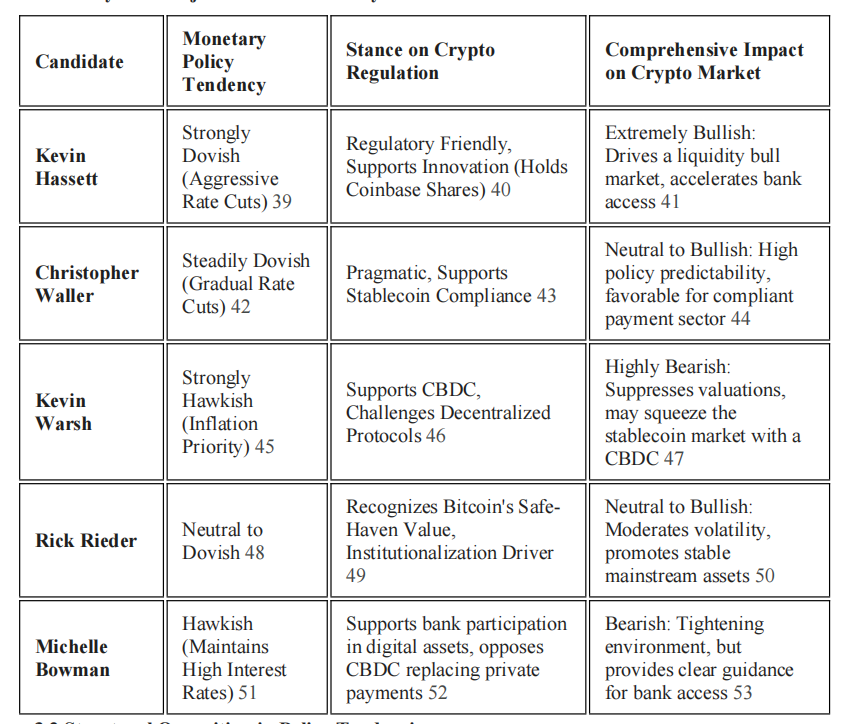
The Structural Impact of the Next Federal Reserve Chair on the Cryptocurrency Industry: Policy Shifts and Regulatory Reshaping
The change of the next Federal Reserve Chair is a decisive factor in reshaping the future macro environment of the cryptocurrency industry.
Trending news
MoreCrypto prices
More






