
Malaysia’s Central Bank Explores Bitcoin & XRP as Currency Alternatives

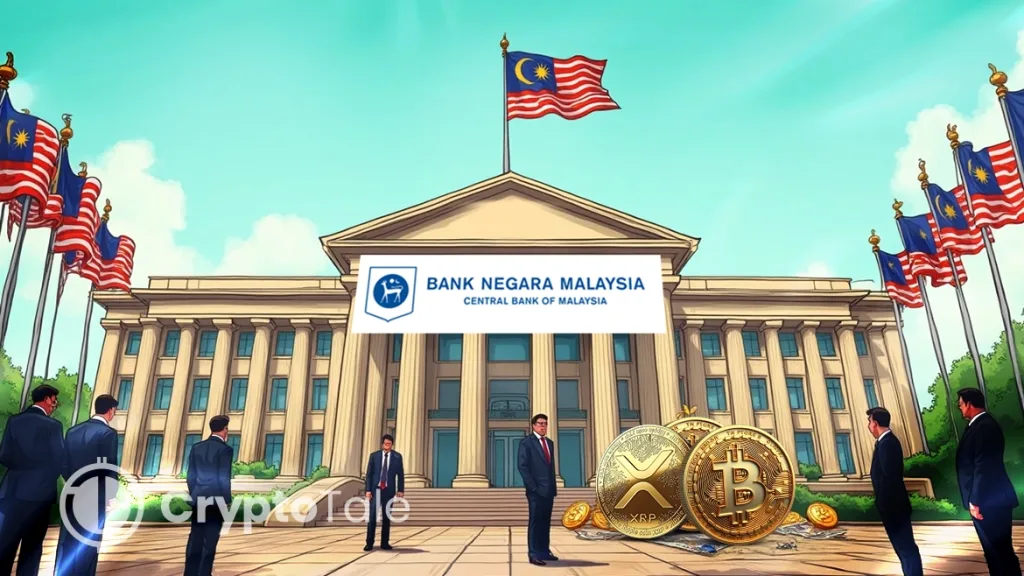
- Bank Negara Malaysia is considering Bitcoin and XRP as alternatives to traditional currency.
- Strong regulations and improved infrastructure are key to cryptocurrency integration.
- Asset tokenization is being explored to foster innovation in Malaysia’s financial sector.
Bank Negara Malaysia (BNM), the country’s central bank, recently published a working paper. It explores the potential for Bitcoin (BTC) and XRP to replace traditional currency in circulation or bank deposits. This marks a rare policy-level shift in Malaysia, signaling an openness to cryptocurrencies as mainstream payment systems.
The paper examines the application of these digital assets within Malaysia’s financial infrastructure. BNM suggests that, if widely adopted, Bitcoin and XRP could eventually replace traditional money. This shift could transform the use of currency, distancing it from physical cash and bank deposits.
BNM Cautions on Bitcoin and XRP’s Stability Issues
Regardless of the optimism, BNM remains wary of embracing Bitcoin and XRP. The paper raises the pertinent challenges that such cryptocurrencies encounter. Neither Bitcoin nor XRP has a stable nominal anchor, which makes them too volatile to substitute for existing payment systems.
BNM has acknowledged the potential of such assets but also emphasized that major concerns need to be addressed. Stability and scalability are among the challenges cryptocurrencies will have to solve in order to gain a place in the mainstream banking world. The paper states that such issues must be addressed to make cryptocurrencies a legitimate alternative to conventional systems of money.
As Malaysia analyses the integration of digital currencies, it is evident that BNM wants to take a slow pace. The paper also stresses effective regulations and consumer protection. To address cryptocurrency-related risks and guarantee their safe utilization, it will be important to establish clear regulations.
Besides regulation, BNM points out that Malaysia should have a technological infrastructure that can handle large cryptocurrency transactions. The central bank highlights that cryptocurrencies need to deal with price volatility and large volumes of transactions before wider adoption.
Another aspect covered by the report is the problem of intermediaries within the crypto ecosystem. The fact that cryptocurrencies are decentralized implies that there is no single power in control of the liquidity. The report warns that reliance on intermediaries concentrates liquidity and introduces counterparty and operational risks.
Although the position taken by BNM shows that it is cautious about Bitcoin and XRP, the central bank does not dismiss the long-term prospects of Bitcoin and XRP. The moves by Malaysia to exploit these crypto assets are just part of a global shift in finance.
Related: Malaysia SC Proposes Faster Crypto Listings With New Safeguards
BNM Announces Key Regulatory Moves on AI, Open Finance, and Tokenization
Bank Negara Malaysia (BNM) Governor Dato’ Sri Abdul Rasheed Ghaffour revealed three significant regulatory developments. One of these includes the release of a discussion paper on artificial intelligence. This paper outlines BNM’s regulatory framework for AI in the financial sector.
Towards the end of the year, BNM will release an Exposure Draft on Open Finance. This draft will present its vision for a customer-permissioned, data-driven sharing ecosystem. It aims to improve data control and transparency for consumers.
BNM will also publish a discussion paper on asset tokenization. This paper will explore potential uses for tokenized assets. It will also set in place measures that will make their adoption within the financial system secure.
While Malaysia’s exploration of cryptocurrencies is still in its early stages, BNM’s approach signals a forward-thinking strategy. Its willingness to explore Bitcoin, XRP, and other digital assets could influence other nations to reconsider their financial systems and embrace the potential of cryptocurrencies in the future.
The post Malaysia’s Central Bank Explores Bitcoin & XRP as Currency Alternatives appeared first on Cryptotale.
Disclaimer: The content of this article solely reflects the author's opinion and does not represent the platform in any capacity. This article is not intended to serve as a reference for making investment decisions.
You may also like
After Pectra comes Fusaka: Ethereum takes the most crucial step towards "infinite scalability"
The Fusaka hard fork is a major Ethereum upgrade planned for 2025, focusing on scalability, security, and execution efficiency. It introduces nine core EIPs, including PeerDAS, to improve data availability and network performance. Summary generated by Mars AI. The accuracy and completeness of this summary are still being iteratively updated by the Mars AI model.

Decoding VitaDAO: A Paradigm Revolution in Decentralized Science

Mars Morning News | ETH returns to $3,000, extreme fear sentiment has passed
The Federal Reserve's Beige Book shows little change in U.S. economic activity, with increasing divergence in the consumer market. JPMorgan predicts a Fed rate cut in December. Nasdaq has applied to increase the position limit for BlackRock's Bitcoin ETF options. ETH has returned to $3,000, signaling a recovery in market sentiment. Hyperliquid has sparked controversy due to a token symbol change. Binance faces a $1 billion terrorism-related lawsuit. Securitize has received EU approval to operate a tokenization trading system. The Tether CEO responded to S&P's credit rating downgrade. Large Bitcoin holders are increasing deposits to exchanges. Summary generated by Mars AI. The accuracy and completeness of this summary are still being iteratively improved by the Mars AI model.

Trending news
MoreCrypto prices
More





