
Why Are Millions of Pi Users Still Waiting? The Unanswered KYC Question

With 44 million users stuck in tentative KYC, Pi Network faces mounting credibility issues as price volatility tests community trust.
The Pi Network is once again under scrutiny over its Know Your Customer (KYC) process, as many users remain stuck in the tentative approval phase.
The stalled verifications have fueled growing frustration within the community, raising concerns about the project’s transparency and long-term credibility.
Pi Network Users Stuck in KYC Limbo
In a post on X (formerly Twitter), a Pioneer stressed that the network has approximately 60 million active users. However, only 16 million have successfully created wallets. This leaves 44 million in a ‘tentative’ status—neither verified nor migrated to the mainnet.
“At this rate, it’s going to be 10 years before some people see their Pi,” the user added.
The KYC system, a critical step for identity verification before mainnet migration, has recently improved for new users, eliminating the previous 30-day waiting period. However, this progress has not alleviated the backlog of users stuck in the tentative phase.
The Pioneer also noted that the three-year lockup period for PI holdings does not begin until migration is complete, further delaying potential access for millions. This stagnation has reignited frustration among adopters, some of whom have voiced concerns about the project’s credibility and timeline.
Criticism of Pi Network’s KYC and migration process is not new. Previous reports from BeInCrypto highlighted similar issues with users even losing their coins. Amid the ongoing challenges, Pi Network has continued to roll out technical updates to address the problems.
On August 27, the project released a Linux Node version and announced a protocol upgrade from version 19 to version 23. An important part of this update is KYC scalability.
Pi Network plans to embed KYC enforcement directly into the blockchain. The protocol will also allow trusted third parties to act as verification authorities in the future. This creates a more distributed and community-driven process and could possibly accelerate the process.
Despite these efforts, Pi Coin’s price suffered. BeInCrypto Markets data showed that the mobile-mined altcoin fell to an all-time low (ATL) of $0.33 on August 26, but rebounded slightly following the upgrade announcement.
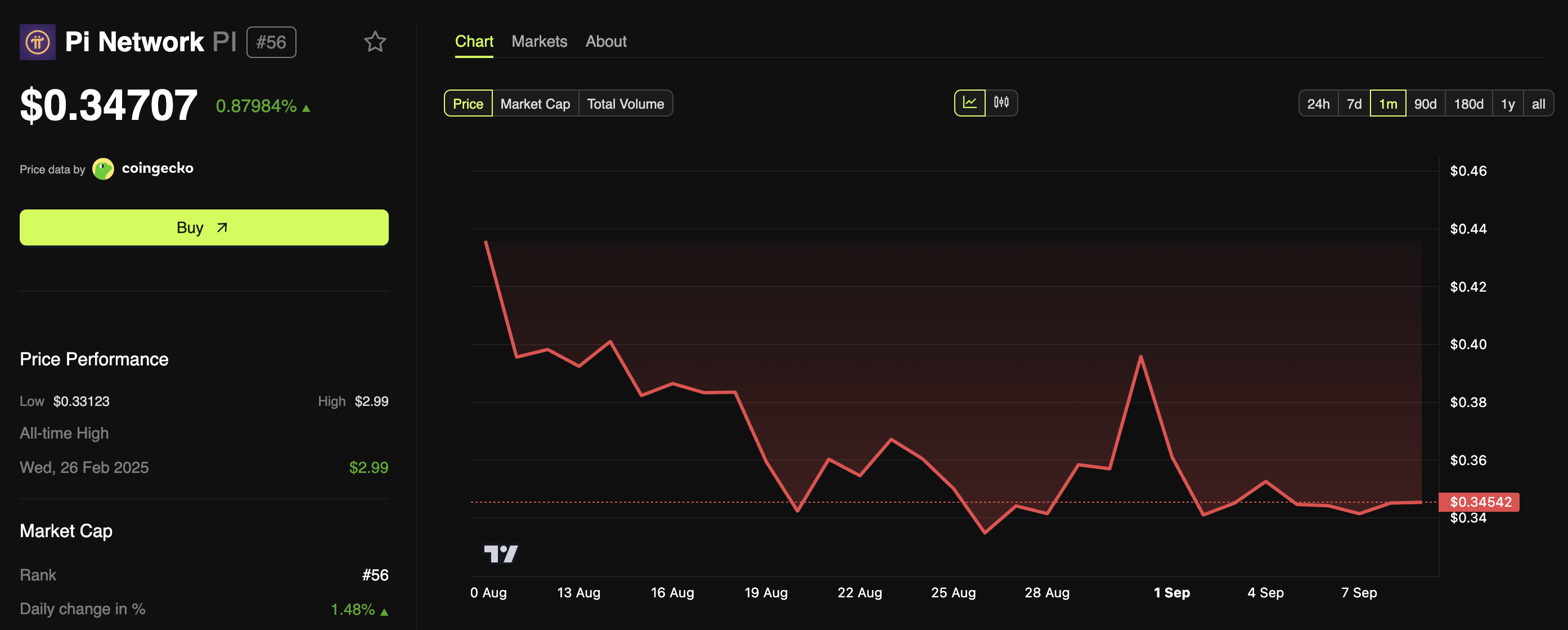 Pi Coin Price Performance. Source:
Pi Coin Price Performance. Source:
Pi Coin Price Performance. Source:
Yet, the gains were short-lived, and PI continued to experience volatility. At the time of writing, the altcoin traded at $0.34, up 0.87984% over the past 24 hours.
Disclaimer: The content of this article solely reflects the author's opinion and does not represent the platform in any capacity. This article is not intended to serve as a reference for making investment decisions.
You may also like
After Pectra comes Fusaka: Ethereum takes the most crucial step towards "infinite scalability"
The Fusaka hard fork is a major Ethereum upgrade planned for 2025, focusing on scalability, security, and execution efficiency. It introduces nine core EIPs, including PeerDAS, to improve data availability and network performance. Summary generated by Mars AI. The accuracy and completeness of this summary are still being iteratively updated by the Mars AI model.

Decoding VitaDAO: A Paradigm Revolution in Decentralized Science

Mars Morning News | ETH returns to $3,000, extreme fear sentiment has passed
The Federal Reserve's Beige Book shows little change in U.S. economic activity, with increasing divergence in the consumer market. JPMorgan predicts a Fed rate cut in December. Nasdaq has applied to increase the position limit for BlackRock's Bitcoin ETF options. ETH has returned to $3,000, signaling a recovery in market sentiment. Hyperliquid has sparked controversy due to a token symbol change. Binance faces a $1 billion terrorism-related lawsuit. Securitize has received EU approval to operate a tokenization trading system. The Tether CEO responded to S&P's credit rating downgrade. Large Bitcoin holders are increasing deposits to exchanges. Summary generated by Mars AI. The accuracy and completeness of this summary are still being iteratively improved by the Mars AI model.

Trending news
MoreCrypto prices
More





