
Bankless: "Write, Read, Prove" — Interpreting Ethereum's New Privacy Roadmap

Source: Bankless
Author: William M. Peaster
Compiled and organized by: BitpushNews

If Ethereum cannot solve its privacy issues, it risks becoming “surveillance infrastructure” when adopted at scale.
This is precisely the challenge that the team recently renamed “Privacy Stewards of Ethereum” (PSE) is directly addressing. They have released a brand new roadmap and a clearly focused mission.
The researchers are shifting from exploring cryptographic experiments to implementing privacy solutions in practice. They have just released a new working roadmap.
This roadmap revolves around three main directions:
-
Private writes → Making on-chain privacy operations (such as transfers, DeFi, voting, etc.) as simple as public operations.
-
Private reads → Preventing metadata leakage when authenticating or querying on Ethereum.
-
Private proving → Making zero-knowledge proofs cheaper and simpler to run on mobile devices.
As PSE delves deeper into these directions, they plan to maintain a “problem radar” to map privacy vulnerabilities, an “execution map” to decide where to build, collaborate, or simply monitor, and a culture of “public communication” to keep the Ethereum community engaged.
In addition, the team already has a series of initiatives that are being launched or continuously supported. These initiatives include:
-
Plasma Fold (writes) — An experimental Layer 2 design using “zero-knowledge folding” for scaling. PSE plans to add private transfer functionality to this architecture.
-
Kohaku (writes) — A wallet proof of concept. It is designed to natively support private sending through privacy pools.
-
Privacy governance (writes) — PSE plans to release a “2025 Privacy Voting Status” report and continue collaborating with Aragon and other privacy voting protocols.
-
Confidential DeFi (writes) — PSE intends to collaborate with the Ethereum Foundation’s EcoDev enterprise group to establish an Institutional Privacy Task Force (IPTF).
-
Network privacy (reads) — PSE plans to form a privacy RPC working group, support Oblivious RAM solutions in wallets, experiment with mixnet-style transaction routing, and more.
-
Privacy identity (proving) — The team is making various efforts around privacy-preserving credential standards, modular zk-snark wallets, and unlinkable credential revocation.
-
Client proving (proving) — The team is also researching efficient proving systems that can run directly on mobile devices and support new types of privacy applications.
By improving privacy, Ethereum can demonstrate that a public blockchain can be both transparent and protective of its users.
Now, PSE has become a mature privacy hub, dedicated to making this vision a reality without attempting to monopolize anything. This is exactly the uniquely advantageous and neutral coordinating role of the Ethereum Foundation.
Ultimately, a network that can safeguard trillions of dollars in assets but exposes every transaction detail is incomplete. Only by achieving privacy in writing, reading, and proving can Ethereum continue to serve as the trusted foundation of the “Internet of Value.”
Fortunately, this new roadmap shows that the Ethereum Foundation is doubling down and treating privacy as a core issue. For this, we applaud them.
Disclaimer: The content of this article solely reflects the author's opinion and does not represent the platform in any capacity. This article is not intended to serve as a reference for making investment decisions.
You may also like
Mars Morning News | Ethereum Fusaka upgrade officially activated; ETH surpasses $3,200
The Ethereum Fusaka upgrade has been activated, enhancing L2 transaction capabilities and reducing fees; BlackRock predicts accelerated institutional adoption of cryptocurrencies; cryptocurrency ETF inflows have reached a 7-week high; Trump nominates crypto-friendly regulatory officials; Malaysia cracks down on illegal Bitcoin mining. Summary generated by Mars AI. The accuracy and completeness of this summary are still undergoing iterative updates.

Do you think stop-losses can save you? Taleb exposes the biggest misconception: all risks are packed into a single blow-up point.
Nassim Nicholas Taleb's latest paper, "Trading With a Stop," challenges traditional views on stop-loss orders, arguing that stop-losses do not reduce risk but instead compress and concentrate risk into fragile breaking points, altering market behavior patterns. Summary generated by Mars AI. The accuracy and completeness of this summary are still being iteratively improved by the Mars AI model.

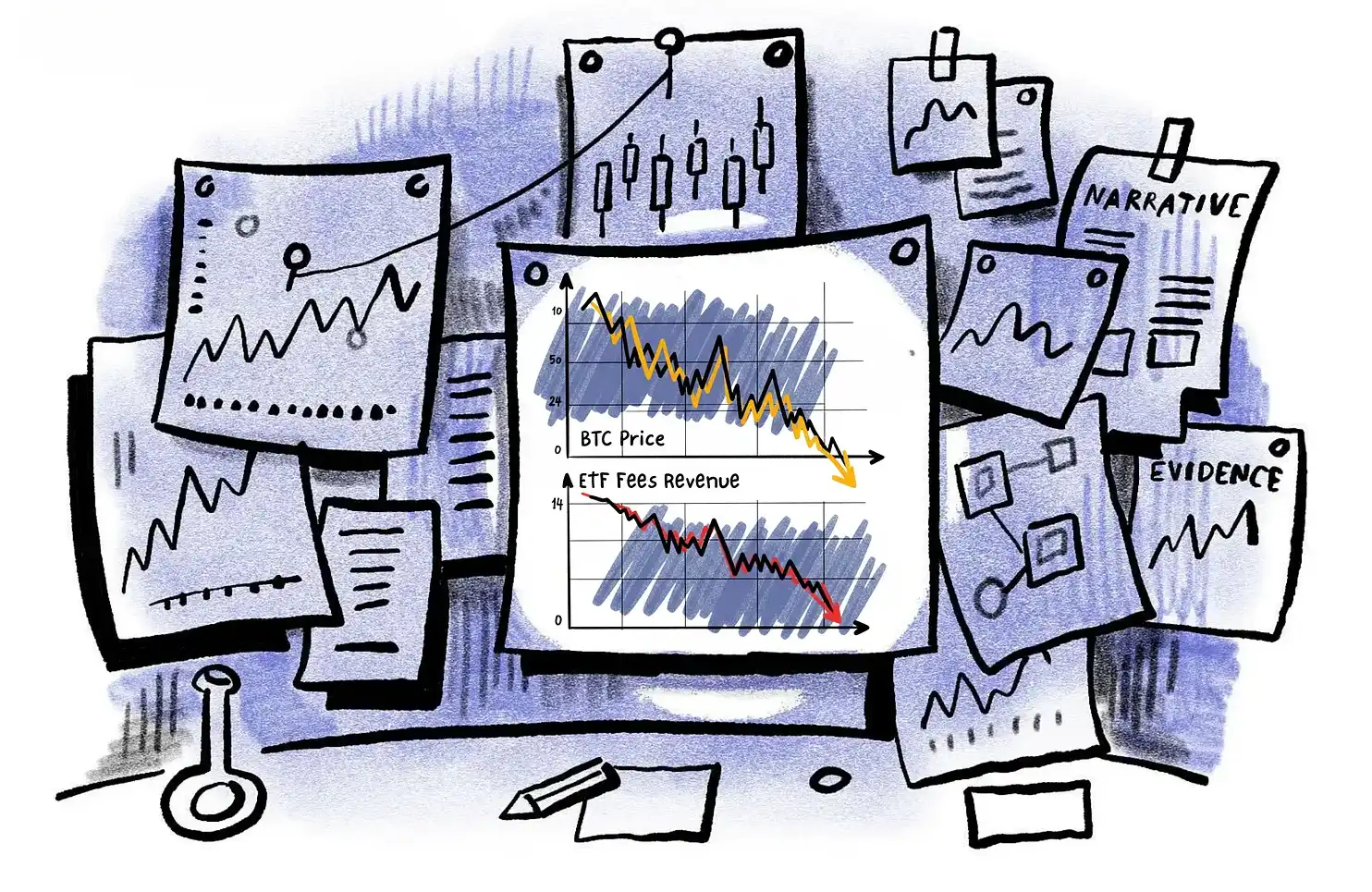
With capital outflows from crypto ETFs, can issuers like BlackRock still make good profits?
BlackRock's crypto ETF fee revenue has dropped by 38%, and its ETF business is struggling to escape the cyclical curse of the market.
Incubator MEETLabs today launched the large-scale 3D fishing blockchain game "DeFishing". As the first blockchain game on the GamingFi platform, it implements a dual-token P2E system with the IDOL token and the platform token GFT.
MEETLabs is an innovative lab focused on blockchain technology and the cryptocurrency sector, and also serves as the incubator for MEET48.

Trending news
MoreCrypto prices
More






