
Large-scale ETH unstaking triggers a redemption wave, with the destination of $11.3 billion in funds becoming the focus

Ethereum co-founder Vitalik Buterin has commented on the increasingly severe issue of staking withdrawal queues, noting that the network's staking exit queue has now extended to over six weeks.
On September 18, he posted on X, stating that this mechanism is a carefully considered design choice rather than a flaw, and compared it to military discipline.
Buterin emphasized that staking is not a casual act but a commitment to safeguarding the network. From this perspective, friction mechanisms such as exit delays actually serve as safety guardrails.
"If anyone in the army could suddenly leave at any time, the army would not be able to maintain cohesion," he wrote, pointing out that Ethereum's reliability depends on ensuring that validators cannot instantly abandon their duties.
However, Buterin also acknowledged that the current design is not perfect. He explained: "This is not to say that the current staking queue design is the optimal solution, but if the threshold is blindly lowered, it would significantly reduce the credibility of the chain for any node that is not frequently online."
Buterin's views coincide with those of EigenLayer restaking protocol founder Sreeram Kannan.
In a post on September 17, Kannan referred to Ethereum's lengthy exit period as a "conservative parameter," considering it a crucial security measure.
He explained that the waiting period can effectively guard against worst-case scenarios, such as validators coordinating attacks and participants attempting to exit collectively before facing slashing penalties.
In light of this, Kannan warned: "Unstaking must never be instantaneous."
He further explained that if the process were shortened to a few days, Ethereum could be exposed to attacks that exhaust its security assumptions. In contrast, a longer window allows for the detection and punishment of malicious behaviors such as double-signing, ensuring that malicious validators cannot easily evade responsibility.
Kannan specifically pointed out that this buffer mechanism allows inactive nodes to reconnect and periodically verify the correct fork.
He emphasized that without such a mechanism, competing forks could all claim legitimacy, making it impossible for offline nodes to determine authenticity when reconnecting.
He concluded: "Ethereum does not adopt a fixed long-term unstaking mechanism, but is designed so that when a small amount of staking exits within a specific period, it can be processed instantly. However, if a large amount of staking applies to exit simultaneously, the queue will accumulate, and in the worst case, it could last for several months."
This strong defense comes as Ethereum's exit queue hits a historic high. Data from the Ethereum validator queue shows that the current withdrawal backlog has reached 43 days, involving 2.48 million ETH (approximately $11.3 billion) waiting to be withdrawn.
Disclaimer: The content of this article solely reflects the author's opinion and does not represent the platform in any capacity. This article is not intended to serve as a reference for making investment decisions.
You may also like
Mars Morning News | Ethereum Fusaka upgrade officially activated; ETH surpasses $3,200
The Ethereum Fusaka upgrade has been activated, enhancing L2 transaction capabilities and reducing fees; BlackRock predicts accelerated institutional adoption of cryptocurrencies; cryptocurrency ETF inflows have reached a 7-week high; Trump nominates crypto-friendly regulatory officials; Malaysia cracks down on illegal Bitcoin mining. Summary generated by Mars AI. The accuracy and completeness of this summary are still undergoing iterative updates.

Do you think stop-losses can save you? Taleb exposes the biggest misconception: all risks are packed into a single blow-up point.
Nassim Nicholas Taleb's latest paper, "Trading With a Stop," challenges traditional views on stop-loss orders, arguing that stop-losses do not reduce risk but instead compress and concentrate risk into fragile breaking points, altering market behavior patterns. Summary generated by Mars AI. The accuracy and completeness of this summary are still being iteratively improved by the Mars AI model.
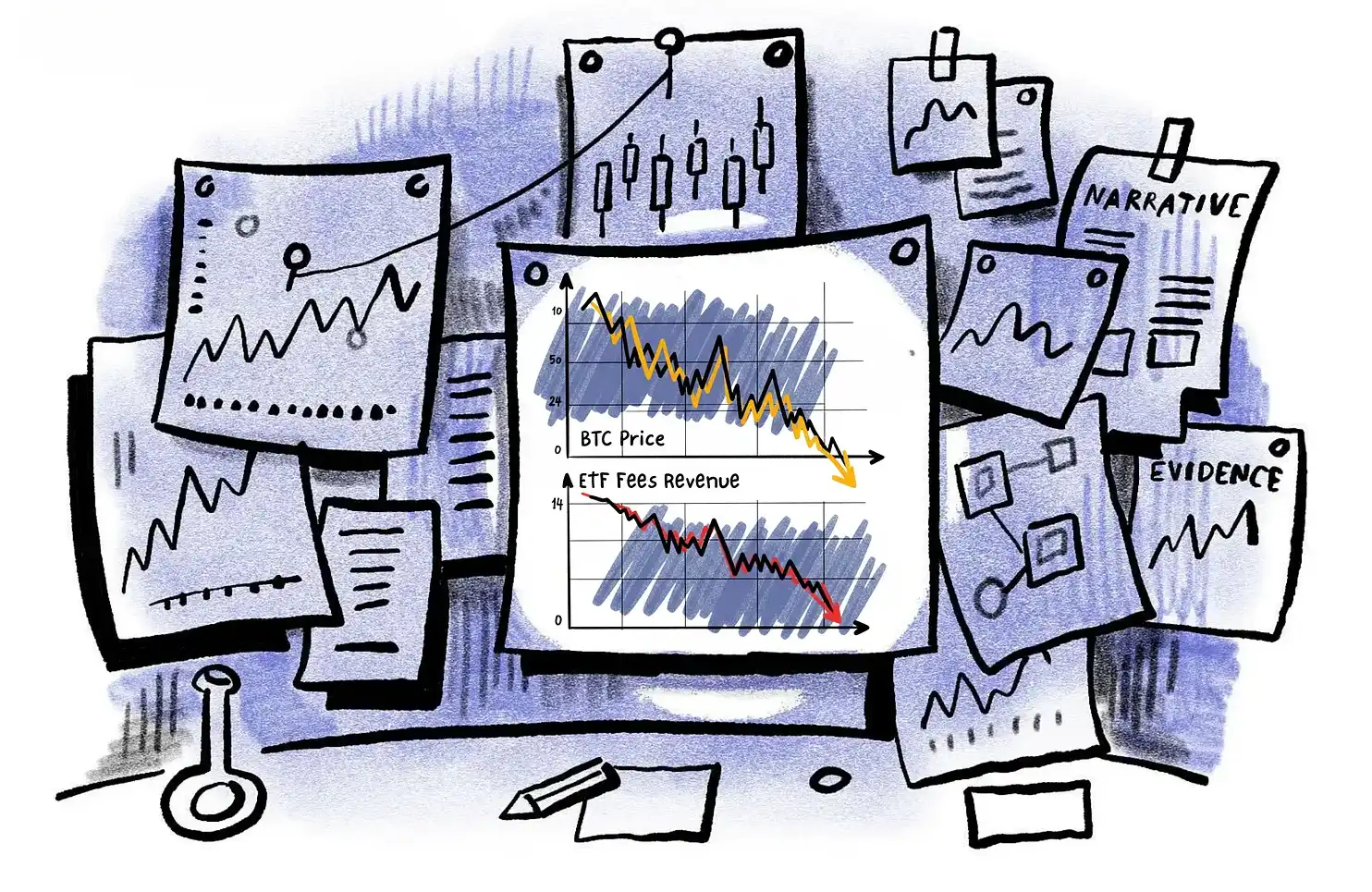
With capital outflows from crypto ETFs, can issuers like BlackRock still make good profits?
BlackRock's crypto ETF fee revenue has dropped by 38%, and its ETF business is struggling to escape the cyclical curse of the market.
Incubator MEETLabs today launched the large-scale 3D fishing blockchain game "DeFishing". As the first blockchain game on the GamingFi platform, it implements a dual-token P2E system with the IDOL token and the platform token GFT.
MEETLabs is an innovative lab focused on blockchain technology and the cryptocurrency sector, and also serves as the incubator for MEET48.

Trending news
MoreCrypto prices
More






