
Kalshi and Polymarket Signal High Odds of U.S. Government Shutdown

The possibility of a U.S. government shutdown is dominating prediction markets, with traders betting heavily on the outcome. Platforms like Kalshi and Polymarket show a strong consensus that negotiations in Washington are unlikely to deliver a deal in time. Rising volumes and market probabilities above 85% suggest that participants see a shutdown as the most likely outcome.

In brief
- Kalshi and Polymarket show over 85% odds of a government shutdown as talks stall in Washington.
- Trading volume on shutdown bets has exceeded $4.6M, reflecting intense market speculation.
- VP JD Vance warns the country is “headed into a shutdown,” dampening hopes for a last-minute deal.
- Platforms like Kalshi and Polymarket are gaining popularity as real-time political and economic barometers.
Kalshi and Polymarket Traders Bet Millions as Odds Exceed 85%
Bets placed on Kalshi and Polymarket have drawn more than $4.6 million in trading volume, reflecting intense speculation about the government’s ability to avoid a shutdown. Both platforms now estimate the probability of a shutdown at over 85% , a figure that has climbed as partisan talks stall.
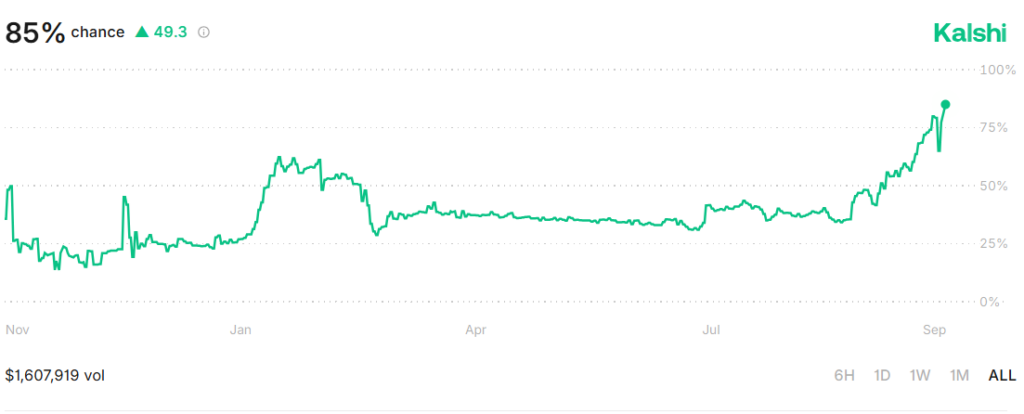
Some users are positioning for a contrarian outcome, betting on the chance of a last-minute deal similar to previous standoffs. However, momentum appears to be shifting in the other direction. Vice President JD Vance stated after a recent meeting that the country was “headed into a shutdown,” offering little optimism for a breakthrough.
A shutdown would be the first in several years, with potential consequences extending beyond temporary suspensions. President Donald Trump suggested the government could use the crisis to enact permanent staff cuts, signaling a more disruptive scenario for federal workers.
Growing Spotlight on Prediction Markets
Prediction platforms have increasingly become barometers for political and economic risk. Kalshi and Polymarket allow users to bet on real-world outcomes, with market prices reflecting crowd-sourced probabilities. Their popularity has surged during major news cycles, giving traders and observers a new way to gauge sentiment.
Kalshi recently reported $500 million in trading volume over a single weekend, surpassing activity recorded during Election Day. Polymarket, meanwhile, has rolled out 4% annual rewards for long-term positions and continues to benefit from recent regulatory clarity. The U.S. Commodity Futures Trading Commission (CFTC) granted a no-action notice to entities tied to Polymarket, giving the platform a green light to continue U.S. operations.
Investor confidence in the sector is also reflected in ongoing fundraising talks . Reports indicate Polymarket may be valued at up to $9 billion in its next round, while Kalshi is seeking investments at around $5 billion. For now, attention remains fixed on Capitol Hill. With no deal in sight, Kalshi and Polymarket participants now treat a shutdown as the market’s expected outcome.
Disclaimer: The content of this article solely reflects the author's opinion and does not represent the platform in any capacity. This article is not intended to serve as a reference for making investment decisions.
You may also like
Hyperliquid Leads All Chains in 24H Fees
Hyperliquid tops all blockchains with $2M in 24H fees, outperforming Tron and edgeX in daily revenue.What’s Driving Hyperliquid’s Growth?Implications for the Blockchain Ecosystem

[Day 4 Live] 10x Challenge: 100% Profit Achieved!
The Enduring Principles of Value Investing: Insights from a 1927 Classic and Warren Buffett
- R.W. McNeel and Warren Buffett share value investing principles emphasizing emotional discipline, long-term thinking, and intrinsic value. - Both stress resisting market emotions, as seen in Buffett's 2008 crisis investments and McNeel's 1927 warnings against speculative frenzy. - Their strategies prioritize buying undervalued assets with "margin of safety" and focusing on durable businesses like Coca-Cola and Apple . - The "bet on America" mindset underpins their faith in U.S. economic resilience, refle

Vitalik Buterin Pushes Forward Idea Of Onchain Gas Futures To Stabilize Ethereum Fees
Quick Take Summary is AI generated, newsroom reviewed. Vitalik proposes onchain gas futures to stabilize gas costs. The system reduces Ethereum fee volatility as adoption grows. Users gain strong tools for gas price hedging inside the network. The proposal supports a more predictable and scalable Ethereum ecosystem.References ⚡ NEW: Vitalik Buterin proposes onchain gas futures market for Ethereum to help users hedge against network fee volatility as adoption increases.
Trending news
MoreCrypto prices
More





