
During extreme market conditions, why would your position be suddenly liquidated?

No Cash & Carry Game for BTC, automatic deleveraging mechanism triggers during long/short imbalance.
Original Author: Doug Colkitt, Founder of ambient
Original Translation: Deep Tide TechFlow
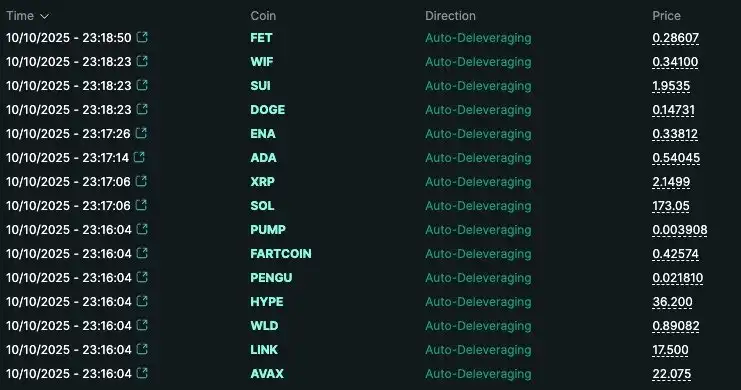
Considering that many people wake up to find their perpetual contract positions liquidated and wonder what "Auto-Deleveraging (ADL)" means, here is a brief introductory guide for everyone.
What is ADL? How does it work? Why does it exist?
First, we need to understand from a more macro perspective what the perpetual contract market is and how it functions. Taking the BTC perpetual contract market as an example, interestingly, there is actually no real BTC in this system. There is only a pile of idle cash in the system.
What the perpetual contract market (or more broadly, any derivative market) does is allocate this pile of cash among participants. It operates through a set of rules designed to create synthetic instruments similar to BTC in a system that actually lacks BTC.
One of the most important rules is: the market has longs and shorts, and the positions of longs and shorts must be in complete balance for the system to function properly. Additionally, both longs and shorts need to deposit cash (in the form of margin) into this pool of funds.
This pool of funds is redistributed among participants as the price of BTC fluctuates.
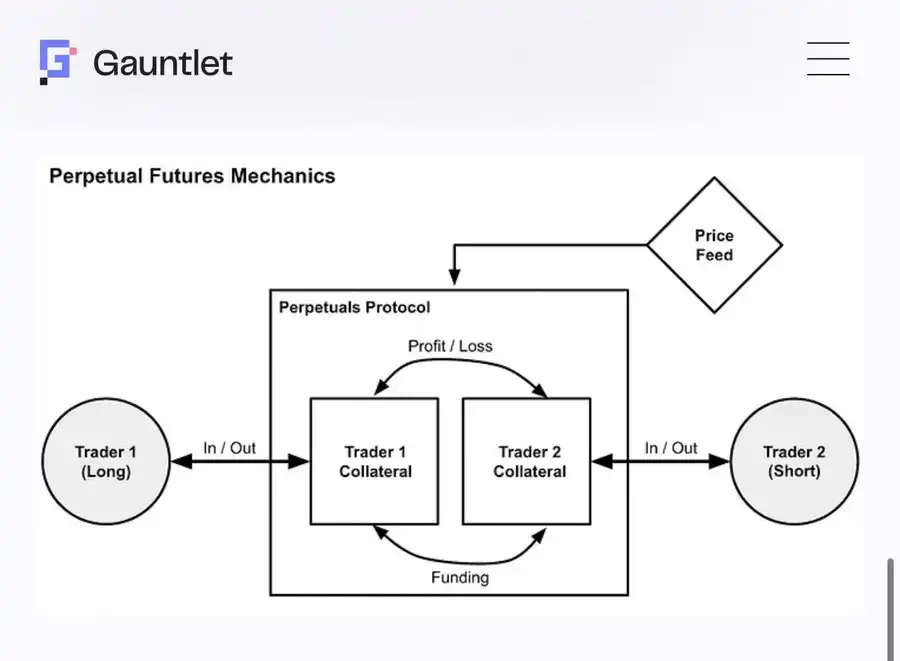
During this process, when the price of BTC fluctuates too much, some participants will lose all their funds. At this point, they will be forcibly liquidated.
Remember, longs can only profit if shorts have funds at risk (and vice versa). Therefore, when funds are depleted, you can no longer participate in the market.
Moreover, every short must be fully matched with a solvent long. If a long in the system no longer has funds at risk, it means that the corresponding short on the other side also has no funds available for profit (and vice versa).
Therefore, if a long is liquidated, one of the following two things must happen in the system:
A) A new long position enters the system, bringing new funds to replenish the pool;
B) The corresponding short position is liquidated to bring the system back into balance.
In an ideal scenario, all of this can happen through normal market mechanisms. As long as a willing buyer can be found at a fair market price, there is no need to force anyone to take action. In a typical settlement operation, this process is usually carried out through the regular order book of the perpetual contract market.
In a healthy and liquid perpetual contract market, this approach works perfectly fine. The liquidated long position is sold into the order book, where the best bid fills this position, becoming a new long in the system and bringing in new funds to replenish the pool. This way, everyone is satisfied.
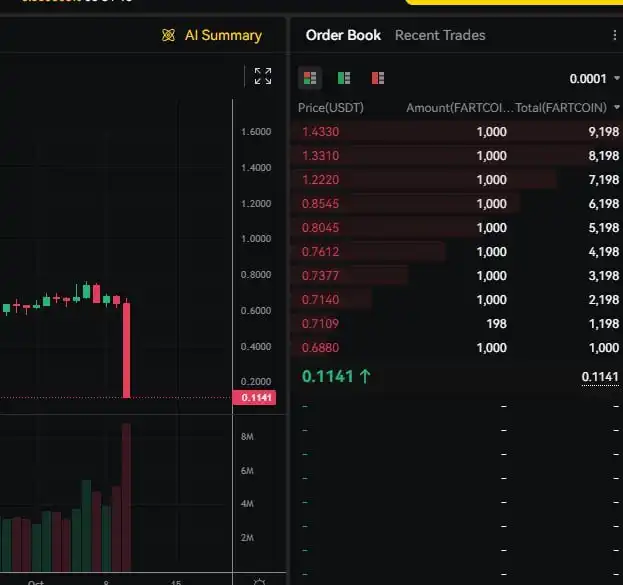
However, there are times when the order book lacks liquidity, or at least not enough liquidity to execute the trade without causing the original position to incur losses beyond its remaining funds.
This becomes a problem because it means there isn't enough cash in the pool to meet the needs of other participants.
Typically, the next step in the "rescue mechanism" is the intervention of an "insurance pool" or "insurance fund." The insurance pool is a special pool of funds supported by the exchange, and in the event of an extreme liquidity event, it steps in and absorbs the liquidated party.
Over the long run, the insurance pool often proves to be quite profitable, as it has the opportunity to buy at a steep discount and sell at a high price during price volatility. For example, Hyperliquid's insurance pool made around $40 million in one hour tonight.
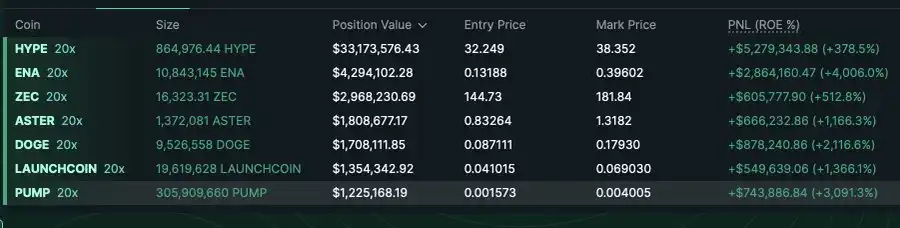
But the insurance pool is not magic; it is just another participant in the entire system. Like everyone else, it needs to inject funds into the pool, abide by the same rules, and its risk-taking and capital contributions are also limited.
Therefore, the system must have a final "rescue step."
This is what we call "Auto-Deleveraging" (ADL). It is the last resort and a (hopefully) rare occurrence because it involves the forced liquidation of a position holder rather than paying them out. This situation occurs very infrequently, so much so that even experienced perpetual contract traders often hardly notice its existence.
You can think of it as an overbooked flight. First, the airline uses market mechanisms to address the overbooking issue, such as continually increasing compensation to entice passengers to volunteer for a later flight. But if ultimately no one accepts, some passengers must be involuntarily bumped from the flight.

If the long positions run out of funds and no one is willing to enter the market to take their place, then the system has no choice but to force at least some of the short positions to close and liquidate their positions. Different exchanges have significantly different processes for selecting which positions to close and at what price.
Usually, the ADL system will use a ranking system to select profitable positions to be liquidated, based on criteria such as: 1) highest profit; 2) leverage level; 3) position size. In other words, the largest and most profitable "whales" will be the first to be liquidated.
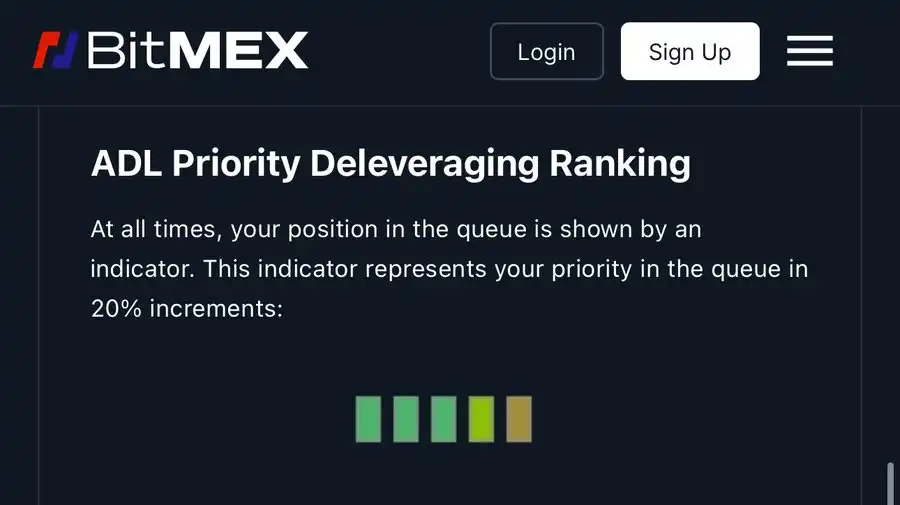
Naturally, people are dissatisfied with ADL because it seems unfair. You are at the peak of your profits, only to be forcibly liquidated. But to some extent, its existence is necessary. Even the best exchange cannot guarantee that there will always be unlimited losing traders to fill the funding pool.
You can think of it as a winning streak when playing Texas Hold'em. You enter the casino, defeat everyone at the table; then switch to the next table, defeat everyone again; then switch to another table. Eventually, everyone else in the casino runs out of chips. That's the essence of ADL.

The beauty of the perpetual futures market is that it is always a zero-sum game, so the system as a whole will never be insolvent.
There is not even real BTC devaluation here. Just a pile of boring cash. Just like the laws of thermodynamics, value is neither created nor destroyed in the system as a whole.
ADL is a bit like the ending of the movie "The Truman Show." The perpetual futures market has built a very sophisticated simulation that appears to be the real world linked to the spot market.
But ultimately, it is all virtual. Most of the time, we don't need to think about this issue... but sometimes, we touch the boundary of this simulation.

Disclaimer: The content of this article solely reflects the author's opinion and does not represent the platform in any capacity. This article is not intended to serve as a reference for making investment decisions.
You may also like
Zcash Halving and Its Impact on Cryptocurrency Market Trends
- Zcash's 2028 halving will cut block rewards to 0.78125 ZEC, continuing its deflationary supply model to reduce annual inflation to 2%. - Historical data shows halvings trigger extreme volatility, with ZEC surging 1,172% in 2025 but collapsing 96% within 16 days. - Institutional adoption grows via $137M Grayscale Zcash Trust, yet EU's MiCA regulations challenge privacy coins' compliance with transparency rules. - Future success depends on balancing privacy features with regulatory adaptability as Zcash's

Emerging Prospects for Industrial Real Estate in Webster, NY
- Webster , NY, is transforming its industrial real estate through the $9.8M FAST NY Grant, upgrading infrastructure on a 300-acre Xerox brownfield into a high-tech hub. - The initiative aims for a 2% industrial vacancy rate by 2025, boosting residential property values by 10.1% and attracting projects like the $650M fairlife® dairy facility. - Xerox campus reconfiguration and 600 Ridge Road redevelopment, supported by state programs, create shovel-ready spaces with modern infrastructure for advanced manuf
Why Solana's Latest Plunge Highlights Underlying Weaknesses in the Crypto Market
- Solana's 57% price crash in Nov 2025 exposed systemic crypto vulnerabilities, including psychological biases, excessive leverage, and fragile infrastructure. - Token unlocks from Alameda/FTX estates and $30M selling pressure triggered the downturn, yet $101.7M in institutional inflows highlighted market paradoxes. - Fed rate cuts drove $417M into Solana ETFs, but uncertainty caused 14% price drops, revealing crypto's growing integration with traditional finance. - $19B in liquidations during the Oct 11 "
The Growing Impact of Security Systems Technology on the Future Development of Higher Education Infrastructure
- 21st-century higher education infrastructure increasingly relies on advanced security systems to address cyberattacks and campus safety threats. - AI and zero-trust architectures enable proactive threat detection, with 80% of institutions adopting zero-trust strategies by 2025. - Integrated security investments boost enrollment, research credibility, and institutional reputation, though skill gaps and outdated infrastructure hinder full implementation. - ROI extends beyond cost savings, with 60% of stude
Trending news
MoreCrypto prices
More





