
Bitcoin Faces Pressure as Trade Tensions and Safe-Haven Flows Challenge Bullish Momentum

Bitcoin ended the week under pressure as investors rotated toward safer assets amid renewed US-China trade tensions and broader market weakness. Despite robust inflows into Bitcoin exchange-traded funds (ETFs), derivatives data suggest traders remain cautious about the sustainability of current price levels.

In brief
- Bitcoin retreats from a $126K record as investors pivot toward gold and bonds amid renewed US-China trade tensions.
- ETF inflows exceed $5B in October, yet derivatives show traders doubt Bitcoin’s ability to hold above key support.
- Gold reaches a record high of $4,050, reflecting heightened demand for safe-haven assets.
- Despite record ETF inflows, Bitcoin remains volatile, with macro headwinds and inflation fears weighing on sentiment.
Bitcoin Loses Momentum After New Peak
After reaching a new all-time high on Monday, Bitcoin has struggled to maintain its upward momentum. Even at that, institutional demand appears solid, with over $5 billion in net spot ETF inflows so far in October, highlighting continued interest from large investors.
However, derivatives indicators such as options skew and funding rates suggest uncertainty over Bitcoin’s ability to hold above support levels. At the time of writing, the OG coin has dropped by over 8% in the past day to $110,982, as market sentiment shifts bearish.
Meanwhile, gold surged to a record high near $4,050 on Wednesday, reflecting growing investor demand for safe-haven assets. The rally came as concerns over US fiscal stability deepened and economic growth slowed. Billionaire investor Ray Dalio warned that rising US debt levels pose a “threat to the monetary order.”
Markets turned volatile after US President Donald Trump accused China of imposing new port fees on rare-earth exports and threatened higher tariffs in response . The S&P 500 fell 1.9% as fears of an escalating trade war pressured global equities and technology shares.
Although Bitcoin is often viewed as “digital gold,” its performance remains closely tied to risk sentiment in traditional markets. The 40-day rolling correlation between Bitcoin and the S&P 500 stands at 73%. Importantly, this highlights how macroeconomic factors continue to influence the behavior of the crypto market.
Traders Turn Defensive as Derivatives and Bond Markets Flash Warning Signs
Investor caution is equally visible in the bond market. Yields on one-year US Treasuries fell to 3.61%, their lowest level in more than three years, as investors sought safety even amid persistent inflation.
The US Personal Consumption Expenditures (PCE) index rose 2.7% year over year in August, the highest in six months. As expected, this has raised concerns that inflation may pick up further in 2026 as new import duties take effect.
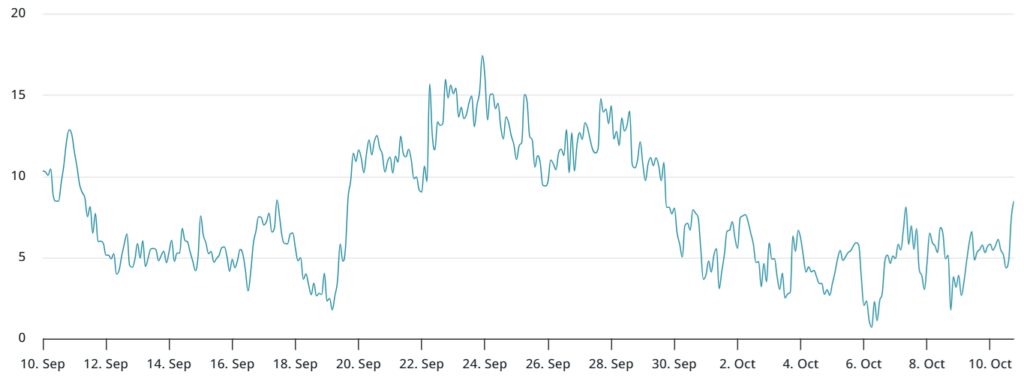
Bitcoin’s options market reflects a similar level of caution among market participants. The 30-day delta skew climbed to 8% on Friday , signaling that traders are paying a premium for downside protection. Recall that the last time this metric showed optimism was in mid-July, following a 13% two-week rally.
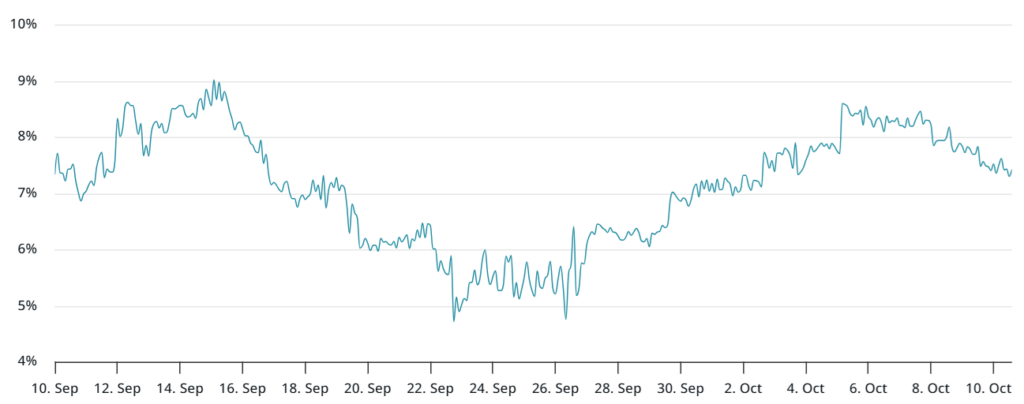
Meanwhile, monthly Bitcoin futures are trading at a 7% premium to spot prices, showing little change over the week. In bullish markets, this premium often exceeds 10% as demand for leveraged long positions increases. The steady level suggests trader confidence has yet to recover, even after Bitcoin’s 14% rally between Sept. 28 and Tuesday.
Stablecoin flows in China offer additional insight into trader sentiment. Tether (USDT), which often trades at a premium or discount—an indicator of market stress—had been slightly below parity earlier in the week, indicating outflows from crypto markets. However, after Bitcoin dipped below $120,000, the discount closed, suggesting that selling pressure has eased for now.
Bitcoin ETF Inflows Surge, Yet Traders Stay Wary Amid Macro Headwinds
Momentum behind Bitcoin ETFs is accelerating, with capital flowing into spot products at a record pace.
Here are some notable developments in the Bitcoin ETF sector:
- BlackRock’s iShares Bitcoin Trust (IBIT) now holds over 800,000 BTC , representing nearly 4% of Bitcoin’s circulating supply
- Plus, it has now surpassed $100 billion in assets under management for the first time since its launch.
- Bitcoin spot ETFs recorded $4 billion in new inflows over the past week, marking nine consecutive days of inflows and signaling strong institutional demand.
- Despite IBIT’s strong performance, the funds collectively saw a net outflow of $4.5 million on Friday.
- Bitcoin’s spot price remains under pressure, trading around $117,600, down 2.56% on the day and nearly 4% for the week, despite the continued ETF inflows.
Even though these investment vehicles have performed strongly in recent weeks , market confidence remains muted. Persistent macroeconomic risks—including trade tensions, inflation concerns, and slowing growth—continue to weigh on sentiment. Derivatives data indicate ongoing hesitation among traders, suggesting that Bitcoin may face further volatility before regaining clear upward momentum.
Disclaimer: The content of this article solely reflects the author's opinion and does not represent the platform in any capacity. This article is not intended to serve as a reference for making investment decisions.
You may also like
Evaluating How Vitalik Buterin's Advancements in ZK Technology Are Shaping Blockchain Investment Trends
- Vitalik Buterin's GKR protocol boosts Ethereum's scalability, enabling 43,000 TPS via ZK computation. - Institutional adoption accelerates with ZK-based compliance solutions, attracting BlackRock and Deutsche Bank partnerships. - ZK startups like zkSync and StarkNet secure $55M+ in funding, with market caps surging as infrastructure matures. - Investors target ZK-EVM compatible projects and hybrid models, aligning with Ethereum's 2026 roadmap.

ZK Technology's 2025 Price Increase: Sustained Value Driven by Blockchain Integration and Growing Institutional Engagement
- ZK technology's 2025 price surge stems from on-chain adoption and institutional investments, signaling a structural market shift. - ZK rollups now process 15,000 TPS with $3.3B TVL, driven by infrastructure upgrades and 230% developer engagement growth. - 35+ institutions including Goldman Sachs deploy ZKsync for confidential transactions, while Nike/Sony adopt it for supply-chain transparency. - Market fundamentals project 22.1% CAGR to $7.59B by 2033, validating ZK as blockchain's foundational infrastr

DASH Experiences 150% Price Jump and Growing Institutional Interest: Examining Blockchain’s Strength During Economic Uncertainty
- DASH surged 150% in June 2025 driven by tech upgrades, institutional interest, and favorable policies. - Platform 2.0 enhanced scalability and token support, positioning DASH as a competitive blockchain platform. - Institutional adoption grew in 2025 Q3-Q4 via merchant integrations in emerging markets and decentralized governance. - Macroeconomic factors like Fed policies and M2 growth boosted liquidity, while volatility persisted due to tightening markets. - Future growth depends on 2026 regulatory clar

The Increasing Importance of Stablecoins in Institutional Investment Strategies
- In 2025, U.S. GENIUS Act and EU MiCA regulations drove institutional adoption of USDC as a compliant, transparent stablecoin. - USDC's 98% U.S. Treasury-backed reserves and monthly audits made it preferred over USDT for regulated entities. - Institutions used USDC to reduce settlement delays by 35% and improve Sharpe ratios by 12% through yield-generating strategies. - With $73.7B circulation and $140B Q3 transaction volume, USDC became a 24/7 global liquidity tool for emerging markets.

Trending news
MoreCrypto prices
More





