
Ethereum Updates Today: Making Blockchain Accessible: Bitget's Innovative Stablecoin Gas Solution
- Bitget Wallet enables stablecoin-based gas payments via EIP 7702, eliminating native token requirements for eight major blockchains. - The update simplifies cross-chain transactions and lowers entry barriers, supporting both EVM and non-EVM networks through gas abstraction. - Industry experts praise the innovation for advancing account abstraction, while security tools and $700M protection funds address potential risks. - Bitget plans to expand stablecoin gas payments to Plasma and Sei, positioning itsel
Bitget Wallet has introduced an innovative function that lets users cover blockchain transaction fees directly with stablecoins such as
With EIP 7702, which was recently added to Ethereum’s Pectra upgrade, externally owned accounts (EOAs) can temporarily function like smart contracts, enabling features such as transaction bundling and sponsored gas fees. This allows users to assign gas payment logic for each transaction without permanently turning their EOAs into smart contracts. Bitget’s solution works with EVM-compatible networks through EIP 7702 and also extends to non-EVM chains like Solana and

This advancement has been recognized for its potential to drive broader blockchain adoption. Jamie Elkaleh, Chief Marketing Officer at Bitget Wallet, highlighted that the upgrade narrows the divide between self-custody and centralized exchanges, letting users transact across different chains without the hassle of managing gas tokens. Experts suggest this change could enhance the practical use of stablecoins beyond just storing value, possibly increasing transaction activity and integration with DeFi platforms. By removing the need to swap assets for gas, the feature also makes it easier for users in areas where obtaining native tokens is expensive or difficult.
Nevertheless, this new approach brings additional security challenges. Wintermute and
Industry leaders, including Ethereum co-founder Vitalik Buterin and Uniswap’s Hayden Adams, have supported EIP 7702 for its compatibility with ERC-4337 and its potential to enable programmable wallets and social recovery features. This update also positions Bitget as a strong contender against MetaMask and OKX Wallet in the gas abstraction arena, with Bitget’s support for both EVM and non-EVM networks giving it a cross-chain advantage.
Looking forward, Bitget intends to extend stablecoin gas fee support to more blockchains, such as Plasma and Sei, and to further enhance cross-chain swaps and transactions. This initiative aligns with the broader movement in Web3 infrastructure, where improving user experience is seen as essential for mainstream growth. As more wallets and dApps adopt similar account abstraction technologies, the industry could see a rise in gasless transactions, subscription-based models, and integrated payment systems.
Disclaimer: The content of this article solely reflects the author's opinion and does not represent the platform in any capacity. This article is not intended to serve as a reference for making investment decisions.
You may also like
Investment Prospects in STEM Learning and Workforce-Ready Talent Streams: Linking with Astar 2.0
- Global STEM education demand surges as AI, blockchain, and biotech reshape industries, creating workforce skill gaps. - Astar 2.0's DeFi innovations (ZK Rollups, interoperability) indirectly support STEM through blockchain infrastructure and cross-chain collaboration. - U.S. and Singapore prioritize tech-integrated workforce strategies, aligning with Astar 2.0's potential to bridge DeFi and STEM education via scalable tools. - Investors can leverage Astar 2.0's $1.399B TVL and hybrid AMM-CEX model to fun

The ZK Transformation: Evaluating How Zero-Knowledge Technology Influences the Future Development of Blockchain
- ZK-rollups scale blockchain networks by bundling transactions, achieving 43,000 TPS and 30% lower gas fees, attracting institutions like Goldman Sachs and JPMorgan . - ZK technology resolves privacy-scalability paradox by enabling verifiable transactions without data exposure, adopted by EU regulators and enterprises like Nike and Sony . - Challenges persist: ZK-SNARKs require heavy computation, trusted setup risks exist, and privacy conflicts with AML regulations in some jurisdictions. - $725M+ VC inves

The Influence of Vitalik Buterin's Support for ZKsync on the Advancement of Scalable Blockchain Technologies: Evaluating the Prospects for Long-Term Investment in Pr
- Vitalik Buterin's 2025 endorsement of ZKsync accelerated its rise as a scalable Ethereum Layer-2 solution with 30,000 TPS and $3.3B TVL. - ZKsync's EVM compatibility and institutional partnerships contrast with StarkNet's quantum-resistant STARK proofs and Aztec's privacy-first architecture. - Analysts project ZK token prices at $0.40–$0.60 by 2025, while StarkNet faces adoption barriers and Aztec navigates regulatory challenges in privacy-focused DeFi. - The $7.59B ZKP market (2033 forecast) hinges on b
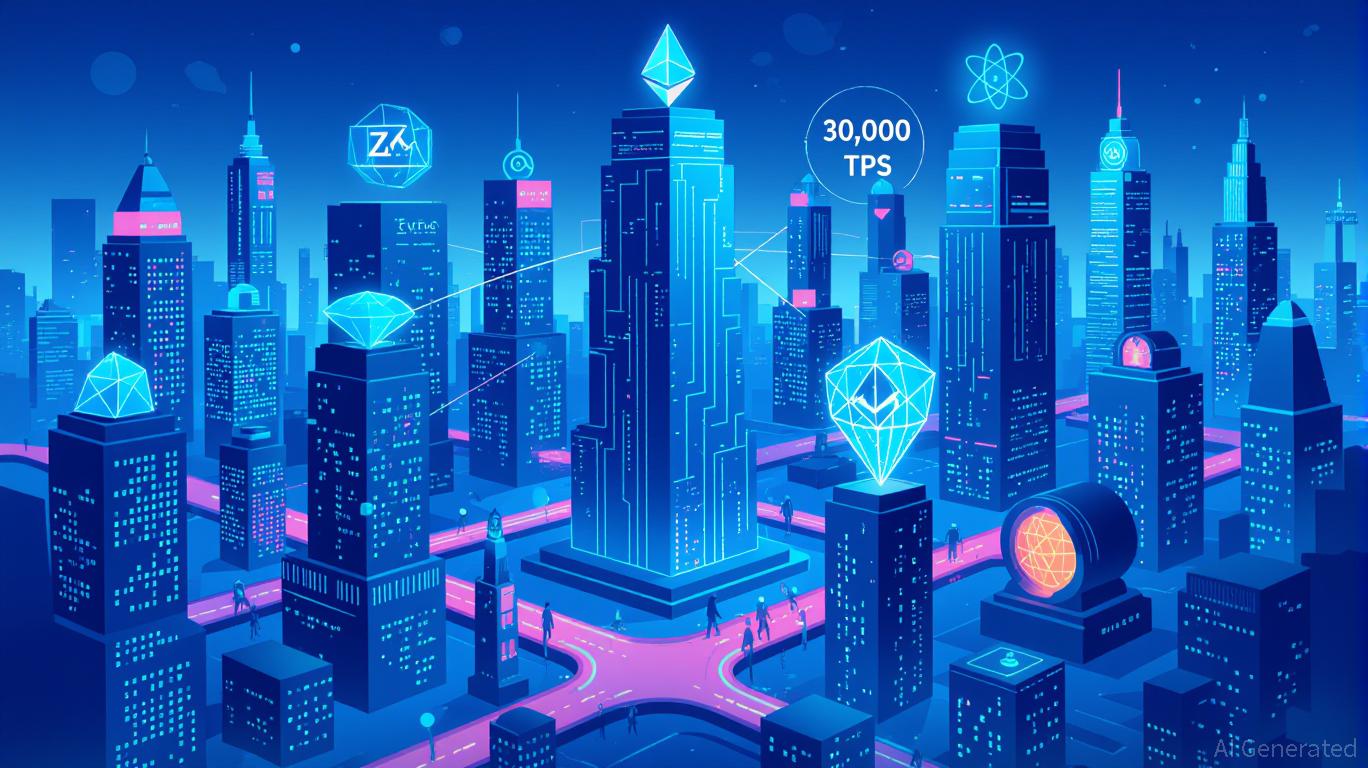
ZK Atlas Enhancement: Transforming Blockchain Scalability and Paving the Way for Institutional Integration
- ZKsync’s 2025 Atlas Upgrade achieves 15,000–43,000 TPS with $0.0001/transaction costs, boosting blockchain scalability for institutions. - Deutsche Bank , Sony , and Citi adopt ZKsync for tokenized assets and privacy-driven transactions, citing compliance and efficiency gains. - Market forecasts predict 60.7% CAGR for ZK Layer-2 solutions through 2031, with Fusaka upgrade targeting 30,000 TPS to solidify ZKsync’s leadership.
Trending news
MoreCrypto prices
More





