
Bitcoin Updates: Institutional Investors Drive Bitcoin Growth While ETFs Transform the Cryptocurrency Landscape
- Bitcoin's institutional adoption accelerates via ETF inflows and corporate strategies, with BlackRock and T. Rowe Price leading diversified crypto fund initiatives. - BlackRock's $211M Bitcoin ETF accumulation and T. Rowe's multi-asset crypto ETF filing highlight shifting ownership from retail to institutional investors. - ETF flows show $477M Bitcoin inflows vs. Ethereum outflows, while whale activity and SpaceX's $134M BTC transfer signal consolidation among long-term holders. - A $21B Bitcoin-collater
Bitcoin's Hyperbitcoinization Accelerates as Institutional Interest Intensifies
Bitcoin is experiencing a rapid increase in market share and institutional participation, fueled by robust inflows into exchange-traded funds (ETFs) and calculated moves by major corporations. These trends point to a more mature and evolving crypto landscape. With

BlackRock, the globe’s largest asset manager, purchased $211 million in Bitcoin for its clients in late October, raising its total Bitcoin holdings to over 800,000 BTC via its ETF, according to
ETFs have become a pivotal influence on Bitcoin’s price movements. Recent figures indicate that U.S. Bitcoin ETFs attracted $477.2 million in net inflows on October 22, with BlackRock’s IBIT accounting for $210.9 million of that total, according to
Large-scale investors, or whales, are also drawing attention to institutional involvement. A well-known Bitcoin whale, BitcoinOG(1011), recently opened $140 million in short positions, leveraging a track record of accurately predicting market downturns, as reported by
Corporate financing has also influenced Bitcoin’s path. 40 Brightwater LLC secured a $21 billion loan using Bitcoin as collateral, with MultiCorp International, Inc. set to receive $10 billion from the proceeds, according to
Market experts remain cautiously positive. While Bitcoin’s dominance has steadied around 57.7%, challenges facing Ethereum ETFs and recent global tensions have prompted a shift back toward Bitcoin, a trend also noted by Coinotag. Nevertheless, some analysts believe Ethereum could regain institutional interest if staking rewards and network improvements become more attractive.
Looking forward, Bitcoin is approaching significant resistance between $115,800 and $118,500, with futures trading volumes and ETF inflows suggesting possible upward momentum, as emphasized by Trading News. Expected interest rate cuts by the Federal Reserve and easing inflation may further encourage risk-taking, though short-term market swings are still likely.
Disclaimer: The content of this article solely reflects the author's opinion and does not represent the platform in any capacity. This article is not intended to serve as a reference for making investment decisions.
You may also like
LUNA up 24.4% in 24 hours: Surge Fueled by Upgrades and Increased Inflows
- LUNA surged 24.4% in 24 hours on Dec 10, 2025, driven by rising on-chain activity, capital inflows, and anticipation of a major network upgrade. - The terrad v3.6.1 upgrade, set for Dec 18, aims to resolve legacy contract issues and enhance security, with successful testnet trials and rollback options in place. - Futures open interest rose to $25.55M, while technical indicators suggest continued bullish momentum, targeting $0.000098 resistance if the 50-week EMA is sustained. - Legal proceedings against

Evaluating HYPE Token: Authenticity and Price Fluctuations Amid the Changing Meme Coin Scene
- Hyperliquid's HYPE token combines DeFi infrastructure with meme coin speculation, distinguishing itself through Layer-1 blockchain technology and structured governance. - Unlike DOGE or SHIB , HYPE features transparent governance proposals, deflationary buybacks ($2.1B projected), and institutional partnerships to counter volatility. - While HYPE's 13% price drop post-token unlock shows market sensitivity, its RSI and support levels suggest resilience compared to BONK's 185% weekly swings. - The token's

The Growing Need for STEM and Technical Studies in American Higher Education
- U.S. higher education is rapidly adopting EdTech SaaS to address STEM workforce demands, with the global market projected to grow from $200.86B in 2025 to $907.7B by 2034. - AI-driven platforms like Frizzle and Labster are revolutionizing STEM education through automated grading, virtual labs, and personalized learning solutions. - Strategic university partnerships and micro-credentialing models (e.g., SkillBloom) are bridging skills gaps in data science, cybersecurity, and engineering. - Investors face

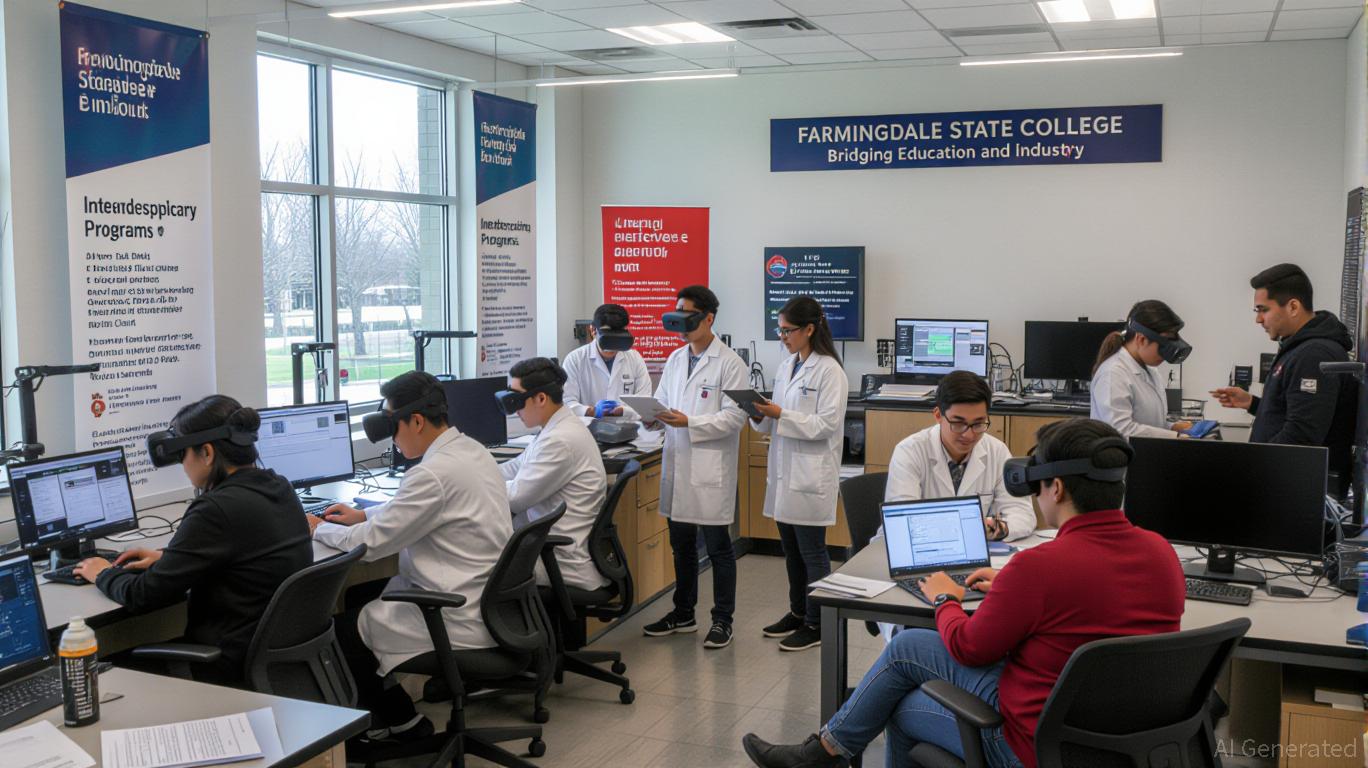
The Influence of Educational Facilities on Sustained Economic Growth and Investment Patterns: Farmingdale State College’s Contribution to Preparing the Workforce and Regional Development
- Farmingdale State College (FSC) aligns interdisciplinary programs with workforce needs, boosting 80% six-month employment rates for 2025 graduates. - Its STEM Diversity Summit and inclusivity initiatives address labor gaps, fostering equitable pathways in biotech and renewable energy sectors. - A $75M Center for Computer Sciences and Broad Hollow Bioscience Park expansion aim to double tech enrollment and create 135 jobs, strengthening Long Island’s innovation ecosystem. - FSC’s focus on applied learning
Trending news
MoreCrypto prices
More





