
Bitcoin News Update: Tether's CEO Challenges S&P's Rating Cut: Innovation Faces Off Against Conventional Finance
- Tether CEO Paolo Ardoino criticized S&P's USDT downgrade, claiming the agency misunderstands its financial model and traditional finance resists innovation. - S&P cited USDT's 5.6% Bitcoin exposure (exceeding its 3.9% buffer) and insufficient reserve transparency as risks to stability, warning of undercollateralization during asset declines. - Tether defends its $181.2B reserves and zero "toxic" assets, while critics highlight a 3.7% equity cushion and potential insolvency if Bitcoin/gold drop 30%. - Chi
Tether CEO Responds to S&P Global Ratings' Downgrade
Paolo Ardoino, CEO of Tether, has strongly criticized S&P Global Ratings following their recent decision to lower the stablecoin's rating. Ardoino accused the agency of misinterpreting Tether's financial structure and suggested that the traditional financial sector is resistant to innovative approaches. S&P's downgrade, which assigned USDT a "weak" stability rating on a five-level scale, was attributed to the company's growing investments in riskier assets such as Bitcoin and gold, as well as concerns over the transparency of its reserve management.
S&P highlighted that Bitcoin now makes up 5.6% of USDT's total supply, surpassing the 3.9% overcollateralization margin. The agency warned that significant drops in the value of Bitcoin or other volatile holdings could leave USDT undercollateralized.
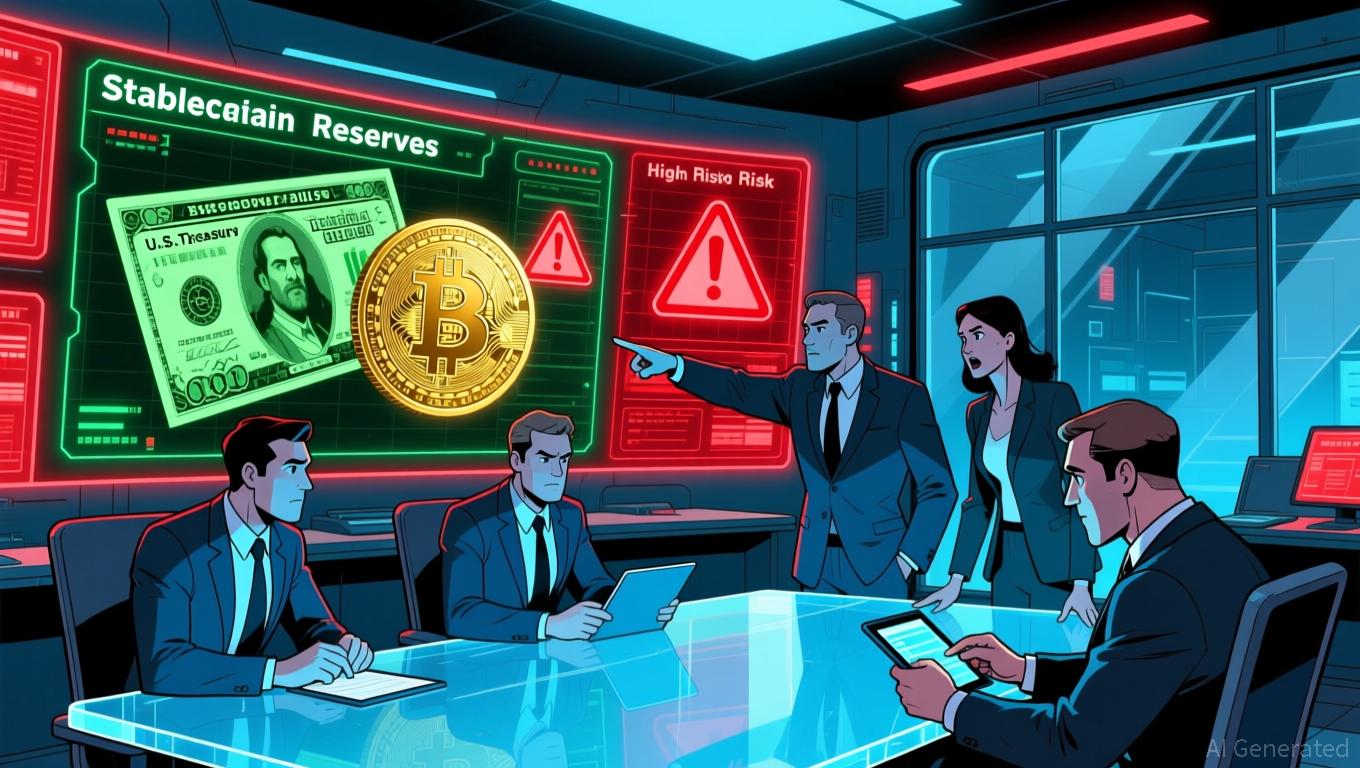
Ardoino dismissed these criticisms as part of a broader reluctance from established financial institutions to accept new financial models, describing the traditional system as "broken." He emphasized that Tether is "overcapitalized" and holds no risky assets in its reserves. Tether claims to back its $184.4 billion in liabilities with $181.2 billion in reserves and has released independent quarterly attestations since 2021, asserting that it has always honored redemption requests, as verified by external audits.
Concerns Over Reserve Strategy
The downgrade has brought renewed attention to Tether's reserve management, especially its increased allocation to Bitcoin and gold. Arthur Hayes, co-founder of BitMEX, cautioned in a recent post that a 30% decline in these assets could eliminate Tether's equity and potentially render USDT insolvent. According to Tether's third-quarter 2025 report, the company holds $12.9 billion in gold and $9.9 billion in Bitcoin as part of a strategy to hedge against possible interest rate cuts by the Federal Reserve. While Tether also maintains $112.4 billion in U.S. Treasury bills and $21 billion in repo agreements, Hayes pointed out that the company's equity buffer—estimated at just 3.7% of assets—may not be sufficient to withstand severe market downturns.
Industry Reactions and Defenses
Many in the industry have challenged these warnings. Tran Hung, CEO of UQUID Card, highlighted that Tether's reserves are primarily held in highly liquid, low-risk assets, with more than $140 billion in cash equivalents available to meet redemption requests, even during crises. Former Citi analyst Joseph noted that Tether earns $10 billion annually in interest from its Treasury holdings and may have a corporate equity buffer exceeding $50 billion. He argued that Tether's liquidity position is more conservative than that of traditional banks, which typically operate with only 5-15% liquidity, and that the company could recapitalize if necessary.
Impact in China and Market Sentiment
The downgrade has sparked a range of reactions in China, where USDT is widely used for underground cryptocurrency trading. Despite the 2021 ban, over 20 million users rely on USDT to access digital assets. Some traders dismissed the S&P downgrade as an overreaction, referencing USDT's stability during previous crises, while others voiced concerns about potential systemic risks if the token were to lose its peg.
Calls for Greater Transparency
Looking forward, Tether is under increasing pressure to enhance transparency, particularly regarding its custodians and counterparties. S&P has urged the company to reduce its exposure to high-risk assets and provide clearer disclosures. Regulators worldwide are also moving toward stricter oversight of stablecoin reserves. Despite these challenges, Ardoino remains steadfast, arguing that traditional rating agencies have repeatedly failed to foresee financial crises and asserting that Tether is "the first overcapitalized company in the financial sector."
Disclaimer: The content of this article solely reflects the author's opinion and does not represent the platform in any capacity. This article is not intended to serve as a reference for making investment decisions.
You may also like
Blockchain’s $6.8 Billion Bet: Will Advancements Outpace Its Security Risks?
- Terminal Finance's collapse exposed blockchain fintech vulnerabilities from delayed tech adoption and security flaws, triggering sector-wide scrutiny. - Naver-Upbit's $6.8B AI-blockchain merger faces challenges after Upbit's $36M Solana breach, mirroring 2019 North Korean-linked attacks. - Balancer's $116M hack revealed systemic DeFi risks, with debates over audit efficacy despite 11 prior security reviews. - Binance's legal troubles and BNB's price slump highlight market skepticism, while initiatives li
Bitcoin News Update: Krugman Links Bitcoin's Decline to Waning 'Trump Trade' Hype
- Bitcoin's 30% drop from October peak linked to fading "Trump trade" speculation, per Nobel laureate Paul Krugman, who frames it as speculative rather than stable value. - BlackRock's IBIT ETF regained $3.2B profit post-$90K rebound, while SpaceX's $105M BTC transfer sparks custodial strategy debates amid market volatility. - Naver's $10B Dunamu acquisition and corporate Bitcoin treasury moves highlight institutional crypto integration, despite $19B industry selloff and regulatory challenges. - Prediction
Bitcoin News Today: "Conflicting Whale Strategies Cast Uncertainty on Bitcoin's Path to $100K"
- Bitcoin's drop below $100,000 coincided with mixed whale strategies, including accumulation, shorting, and exchange deposits, signaling uncertain market direction. - Ethereum whales used 16.08 million DAI to buy 5,343 ETH at $3,010, while Bitcoin whales deposited 9,000 BTC, potentially signaling selling preparation. - Derivatives markets showed conflicting bets, with a $91M BTC short and $36.4M long flip, while ETF inflows ($84M total) hinted at institutional confidence amid macroeconomic risks. - Analys

Exchanges Call on SEC: Deny Exemptions to Maintain Fairness in the Market
- WFE warns SEC against broad crypto exemptions for tokenized stocks, citing risks to investor protections and market integrity. - Tokenized stocks lack dividend rights, voting access, and custody frameworks, creating "mimicked products" with weaker safeguards. - SEC's sandbox-style exemptions risk regulatory arbitrage, allowing crypto platforms to bypass rules enforced on traditional exchanges. - Global bodies like IOSCO warn tokenization amplifies data integrity and custody risks, urging unified standard
Trending news
MoreCrypto prices
More





