
Why Monad Bears Could End Up Triggering a 40% C’up’ Move?

Monad price has dropped almost 40% from its recent peak, but the last 24 hours have turned active again. The MON token is up more than 27%, and the chart now hints at a classic pattern that often leads to sharp breakouts. At the same time, derivatives data show traders leaning heavily to the short
Monad price has dropped almost 40% from its recent peak, but the last 24 hours have turned active again. The MON token is up more than 27%, and the chart now hints at a classic pattern that often leads to sharp breakouts.
At the same time, derivatives data show traders leaning heavily to the short side. This mix creates an unusual setup where bearish positions could end up driving the next big move.
Possible Cup And Handle Setup Forms On The Chart
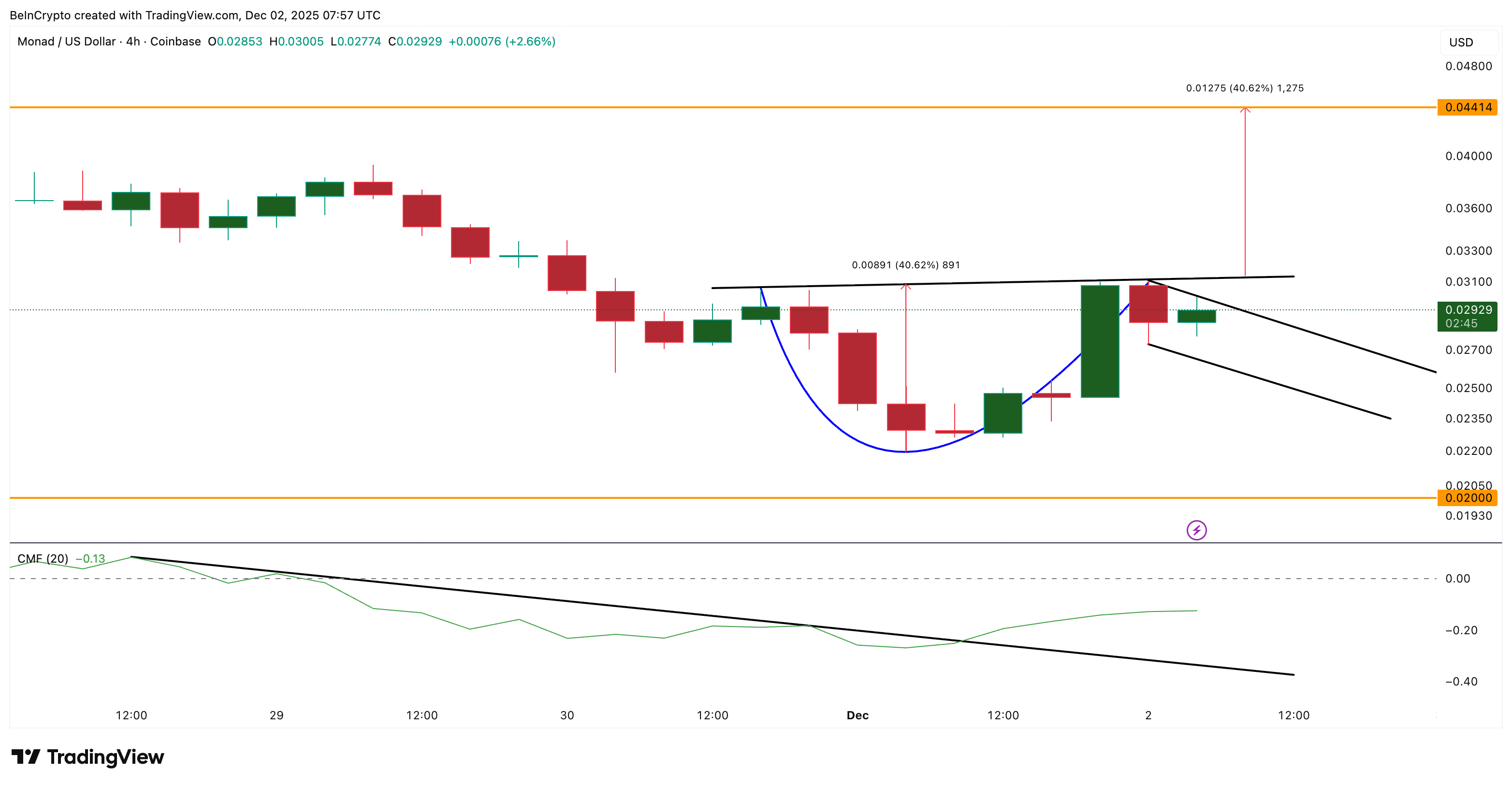
Monad trades inside a possible cup-and-handle pattern on the 4-hour chart. A cup-and-handle forms when the price rounds up, pauses, then builds a smaller pullback on the right side. This smaller pullback is called the handle. Breakouts from this pattern often lead to strong rallies.
CMF adds support to this idea. CMF (Chaikin Money Flow) tracks whether big money is entering or leaving. It has broken above its falling trend line, showing that large buyers may be returning. But CMF is still below zero. Until it moves above zero, Monad can stay inside the handle. A move above zero, while staying above the trend line, often triggers a clean breakout.
 Monad Attempts Pattern Breakout:
Want more token insights like this? Sign up for Editor Harsh Notariya’s Daily Crypto Newsletter.
If the neckline breaks, the pattern points to a target near $0.044. This lines up with the recent high Monad set about a week ago.
Short Squeeze Setup Builds As Traders Lean Bearish
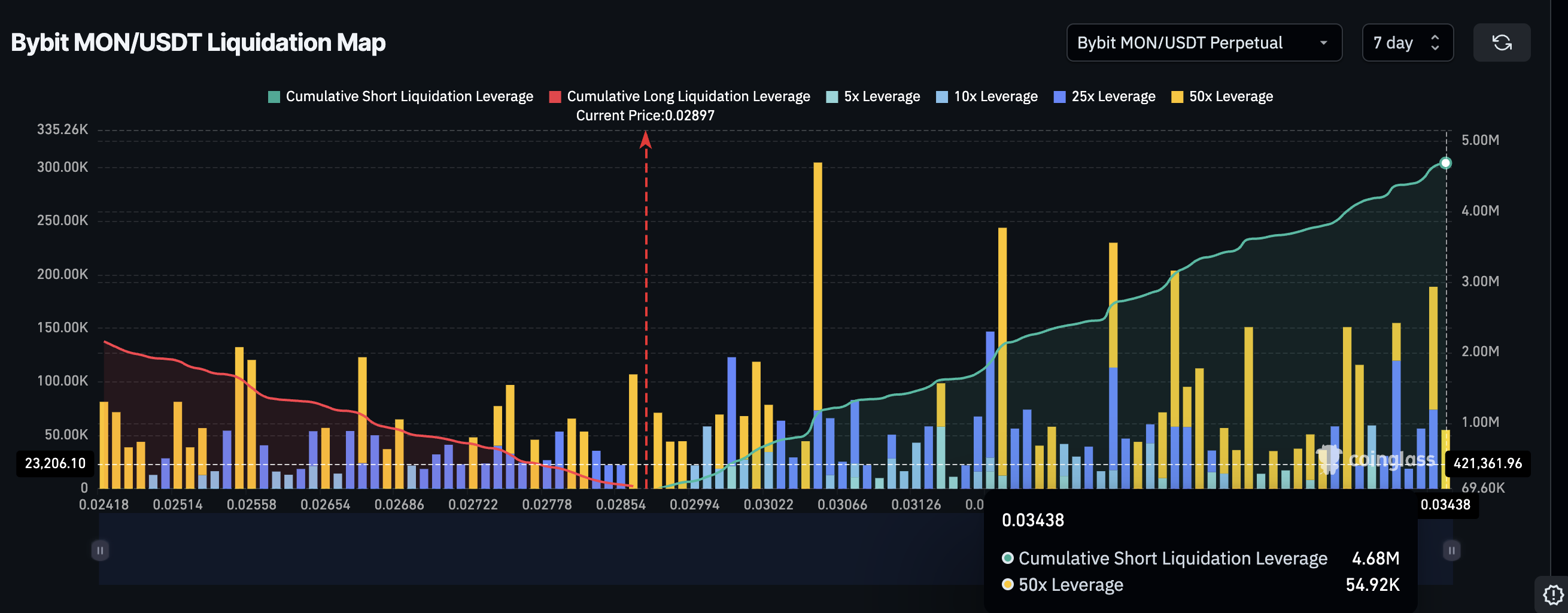
A second catalyst sits in derivatives. The Bybit liquidation chart shows short liquidation leverage stacked far above long positions. Shorts total about $4.68 million MON, while longs sit near $2.16 million. That means short leverage is almost double the longs.
 Liquidation Map Favors Bears:
This is why Monad bears — traders betting against the price — could end up driving a breakout. When a price move pushes against heavy shorts, those traders are forced to close. That creates a short squeeze, which sends the price higher. Derivatives-led moves have been the feature of the current crypto market cycle.
Monad Price Levels: What Confirms And What Invalidates The Setup
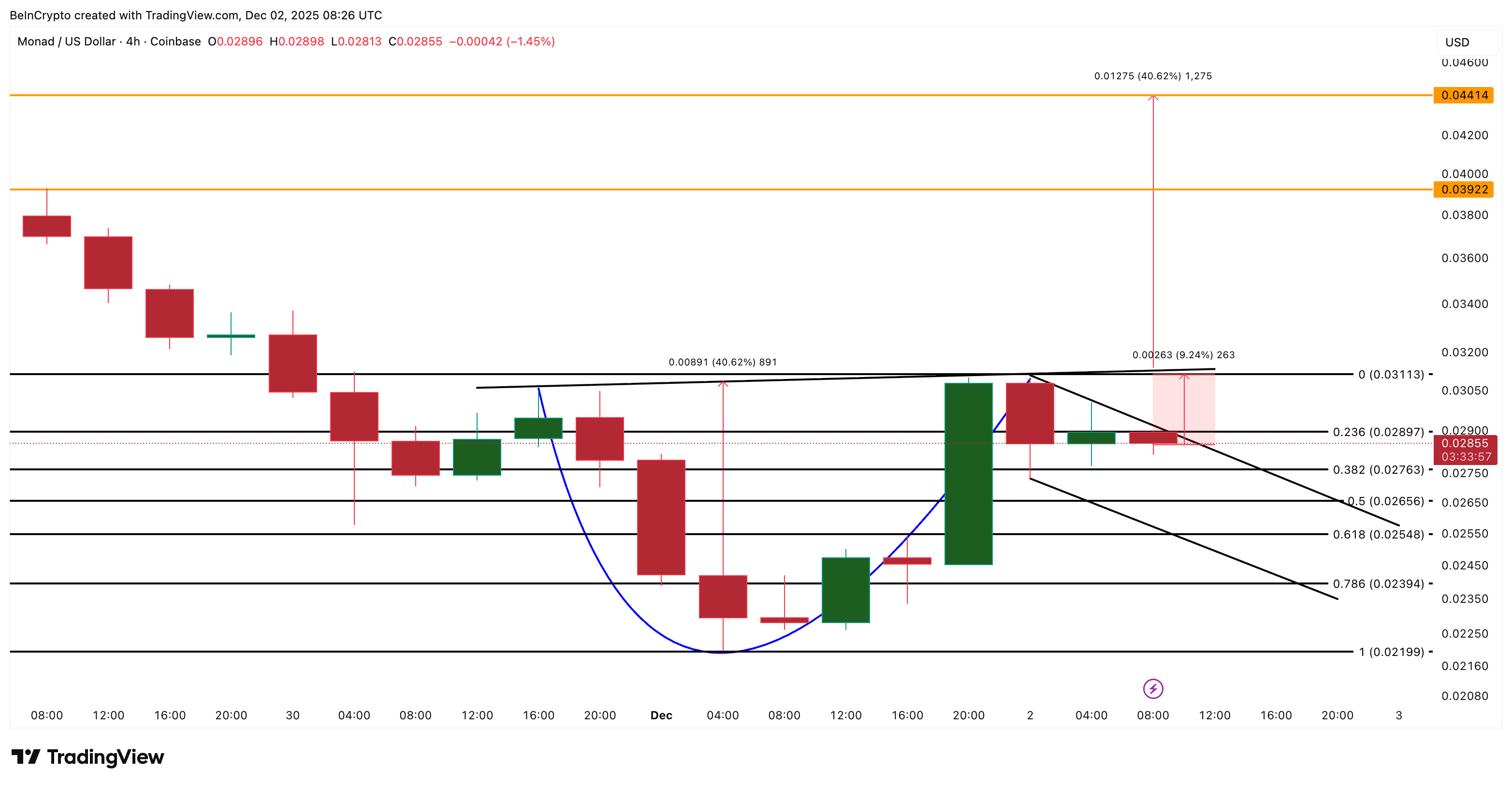
The Monad price breakout path starts above $0.031, a 9% upmove from the current level. Do note that a break above $0.031 would continue to liquidate the shorts, per the liquidation map shared earlier. The handle breakout, however, happens with a 4-hour close above $0.028.
Clearing this level opens the move toward $0.039. If momentum stays strong, the final leg toward $0.044 can complete the full 40% cup move.
 Monad Price Analysis:
But invalidation sits close. A 4-hour close below $0.025 breaks the handle and weakens the structure. If the Monad price falls below $0.021, the trend turns fully bearish.
For now, pattern strength, rising CMF, and a crowded short side put Monad in a rare position: bears could create the fuel for the next big upmove.
Disclaimer: The content of this article solely reflects the author's opinion and does not represent the platform in any capacity. This article is not intended to serve as a reference for making investment decisions.
You may also like
The Impact of Institutional Funding on Education and Workforce Training in Renewable Energy
- Institutional investors are boosting renewable energy education and workforce programs to drive long-term economic resilience and sustainability. - Global investments hit $386B in H1 2025, with education initiatives bridging skill gaps and enabling equitable clean energy transitions. - Case studies like Morocco’s 38% renewable electricity and Portugal’s green skills programs highlight education’s role in job creation and sector growth. - Education and green finance synergies in RCEP and U.S. $265B 2024 i

The Growing Influence of Artificial Intelligence on Universities and Preparing Tomorrow’s Workforce
- AI integration in higher education drives academic program expansion, with 2.5% undergraduate and 3% graduate enrollment growth in 2024. - Universities invest $33.9B in generative AI to modernize curricula and partner with industries , addressing 58% workforce readiness gaps. - AI-driven tools boost student retention (52% adoption) and project 1.5% U.S. GDP growth by 2035 through automation in key sectors. - Challenges persist: 71% academic integrity concerns and 52% training gaps highlight risks in AI a

The CFTC-Sanctioned Transformation in Clean Energy Trading
- CFTC's 2025 withdrawal of carbon credit derivatives guidance creates regulatory uncertainty but sparks innovation in blockchain/AI solutions. - OBBBA's 2026 construction deadline accelerates solar/wind project cancellations while preserving tax credit transferability mechanisms. - Battery storage, geothermal, and hydrogen emerge as resilient sectors amid market shifts, supported by IRA tax credits and OZ modernization. - Investors prioritizing domestic supply chains and third-party certified projects gai

Aligning university programs with new technology sectors to pinpoint areas with strong investment potential
- Higher education is redefining curricula to align with AI, quantum computing, green energy, and biotech sectors, addressing urgent talent gaps. - Green energy apprenticeships (e.g., ACE Network) and biotech-AI hybrid training programs are scaling rapidly to meet workforce demands. - Quantum computing initiatives like Connecticut's $1B QuantumCT plan highlight trillion-dollar investment potential in talent development and infrastructure. - AI ethics integration and edtech platforms for real-time labor mar

Trending news
MoreCrypto prices
More





