
Fasanara Digital and Glassnode: Institutional Market Outlook for Q4 2025

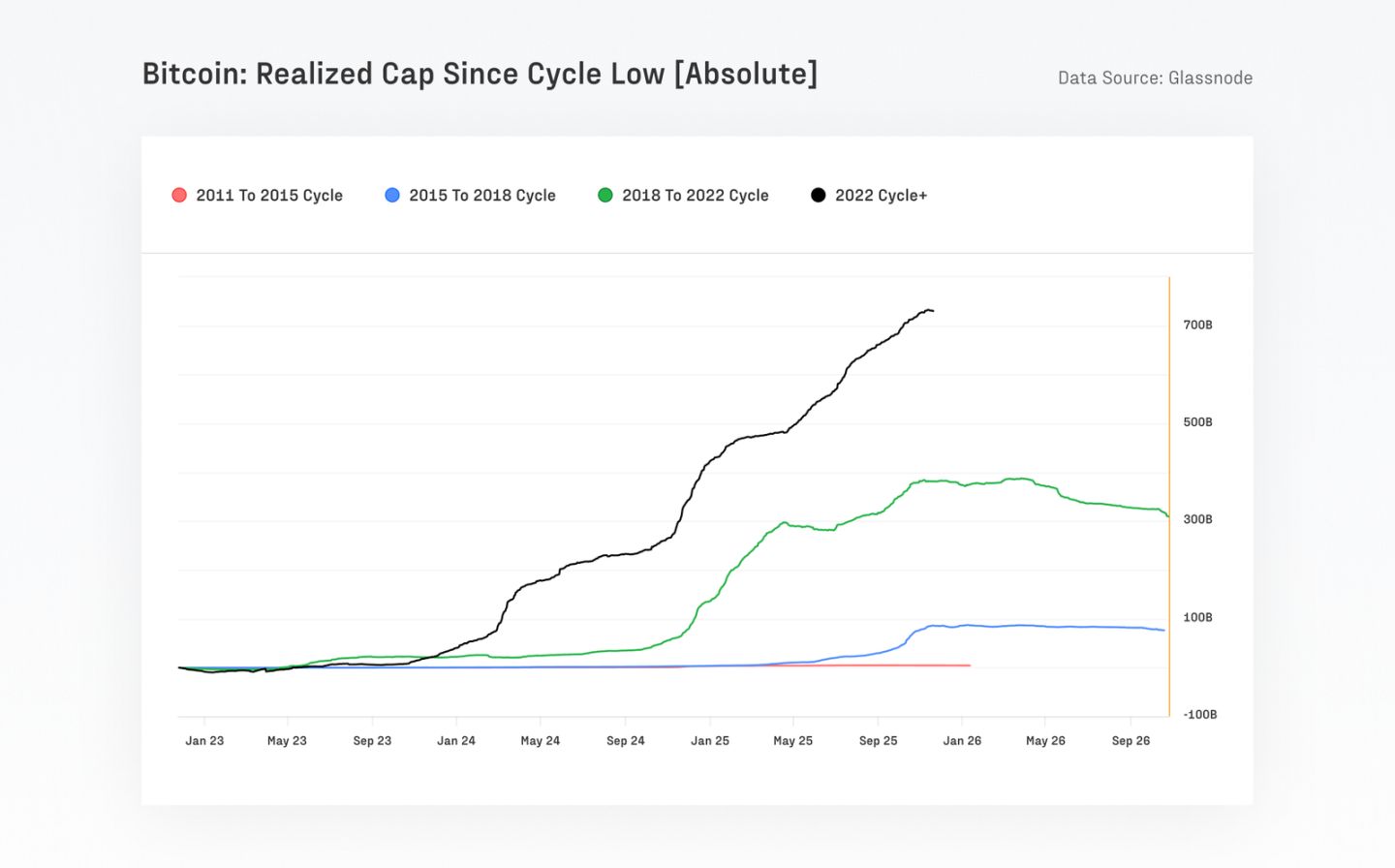
Bitcoin has dominated the market in this cycle, attracting over $732 billions in new capital. Institutional participation and market structure have significantly strengthened, while tokenized assets and decentralized derivatives are rapidly reshaping the industry ecosystem.
Bitcoin has dominated the market in this cycle, attracting over $732 billion in new capital. Institutional participation and market structure have significantly strengthened, while tokenized assets and decentralized derivatives are rapidly reshaping the industry ecosystem.
Written by: Glassnode
Translated by: AididiaoJP, Foresight News
Amid the current market pullback and macro pressures, we have jointly released a collaborative report with Fasanara Digital, analyzing the evolution trends in core ecosystem infrastructure during Q4, including spot liquidity, ETF capital flows, stablecoins, tokenized assets, and decentralized perpetual contracts.
Digital assets are currently in one of the most structurally significant stages of this cycle. Driven by deep spot liquidity, historic capital inflows, and regulated ETF demand, Bitcoin has moved beyond the expansion phase of the past three years. The market focus is shifting: capital flows are becoming more concentrated, trading venues are maturing, and derivatives infrastructure is demonstrating greater resilience amid shocks.
Based on Glassnode’s data insights and Fasanara’s trading perspective, this report outlines the evolution of market structure heading into 2025. We focus on the liquidity reconstruction of spot, ETF, and futures markets, the scale changes of leverage cycles, and how stablecoins, tokenization, and off-chain settlement are reshaping capital flows. Together, these trends depict a market architecture that is markedly different from previous cycles and continues to evolve. The following are the key takeaways:
Key Points
- Bitcoin has attracted over $732 billion in new capital, surpassing the total of all previous cycles, pushing its realized market cap to around $1.1 trillion, with prices rising over 690% during this period.
- Bitcoin’s long-term volatility has nearly halved, dropping from 84% to 43%, reflecting deepening market depth and increasing institutional participation.
- In the past 90 days, Bitcoin’s total settlement value was about $6.9 trillion, on par with or even exceeding the quarterly transaction volumes of traditional payment networks like Visa and Mastercard. As trading activity migrates to ETFs and brokers, on-chain activity has shifted, but Bitcoin and stablecoins remain dominant in on-chain settlements.
- ETF daily trading volume has grown from less than $1 billion to over $5 billion, peaking at over $9 billion in a single day (e.g., after the deleveraging event on October 10).
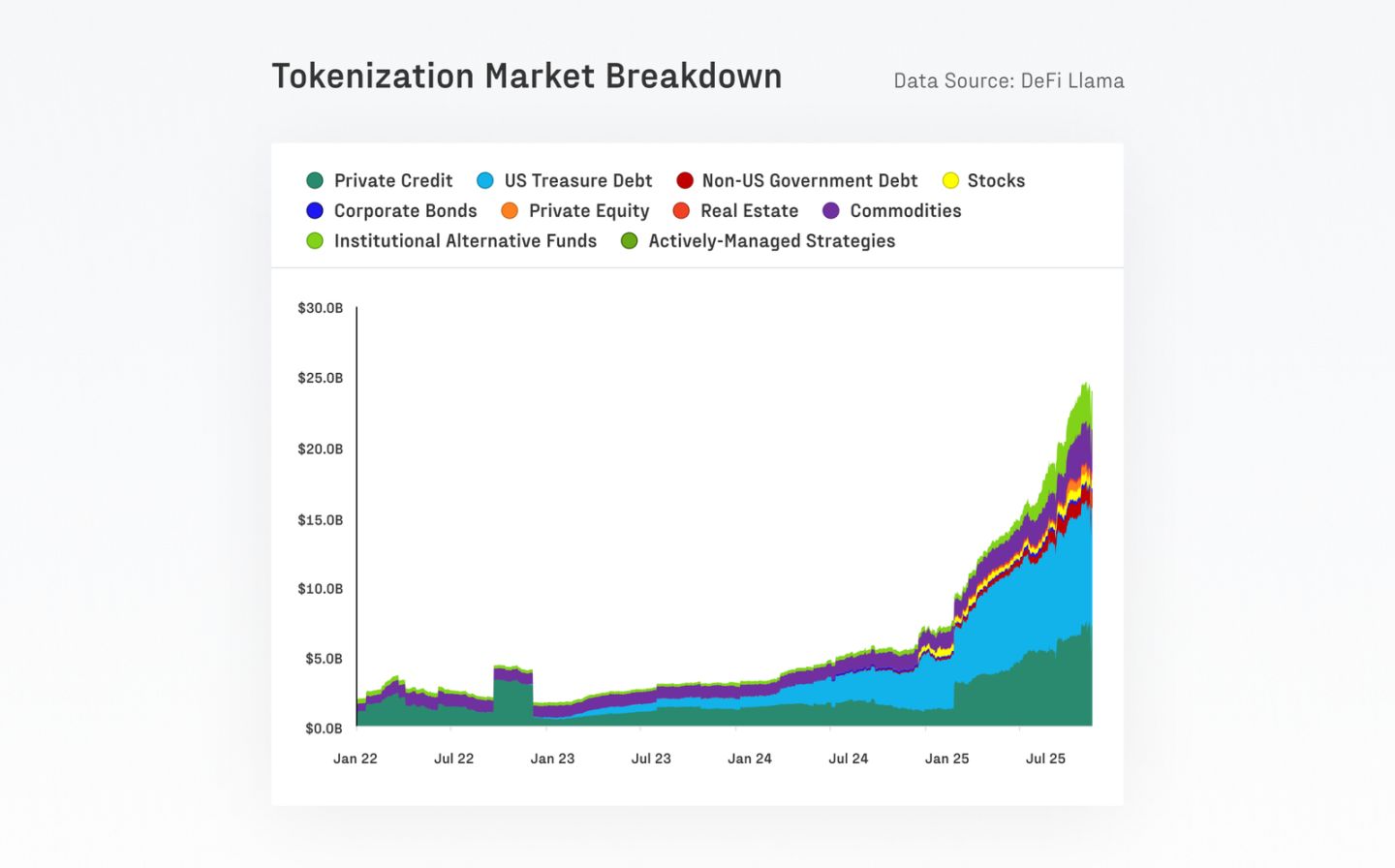
- The scale of tokenized real-world assets (RWA) has grown from $7 billion to $24 billion within a year. With low correlation to traditional crypto assets, RWAs help enhance DeFi’s stability and capital efficiency.
- The decentralized perpetual contracts market has experienced explosive and sustained growth: DEX perpetuals’ market share has risen from about 10% to 16–20%, with monthly trading volumes surpassing $1 trillion.
- Venture capital activity remains closely tied to the altcoin cycle, mainly focusing on mature and high-profile areas such as exchanges, core infrastructure, and scaling solutions.
This Cycle Is Led by Bitcoin, Driven by Spot, and Supported by Institutional Capital
Bitcoin’s market dominance is approaching 60%, indicating a return of capital to highly liquid mainstream assets, while altcoins have correspondingly retraced. Since November 2022, Bitcoin’s dominance has risen from 38.7% to 58.3%, while Ethereum’s share has dropped to 12.1%, continuing its trend of underperforming Bitcoin since the 2022 Merge.
From the cycle low to the high, Bitcoin has attracted $732 billion in new capital, surpassing the total of all previous cycles. Ethereum and other altcoins have also performed strongly, with gains exceeding 350% at their peak, but have not outperformed Bitcoin as in previous cycles.
Liquidity Deepens, Long-Term Volatility Declines, but Leverage Shocks Remain
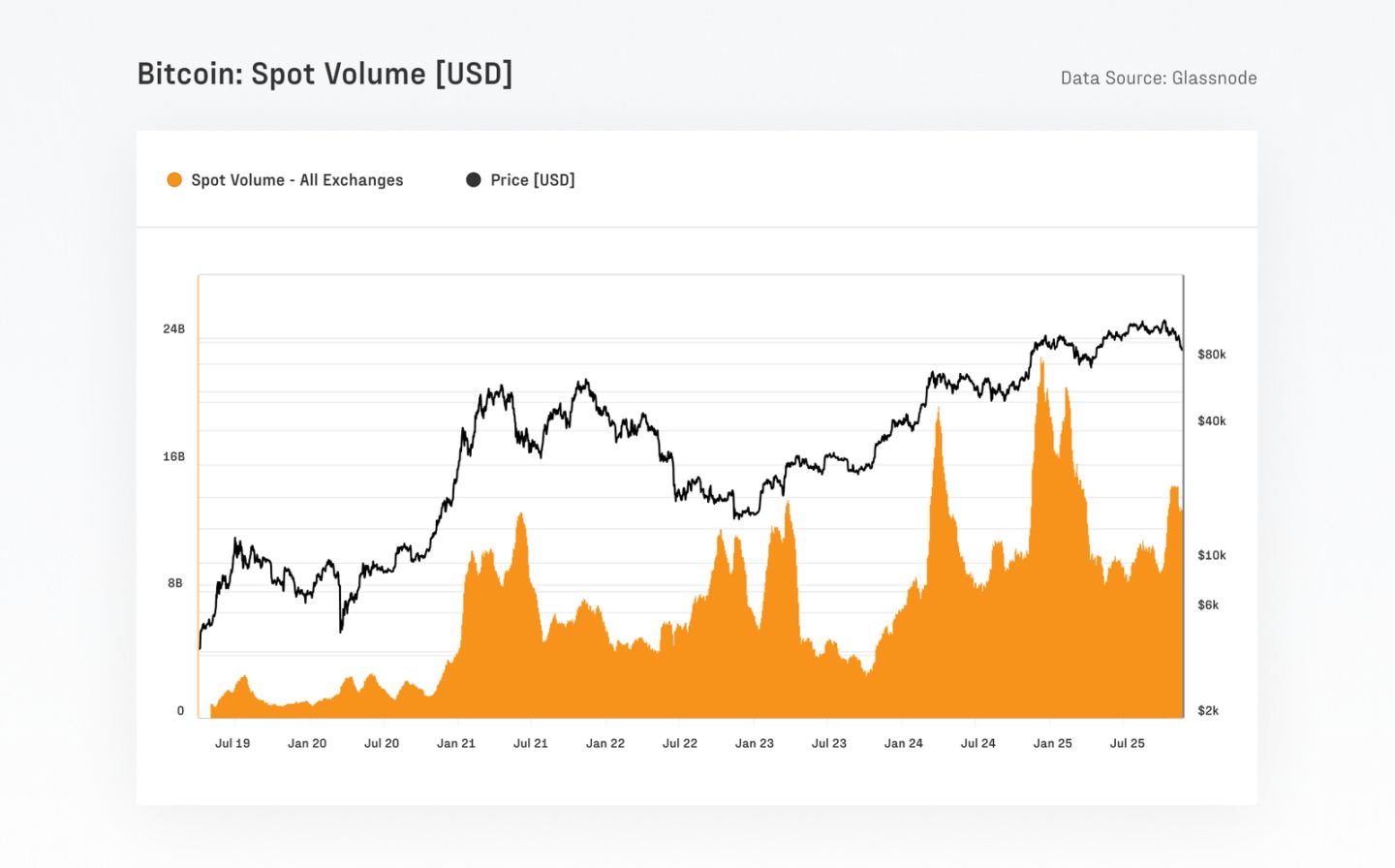
Bitcoin’s market structure has significantly strengthened, with spot daily trading volume rising from $4–13 billion in the previous cycle to the current $8–22 billion. Long-term volatility continues to decline, with 1-year realized volatility dropping from 84.4% to 43.0%. Meanwhile, open interest in futures has reached a record $67.9 billion, with CME accounting for about 30%, reflecting significant institutional involvement.
On-Chain Activity Migrates Off-Chain, but Bitcoin and Stablecoins Remain the Main On-Chain Settlement Forces
After the approval of US spot ETFs, the number of daily active Bitcoin on-chain entities dropped from about 240,000 to 170,000, mainly reflecting a shift in activity to brokers and ETF platforms rather than a decline in network usage. Despite this migration, Bitcoin still settled about $6.9 trillion in value over the past 90 days, comparable to the quarterly processing volume of mainstream payment networks like Visa and Mastercard. After Glassnode’s entity adjustment, the actual economic settlement volume still reached about $870 billion per quarter, equivalent to $7.8 billion per day.
Meanwhile, stablecoins continue to provide liquidity support for the entire digital asset ecosystem. The total supply of the top five stablecoins has reached a historical high of $263 billion. Combined, USDT and USDC have an average daily transfer volume of about $225 billion, with USDC circulating at a noticeably higher velocity, reflecting its greater use in institutional and DeFi-related capital flows.
Tokenized Assets Are Expanding Market Financial Infrastructure
Over the past year, the scale of tokenized real-world assets (RWA) has surged from $7 billion to $24 billion. Ethereum remains the primary settlement layer for these assets, currently hosting about $11.5 billion worth. The largest single product, BlackRock’s BUIDL, has grown to $2.3 billion, more than quadrupling in size this year.
As capital continues to flow in, tokenized funds have become one of the fastest-growing asset classes, opening new distribution channels for asset management institutions. This reflects the expanding scope of on-chain assets and the increasing institutional acceptance of tokenization as a distribution and liquidity channel.
Disclaimer: The content of this article solely reflects the author's opinion and does not represent the platform in any capacity. This article is not intended to serve as a reference for making investment decisions.
You may also like
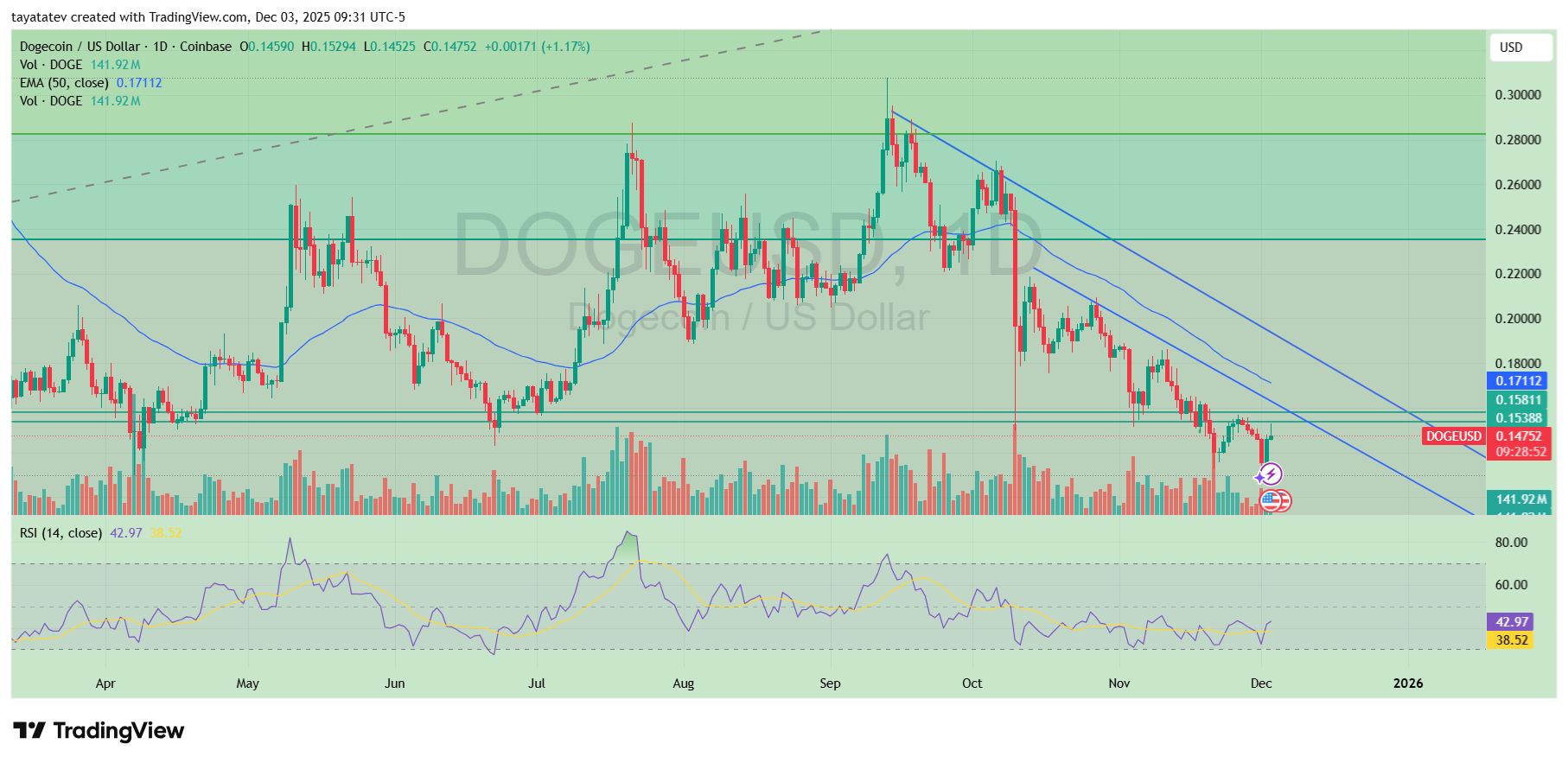
Dogecoin Trapped in Falling Channel as 0.158 Dollar Barrier Blocks Path Back to Fibonacci Golden Zone
COC the Game Changer: When Everything in GameFi Becomes "Verifiable", the Era of P2E 3.0 Begins
The article analyzes the development of the GameFi sector from Axie Infinity to Telegram games, pointing out that Play to Earn 1.0 failed due to the collapse of its economic model and trust issues, while Play for Airdrop was short-lived because it could not retain users. COC Game has introduced the VWA mechanism, which verifies key data on-chain in an attempt to address trust issues and build a sustainable economic model. Summary generated by Mars AI. This summary was generated by the Mars AI model, and its accuracy and completeness are still being iteratively updated.

BTC Volatility Weekly Review (November 17 - December 1)
Key metrics (from 4:00 PM HKT on November 17 to 4:00 PM HKT on December 1): BTC/USD: -9.6% (...

When all GameFi tokens have dropped out of the TOP 100, can COC reignite the narrative with a Bitcoin economic model?
On November 27, $COC mining will be launched. The opportunity to mine the first block won't wait for anyone.
Trending news
MoreCrypto prices
More






