
Crypto: Polygon Deploys the Madhugiri Hard Fork to Speed Up its Network

This month, Polygon seems to be accelerating the pace. After the partnership with MasterCard, the crypto blockchain follows up with the launch of the Madhugiri hard fork. Its goal: to propel crypto towards a new standard of speed, stability, and institutional adoption.

In brief
- Polygon accelerates the crypto network with Madhugiri, doubling block speed and optimizing transactions.
- The hard fork prepares institutional adoption, integrating reliable stablecoins and tokenized assets.
A crypto update tailored for speed and efficiency
The Madhugiri update of Polygon promises a silent revolution in the crypto universe. The heart of the change? A reduction of consensus time to 1 second. In other words, blocks are now validated twice as fast, with a network throughput up by 33%.
This performance gain is based on the integration of three EIPs:
- EIP-7823;
- EIP-7825;
- EIP-7883.
These technical improvements limit gas-intensive operations. But not only that! They also secure crypto transactions and guarantee a smoother experience.
Polygon has also introduced a new type of transaction for the Ethereum–Polygon crypto bridge. The goal: to allow fast updates without disrupting the network, thus making it more suitable for intensive use cases (payments, tokenized asset transfers, stablecoin transactions…).
Polygon aims for large scale crypto adoption with Madhugiri
Beyond the technical aspect, Polygon is preparing the ground for a stablecoin supercycle. It actually envisions the emergence of 100,000 stablecoins in the coming years, all focused on real-world uses.
The launch of KRW1 already shows growing interest in this blockchain. It is a Korean stablecoin pegged to the won. With Madhugiri, Polygon is thus laying the foundations of a crypto network able to handle up to 100,000 transactions per second in the future.
Note that this hard fork arrives after several protocol evolutions. We refer to Heimdall, Bhilai, and Rio. Added to this is the partnership with MasterCard .
In any case, Polygon confirms its ambition to become the technical backbone of future crypto infrastructures. While speed attracts, the robustness of the network could well push financial giants into the blockchain arena. Especially since it already crushes some known sector players!
Disclaimer: The content of this article solely reflects the author's opinion and does not represent the platform in any capacity. This article is not intended to serve as a reference for making investment decisions.
You may also like
Powell: Employment is weakening, inflation remains high, and no one is talking about rate hikes now
Powell pointed out that the U.S. labor market is cooling, with hiring and layoffs slowing down and the unemployment rate rising to 4.4%. Core PCE inflation remains above the 2% target, but service inflation is slowing. The Federal Reserve has cut interest rates by 25 basis points and started purchasing short-term Treasury bonds, emphasizing that the policy path needs to balance risks between employment and inflation. Future policies will be adjusted based on data. Summary generated by Mars AI. This summary is produced by the Mars AI model, and the accuracy and completeness of its generated content are still in the process of iterative improvement.

$RAVE TGE Countdown: When Clubbing Becomes an On-Chain Economic Activity, the True Web3 Breakthrough Moment Arrives
RaveDAO is rapidly growing into an open cultural ecosystem driven by entertainment, becoming a key infrastructure for Web3 to achieve real-world adoption and mainstream breakthrough.

A "hawkish rate cut" that's not so "hawkish," and balance sheet expansion that's "not QE"
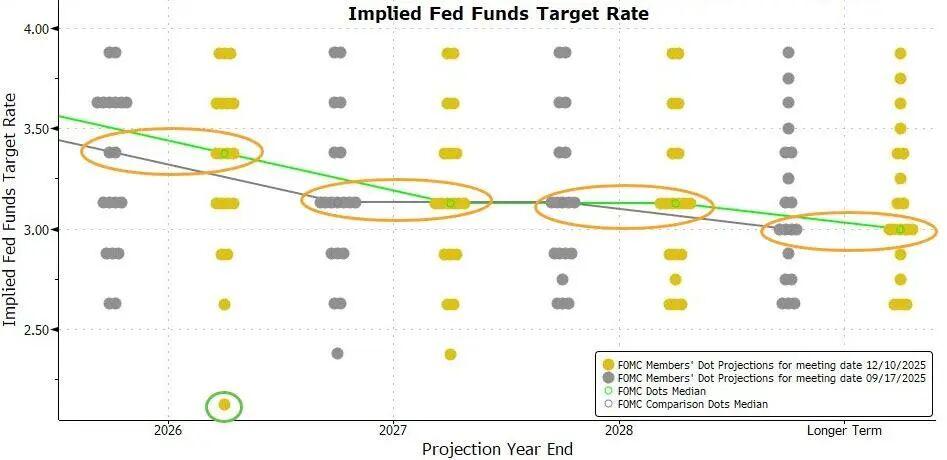
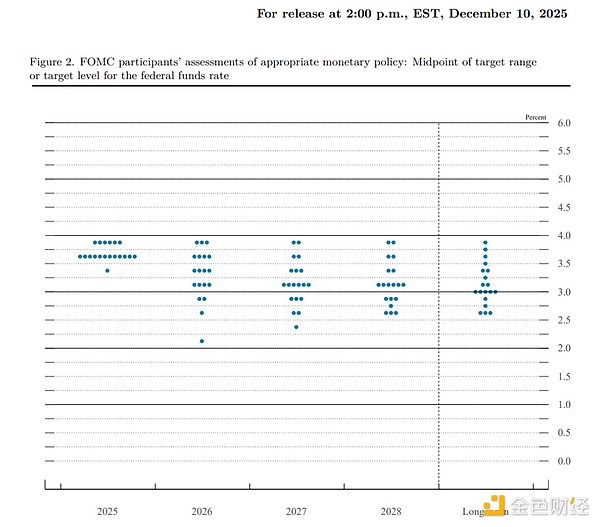
The Federal Reserve has cut interest rates by another 25 basis points as expected, still projecting one rate cut next year, and has launched an RMP to purchase $40 billion in short-term bonds.
Trending news
MoreCrypto prices
More





