
Bitcoin Is Just One Push Away From Ending Its Correction — Here’s How

Bitcoin price has extended its correction after the FOMC rate cut. The coin is down about 13% over the past 30 days and almost 4% in the past week. The move still fits inside a slow, grinding corrective phase since the October peak. But two on-chain shifts now show something that did not appear at
Bitcoin price has extended its correction after the FOMC rate cut. The coin is down about 13% over the past 30 days and almost 4% in the past week. The move still fits inside a slow, grinding corrective phase since the October peak.
But two on-chain shifts now show something that did not appear at any point earlier in this downturn. These signals suggest the correction could be close to a turn — if Bitcoin delivers the push it needs.
Two Metrics Now Point Toward a Possible Turn
Short-term capitulation is showing up clearly now. CryptoQuant’s realized profit-and-loss data shows short-term Bitcoin holders are still deep in losses. This usually happens near the end of a correction, not the middle, because panicked selling at a loss often marks late-stage exhaustion.
BTC Short-Term Holders are Still in a Pain Zone“Structurally, these deep loss pockets usually show up closer to the late stages of a correction than the early ones.”
— CryptoQuant.com
This fits with what shows up on HODL Waves.
HODL Waves measure how much Bitcoin each “age band” holds — from very new coins to very old ones. It shows which groups are accumulating or selling. The one-day to one-week cohort held 6.2% of the supply in late November. By December 10, they held only 2%.
That is a massive 68% drop and signals heavy short-term selling, the kind that often completes a correction rather than starts a new one. Plus, this cohort dumping also pushes speculative money out of the asset.
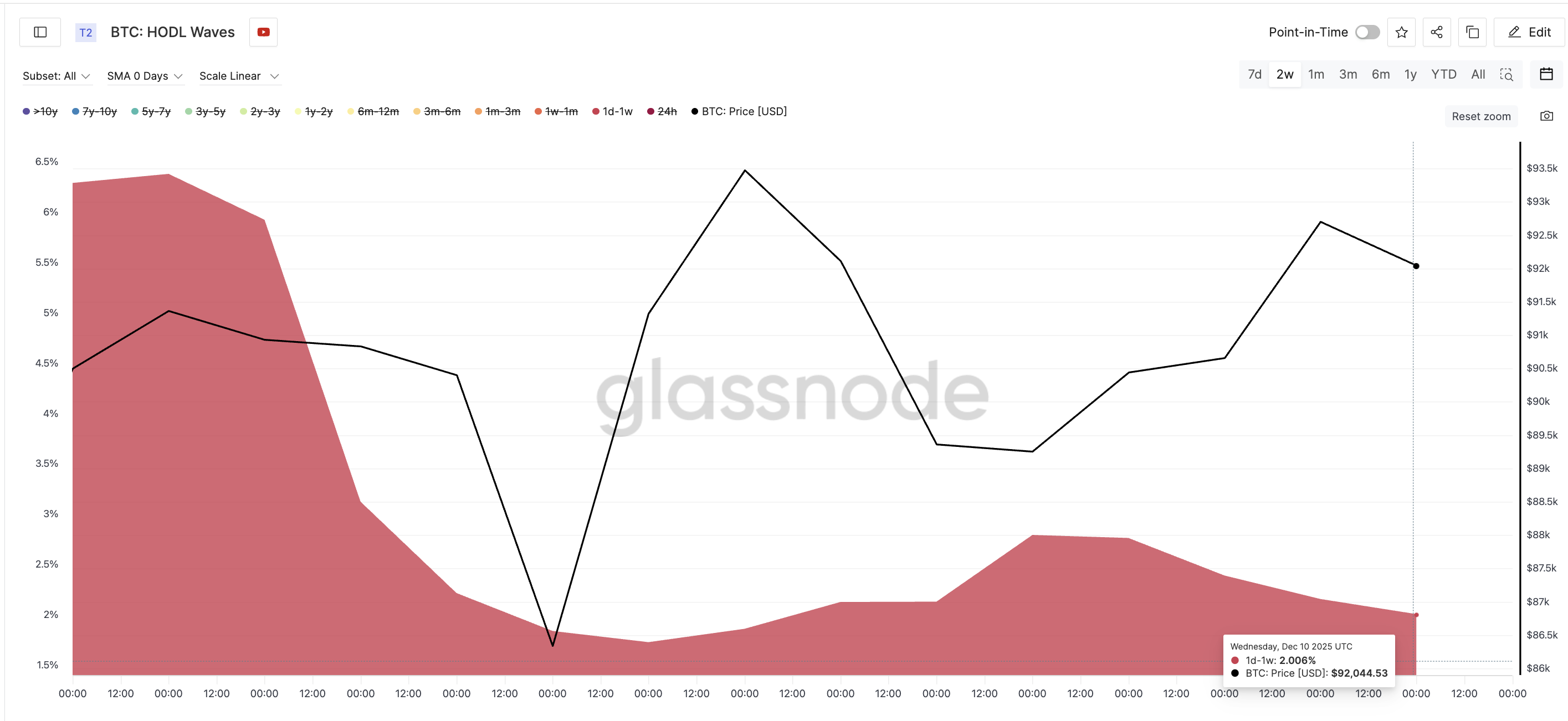 Short-Term Holders Keep Selling:
Want more token insights like this? Sign up for Editor Harsh Notariya’s Daily Crypto Newsletter.
The next signal comes from Exchange Net Position Change, which tracks how many coins move into or out of exchanges each day.
On November 27, net flows were +5,103 BTC (coins moving in).
By December 10, the flows flipped to –43,292 BTC, a flip of more than 8.4x from inflows to outflows.
A similar shift happened between September 17 and September 25. After that flip, Bitcoin rallied toward its all-time high above $126,000.
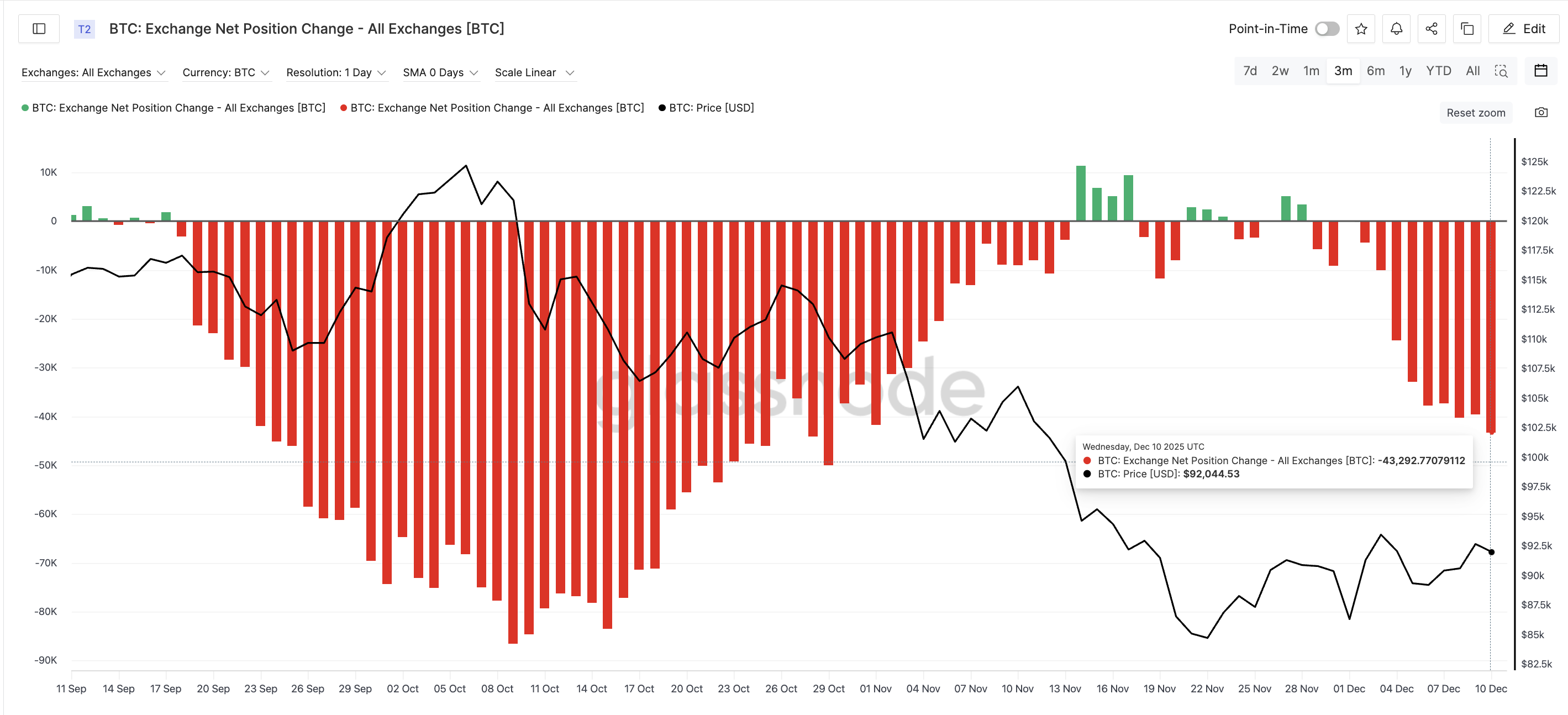 BTC Buying Intensifies:
Now the same combination — short-term capitulation plus strong outflows — is forming again. Together, they create the cleanest trend-shift setup of this entire correction.
Bitcoin Price Needs a 4% Push to Break Out?
If these signals are pointing to a turn, the Bitcoin price chart needs to confirm it. The Bitcoin price has been moving inside a symmetrical triangle on the daily chart. A symmetrical triangle forms when buyers and sellers slow at the same pace. Each side has only two touch points, which makes both trend lines weak. A small push can break the entire setup on either side.
That push is clear: Bitcoin needs a daily close above $94,140, which is only about a 4% move from current levels. This level overlaps with both the horizontal resistance and the upper edge of the triangle. A clean breakout opens the path toward $97,320 and then $101,850.
On the downside, the nearest risk level is $90,180. A daily close under it weakens the bullish case. If that breaks, $87,010 is the next major support. Losing that exposes $80,640, where the broader bullish idea breaks.
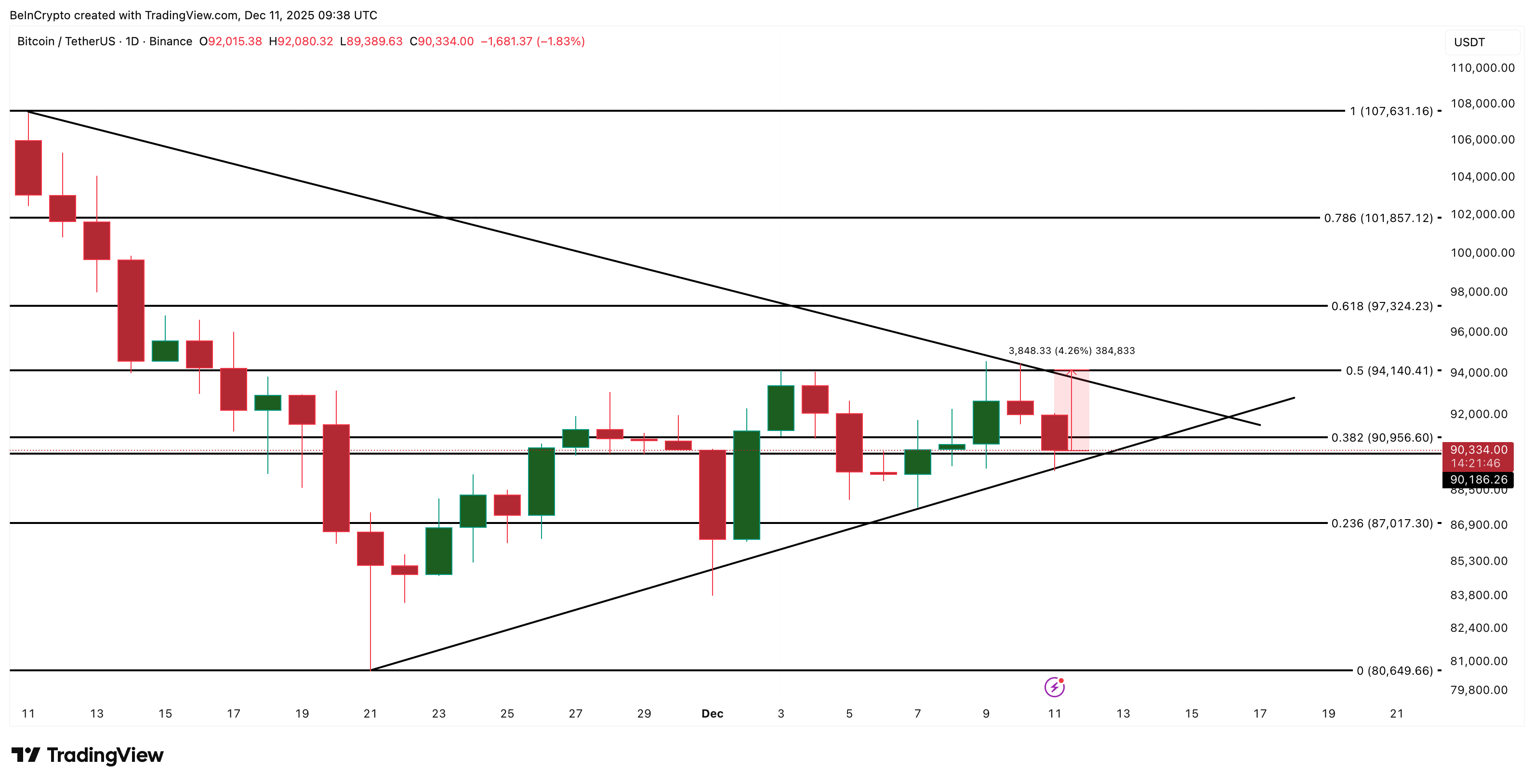 Bitcoin Price Analysis:
Right now, the setup is neutral but improving. Short-term capitulation and heavy outflows give the Bitcoin price a chance to end its correction — but only if it delivers that 4% breakout.
Disclaimer: The content of this article solely reflects the author's opinion and does not represent the platform in any capacity. This article is not intended to serve as a reference for making investment decisions.
You may also like
The Growing Need for Financial Services Focused on Wellbeing
- Financial services are integrating nine wellness dimensions into financial planning to align well-being with economic outcomes. - Studies show only 38% of individuals achieve ideal financial wellness, linking health and financial resilience. - AI tools and wellness programs boost productivity and retention, with 52% growth in AI coaching since 2020. - Wellness-focused real estate and cultural investments reflect rising demand for holistic prosperity. - The $2 trillion wellness industry drives sustainable

Bitcoin Price Fluctuations: Optimal Entry Strategies Amid Changing Macroeconomic Conditions
- Bitcoin's volatility offers high returns but poses psychological risks, requiring disciplined risk management and emotional resilience. - Social media and behavioral biases like FOMO and loss aversion exacerbate impulsive trading during market swings. - Strategic frameworks (position sizing, DCA) and financial literacy help investors navigate volatility while avoiding overleveraging. - Case studies show predefined plans and diversification reduce panic selling during crashes like the 2024 "Black Friday"

Investing in Sectors Focused on Wellness in 2026: Strategically Aligning with Enduring Human-Centered Trends
- Global wellness market to grow from $6.87T in 2025 to $11T by 2034 at 5.4% CAGR, driven by preventive health, mental wellness, and financial well-being integration. - Wearables (Apple Watch, Oura Ring) and AI platforms (Calm, Headspace) are reshaping physical/emotional wellness, with corporate programs boosting productivity and reducing healthcare costs. - Financial wellness emerges as critical axis, with companies like CHC Wellbeing linking health incentives to economic stability through gamified reward

The Growth and Evaluation of Investments in AI-Powered Educational Technology
- The global AI-driven EdTech market is projected to grow from $7.05B in 2025 to $112.3B by 2034 at 36.02% CAGR, driven by personalized learning and AI-powered tools reducing educator workloads by 25%. - However, 50% of students report reduced teacher connections, 70% of educators fear weakened critical thinking, and 63% of specialists cite AI-related cybersecurity risks, highlighting ethical and systemic challenges. - Anthropology and interdisciplinary approaches address AI biases and cultural gaps, exemp

Trending news
MoreCrypto prices
More





