
In 2026, Goldman Sachs No Longer Provides "Average Answers"—A Comprehensive Judgment Based on Seven Industry Reports

At the end of the year, major investment banks tend to release their industry outlooks for the upcoming year.
But if you only read a few scattered reports, it’s easy to be swayed by the different conclusions.
So this time, I did something a bit more “tedious,” but also more valuable—
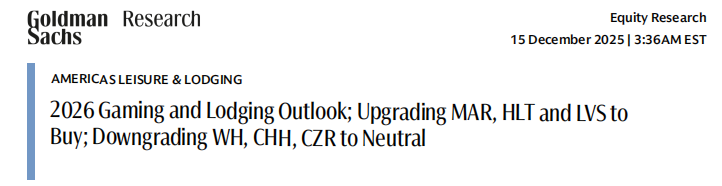
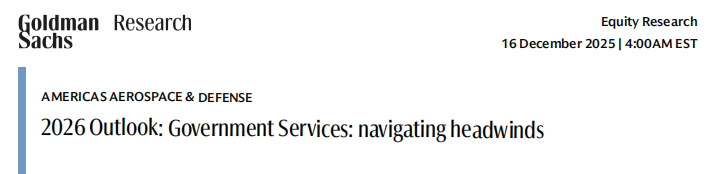
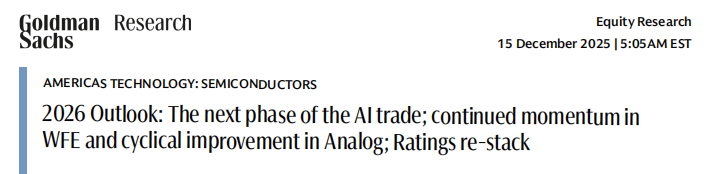
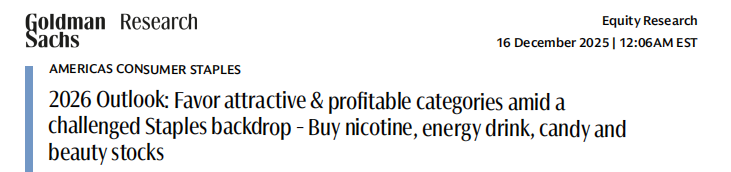
I read through all seven of Goldman Sachs’ 2026 annual industry research reports released in December.
The industries covered include:
Semiconductors, dining, branded consumption, essential consumption, real estate and building materials, defense services, as well as hotels and gaming.
The conclusion is clear and consistent:
In 2026, Goldman Sachs will no longer provide an “average answer.”
I. A Very Clear Consensus: Divergence, Not a Full Recovery
To sum up Goldman Sachs’ outlook for 2026 in one sentence, it would be:
No longer pricing “the whole industry,” but acknowledging that long-term divergence has already occurred.
You’ll notice that in almost every industry, Goldman Sachs keeps emphasizing the same thing:
Not all companies will benefit
Not all demand will return
And certainly not “this sector is due for a rally just because it’s its turn”
This is not an emotional judgment, but a very typicalpost-cycle research framework.
II. U.S. Consumption: Not a Recovery, but Structural Division
1️⃣ Dining: Winners Keep Taking Market Share
Goldman Sachs’ stance on the dining industry is quite pragmatic.
They believe:
Low-income groups remain under pressure
Young consumers are more cautious
The room to drive growth through price increases has clearly narrowed
In this context, those that can outperform are not “cheap,” but rather:
Scale advantages
Operational efficiency
Digitalization and membership systems
In other words,growth in the dining industry comes more from “the strong devouring the weak,” rather than from expanding demand itself.
2️⃣ Apparel and Branded Consumption: The Money Remains, But Flows Only to a Few Brands
Compared to dining, Goldman Sachs is not pessimistic about apparel and branded consumption.
They do not believe consumers have stopped buying clothes,
but they make it very clear:
Consumer spending is concentrating on companies with strong brand power and execution.
What determines success is not the prosperity of the industry, but rather:
Whether the brand has pricing power
Whether the distribution channels are controllable
Whether inventory, cost, and pace management are stable
This means:
The industry may survive, but there’s no guarantee that you will.
3️⃣ Essential Consumption: Defensive Characteristics Are Fading
This is a rather counterintuitive judgment.
Traditionally, essential consumption is considered a defensive asset.
But Goldman Sachs’ view for 2026 is:
Essential consumption overall may still underperform the market.
The reasons are not complicated:
Changes in consumption structure
Competition from private labels
The long-term impact of GLP-1 drugs on diet and consumption habits
What Goldman Sachs really values are the structural opportunities within sub-sectors, not the “essential” label itself.
III. AI & Semiconductors: The Main Track Remains, But Now Enters a “Strict Screening” Phase
In the tech sector, especially semiconductors, the signals from Goldman Sachs are critical.
They do not deny that AI investment continues,
and also acknowledge that infrastructure Capex still has room for upward revision.
But at the same time, they repeatedly emphasize:
In 2026, AI investment returns to being a “multiple choice question,” not a “yes or no question.”
The research focus has shifted from:
Whether a company has AI
to:Whether the client structure is high quality
Whether it truly participates in core training and inference processes
Whether the business model can continuously generate cash flow
That’s why you see Goldman Sachs starting to downgrade some companies with strong AI labels but weak fundamentals.
In summary:
AI remains important, but just telling stories is no longer valuable.
IV. Traditional Industries: Industry Matters Less, Companies Matter More
Real Estate & Building Materials
Goldman Sachs remains cautious on the overall real estate chain.
The reasons are straightforward:
Interest rates remain high
Transaction volumes are sluggish
Consumer confidence is lacking
But they do not completely write off the sector.
What they are willing to allocate to are those companies that:
Have clear capital returns
Strong cost control
Can maintain profitability during downturns
The industry faces headwinds, but companies can be different.
Defense & Government IT Services
In the defense and government services sector, Goldman Sachs also emphasizes differentiation.
With tighter budgets and stricter contract reviews,
the sector as a whole is under pressure, but a few companies can still outperform.
The reason is simple:
High technological content, aligned with long-term security and digitalization needs.
Hotels & Gaming: A Complete Split Between High-End and Low-End
In the hotel and gaming sector, Goldman Sachs uses a direct term:
Bifurcation.
High-end consumption, international traffic, and destination-type assets remain resilient
Low-end, price-sensitive demand continues to be under pressure
This, essentially, follows the same logic as the earlier judgments on consumption sectors.
V. Looking at All Seven Industries Together, What Is Goldman Sachs Really Saying?
When you put these seven industry research reports side by side, you’ll see a very clear outline:
Consumption: Stratification
Technology: Divergence
Traditional industries: Survival of the fittest
In 2026, Goldman Sachs no longer attempts to give a “single narrative,”
but instead frankly admits:
This is a year that rewards only a few companies.
My Understanding:
After reading this set of reports, I have a strong feeling:
2026 may not be a year where big mistakes are easily made,
but it will certainly be a year where it’s hard to make money through “average allocation.”
Indices may still rise,
stories may still be told,
but true excess returns will only be found in the structurally best areas.
If you’re still accustomed to:
Sector rotation
Concept labels
Then 2026 might be a tough year for you.
But if you’re willing to:
Embrace divergence
Acknowledge imbalance
Focus on company quality
Then this is actually a year where research-driven investors have an advantage.
Disclaimer: The content of this article solely reflects the author's opinion and does not represent the platform in any capacity. This article is not intended to serve as a reference for making investment decisions.
You may also like
Bitcoin deemed too vulnerable: Jefferies bets on gold against quantum threat

CME Drops Chainlink Futures Bombshell as Micro LINK Goes Live for 24/7 Regulated Trading

JPMorgan Chase wages war on yield-bearing stablecoins through the GENIUS Act
Tesla given extension in US probe regarding its autonomous driving technology
Trending news
MoreCrypto prices
More






