
Why the Federal Reserve has traditionally operated independently from the White House

Justice Department Considers Criminal Charges Against Federal Reserve
According to Federal Reserve Chair Jerome Powell, the Justice Department has warned the Federal Reserve of possible criminal prosecution related to testimony he gave this summer about the central bank’s building renovation project.
Escalating Tensions Between the White House and the Fed
This move marks a significant intensification of efforts by the current administration to assert more influence over the Federal Reserve, following ongoing attempts by former President Donald Trump to challenge the institution’s autonomy.
Trump has frequently criticized Powell for refusing to lower short-term interest rates and has even threatened to dismiss him. Trump has insisted that the Fed reduce borrowing costs to stimulate economic growth and decrease the government’s interest payments. His frustration persisted even after the Fed lowered rates in three of the last four months of 2025.
Additionally, Trump has accused Powell of mishandling the central bank’s $2.5 billion renovation. In a notable shift from his usual response to Trump’s criticisms, Powell described the threat of criminal charges as a mere “pretext” to undermine the Fed’s independence in setting monetary policy.
Political Reactions and Internal Divisions
Although most Republican lawmakers have remained largely silent, a few have started to break ranks. North Carolina Senator Thom Tillis, a member of the Senate Banking Committee, stated, “Any lingering doubt about whether Trump Administration advisers are working to end the Federal Reserve’s independence should now be gone.”
Trump is also attempting to remove Federal Reserve Governor Lisa Cook based on unsubstantiated claims of mortgage fraud, an accusation first raised by Bill Pulte, a Trump appointee to the Federal Housing Administration.
Why the Federal Reserve’s Independence Is Crucial
The Federal Reserve plays a pivotal role in the U.S. economy. By adjusting its key short-term interest rate—typically lowering it during economic downturns—the Fed can make loans more affordable, encouraging spending, growth, and job creation. Conversely, raising rates helps control inflation but can slow the economy and lead to job losses.
Economists have long favored independent central banks, as they are better positioned to make tough decisions, such as raising rates to control inflation, even if those moves are unpopular and make borrowing more expensive for consumers.
The importance of central bank independence became clear after the prolonged inflation of the 1970s and early 1980s. Former Fed Chair Arthur Burns is often criticized for allowing inflation to spiral by yielding to President Richard Nixon’s pressure to keep rates low before the 1972 election—a move Nixon believed would help his reelection campaign.
Lessons from History: Volcker’s Tenure
In 1979, President Jimmy Carter appointed Paul Volcker as Fed chair. Volcker raised the central bank’s short-term rate to nearly 20%—a dramatic increase from today’s 3.6%, which is the lowest in almost three years. These high rates triggered a severe recession, sent unemployment close to 11%, and sparked widespread protests.
Despite the backlash, Volcker remained steadfast. By the mid-1980s, inflation had dropped to low single digits. Economists often cite Volcker’s resolve as a prime example of why an independent Fed is essential.
Market Implications of Threats to Fed Independence
Any attempt to dismiss Powell would likely unsettle financial markets, causing stock prices to fall and bond yields to rise, which would increase interest rates on government debt and consumer loans such as mortgages, auto loans, and credit cards. The 10-year Treasury yield, a benchmark for mortgage rates, would likely climb.
On Monday, all major U.S. markets opened lower, bond yields increased, and the dollar weakened.
Investors generally favor an independent central bank because it tends to manage inflation more effectively and makes policy decisions that are less susceptible to political influence, resulting in greater predictability. Fed officials regularly communicate how they might adjust interest rates in response to changing economic conditions.
If the Fed were more politically influenced, it would become much harder for markets to anticipate or interpret its actions.
While the Fed sets short-term rates, longer-term borrowing costs are determined by financial markets. If investors believe inflation will remain high, they demand higher yields on government bonds, driving up borrowing costs throughout the economy.
Internationally, Turkey provides a cautionary tale. President Recep Tayyip Erdogan pressured the central bank to keep rates low in the early 2020s, even as inflation soared to 85%. In 2023, when the central bank regained some independence, inflation began to fall, but short-term rates had to be raised to 50% to combat inflation, and remain elevated.
Checks and Balances: How the Fed Remains Accountable
Although the Fed operates independently, it is still subject to oversight. The president appoints the Fed chair for a four-year term, subject to Senate confirmation, and selects the other six board members, who serve staggered terms of up to 14 years.
These appointments allow a president to gradually shape the Fed’s direction. President Joe Biden, for example, has appointed four of the current seven board members: Powell, Cook, Philip Jefferson, and Michael Barr. Adriana Kugler, another Biden appointee, resigned unexpectedly on August 1, five months before her term ended. Trump has nominated Stephen Miran, his chief economist, as a possible replacement, pending Senate approval. Cook’s term runs until 2038, so her removal would let Trump install a loyalist much sooner.
Powell’s term as chair ends in May, giving Trump the opportunity to appoint a new leader. However, the Fed’s interest-rate committee consists of 12 voting members, so changing the chair alone does not guarantee a shift in policy direction.
Congress also has the authority to define the Fed’s objectives through legislation. In 1977, lawmakers gave the Fed a “dual mandate” to maintain price stability and pursue maximum employment, with stable prices defined as 2% inflation.
Additionally, the 1977 law requires the Fed chair to testify before both the House and Senate twice a year about economic conditions and monetary policy.
Can the President Remove the Fed Chair?
The Supreme Court recently indicated, in a case involving other independent agencies, that a president cannot dismiss the Fed chair simply for policy disagreements. However, removal “for cause”—such as misconduct or negligence—may be possible.
This may explain why the Trump administration is focusing on the building renovation as a potential justification for removal. Still, Powell would likely contest any attempt to oust him, and the dispute could ultimately reach the Supreme Court.
Disclaimer: The content of this article solely reflects the author's opinion and does not represent the platform in any capacity. This article is not intended to serve as a reference for making investment decisions.
You may also like
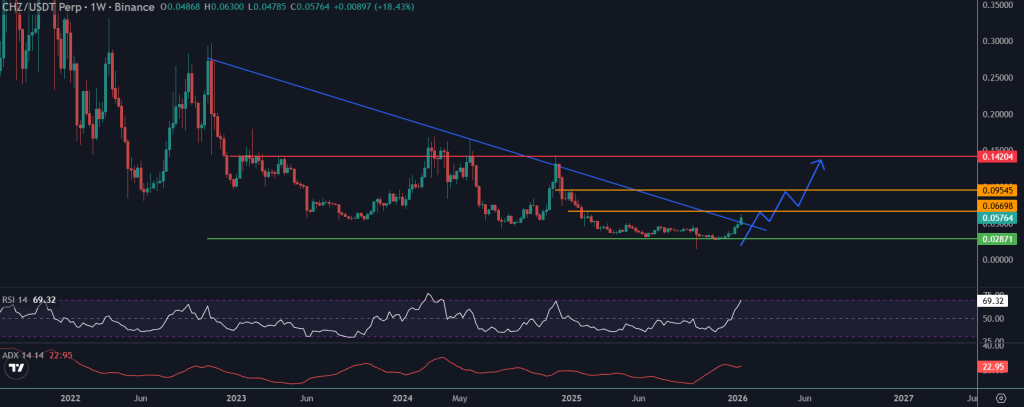
Chiliz Price Jumps as Fan Token Interest Returns:Can CHZ Extend Its Early-2026 Momentum?
 VIPBitget VIP Weekly Research Insights

Bitcoin’s Resurgence: US Demand Shifts Market Sentiment
Trending news
MoreCrypto prices
More






