
ChatGPT suddenly announces ads, $8 subscription plan can't avoid them
Just now, OpenAI officially announced a milestone decision:ads will be introduced in the free version of ChatGPT and the entry-level subscription tier "ChatGPT Go." This feature will be tested first with adult users in the United States over the coming weeks.
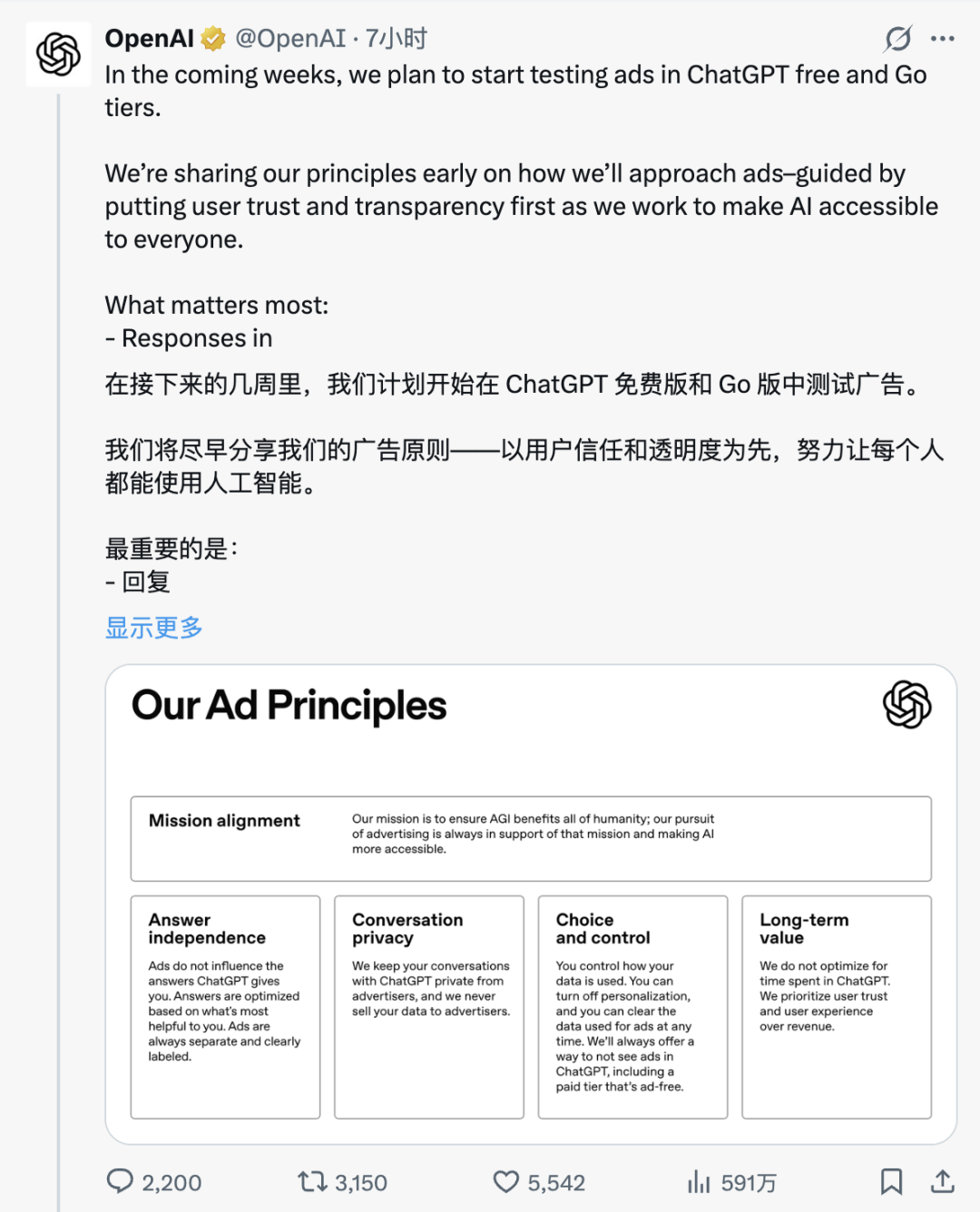
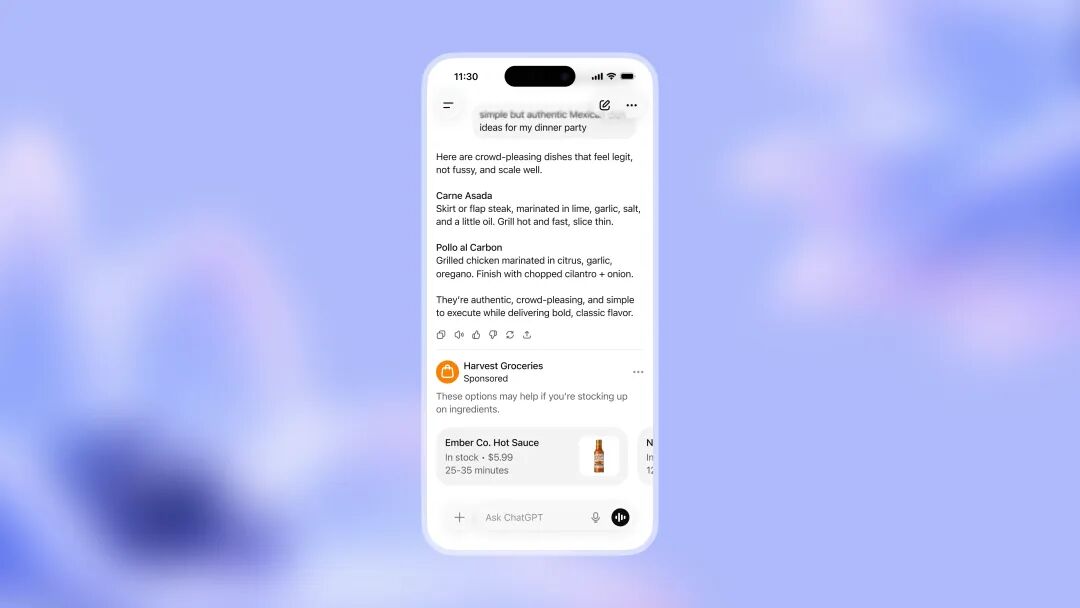
The good news is that ads won't forcibly interrupt your conversations; they will quietly appear at the bottom of the response content only when the system determines a relevant sponsored product exists, and they will be clearly labeled.
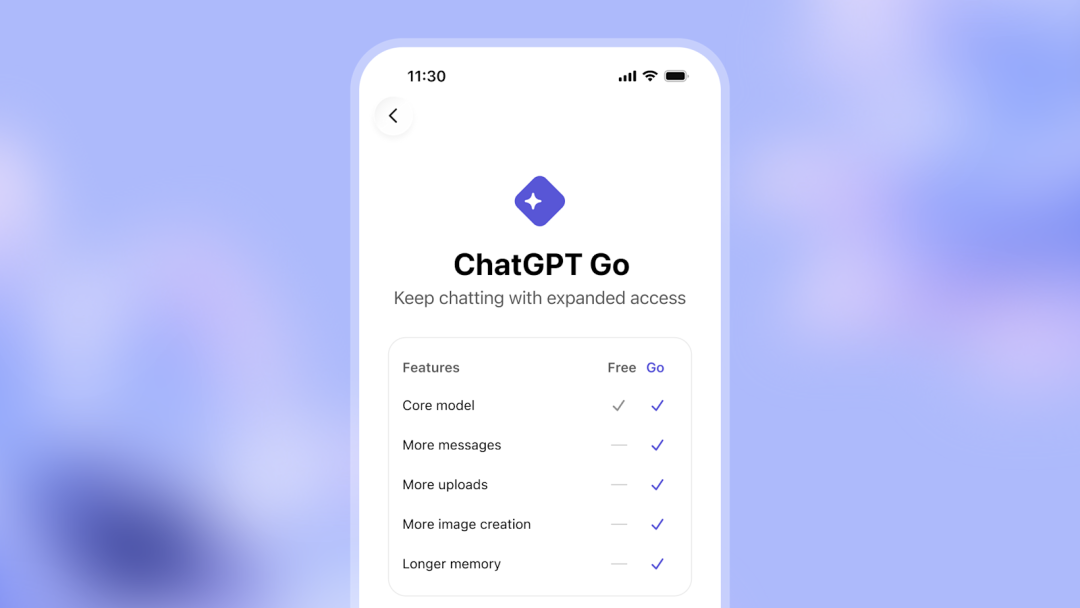
If you are a paid Plus, Pro, or Enterprise user, congratulations—your interface remains ad-free; but if you plan to try the newly launched ChatGPT Go subscription service, which costs only $8 per month, you are still among those targeted for ads.
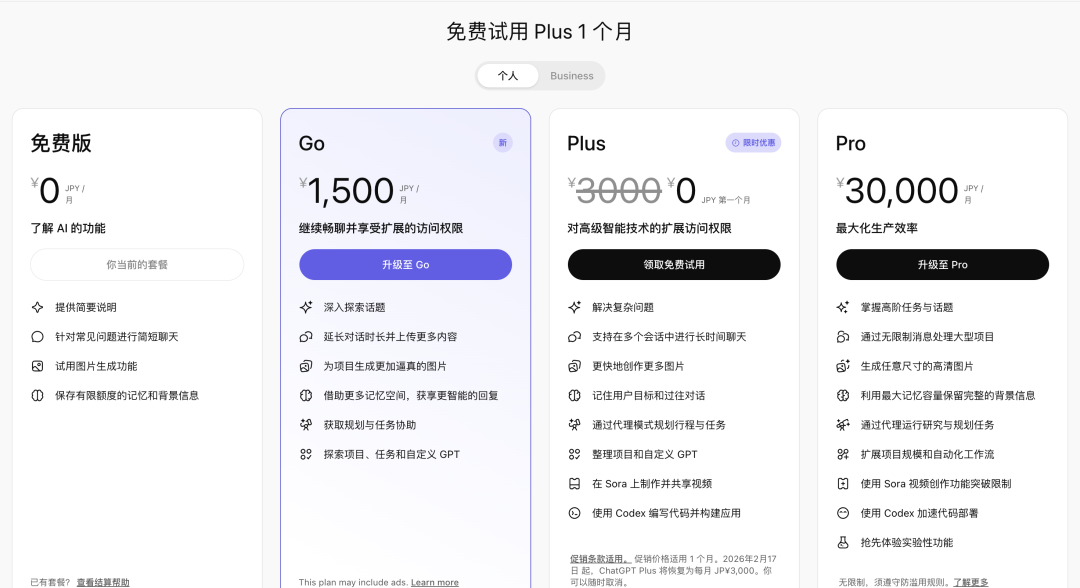
The ChatGPT Go subscription service is now available in all regions where ChatGPT is supported. Benefits and core features include access to the GPT-5.2 Instant model, 10 times more message, file upload, and image generation quota than the free version, and longer memory and context window.
With this, ChatGPT has officially built a clearly tiered three-level consumer subscription system:
Go ($8): Entry-level, focused on value for money and daily tasks.
Plus ($20): Advanced tier, supports GPT-5.2 Thinking and Codex, suitable for deep reasoning tasks.
Pro ($200): Flagship tier, supports GPT-5.2 Pro, offering the highest permissions and performance.
Additionally,to ease user concerns about "chat turning into a sales pitch," OpenAI emphasizes that ads will absolutely not interfere with the objectivity of responses,and AI will continue to generate content in the way that is most helpful to you, not simply favoring whoever pays the most.
More importantly, on the privacy front, your conversation records will not be bundled and sold to advertisers, you have the right to disable personalized settings at any time, and users under 18 will be completely shielded from ads.
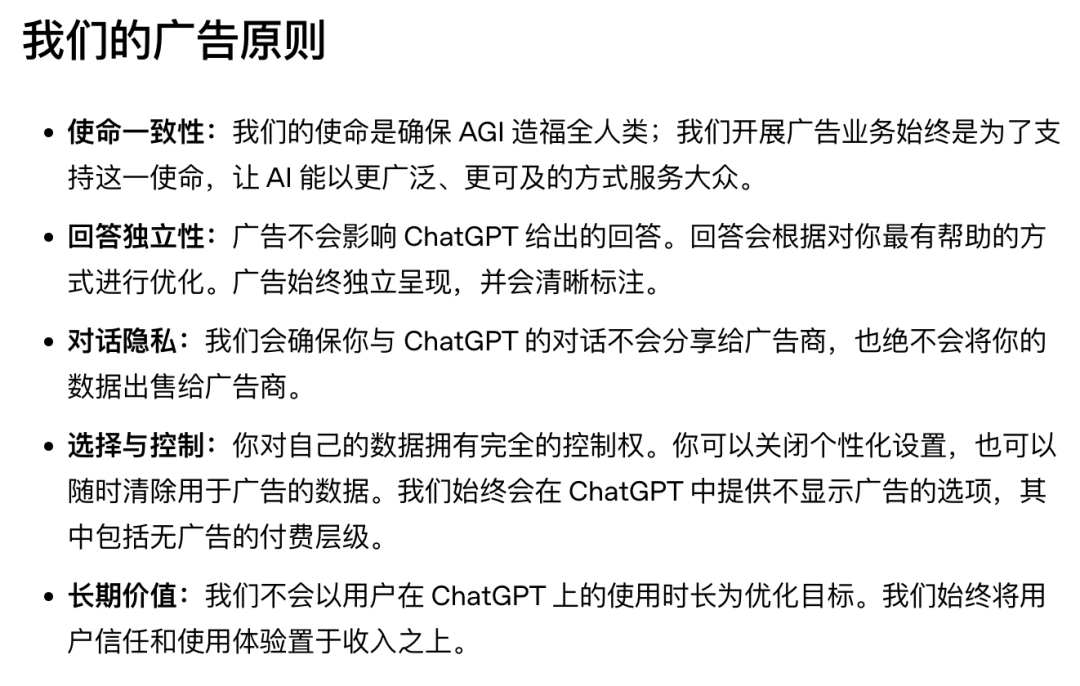 Screenshot of ChatGPT advertising principles | Official blog
 OpenAI is frank about its rationale:the introduction of ads is meant to enable more people to use the tool for free or at low cost,after all, expensive computing costs are a reality, and to realize the vision of "AI for all," diversified revenue streams are essential.
Interestingly,OpenAI doesn't intend to just slap a few ad banners in place; they are proposing a new concept called "conversational advertising."
Imagine this: when you ask for a Mexican dinner recipe, not only does a food brand sponsor appear at the bottom, but you can also directly ask the ad questions and interact for more information.
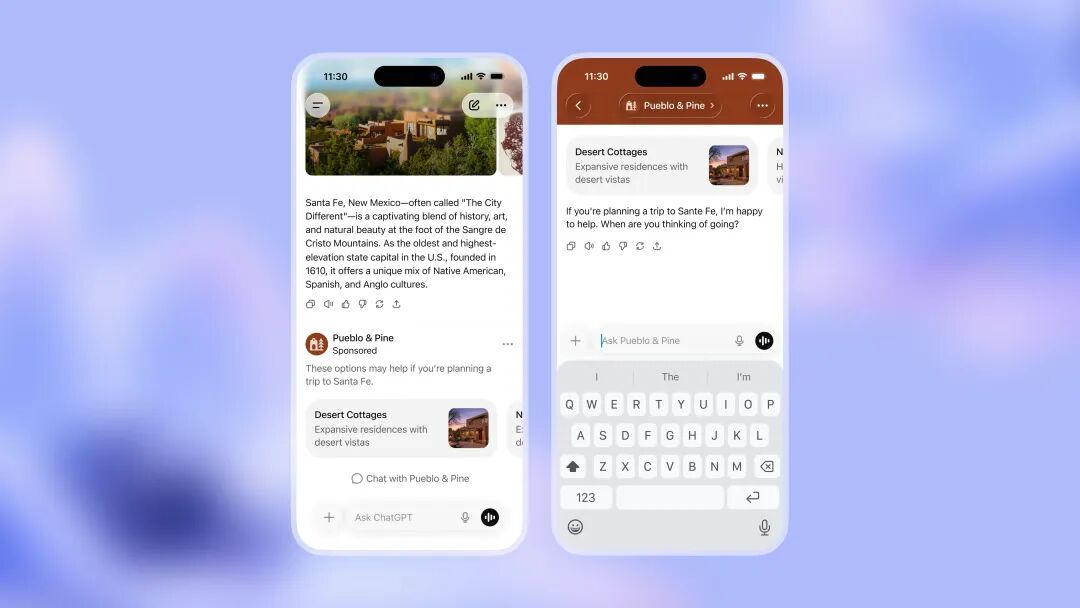
Although OpenAI is working hard to present this "conversational advertising" as a win-win innovative experience, seeking to show that ads can also be valuable content, history has shown repeatedly that when a platform acts as both referee and player, user interests are often the first to be sacrificed.
Adding ads to AI is a shortcut to profitability, but also a bankruptcy of imagination Let's admit reality first. In the era of large models that constantly burn cash,"putting ads in AI" is indeed the most stable and quickest way to recoup investment. The internet has already made these mistakes. Early portals sold ad space, then search engines sold keywords, and later social networks and short video platforms sold feed ads. The pattern hasn't changed much: gather people first, then sell their attention to advertisers. The ad formats grow subtler, but the systems become more mature.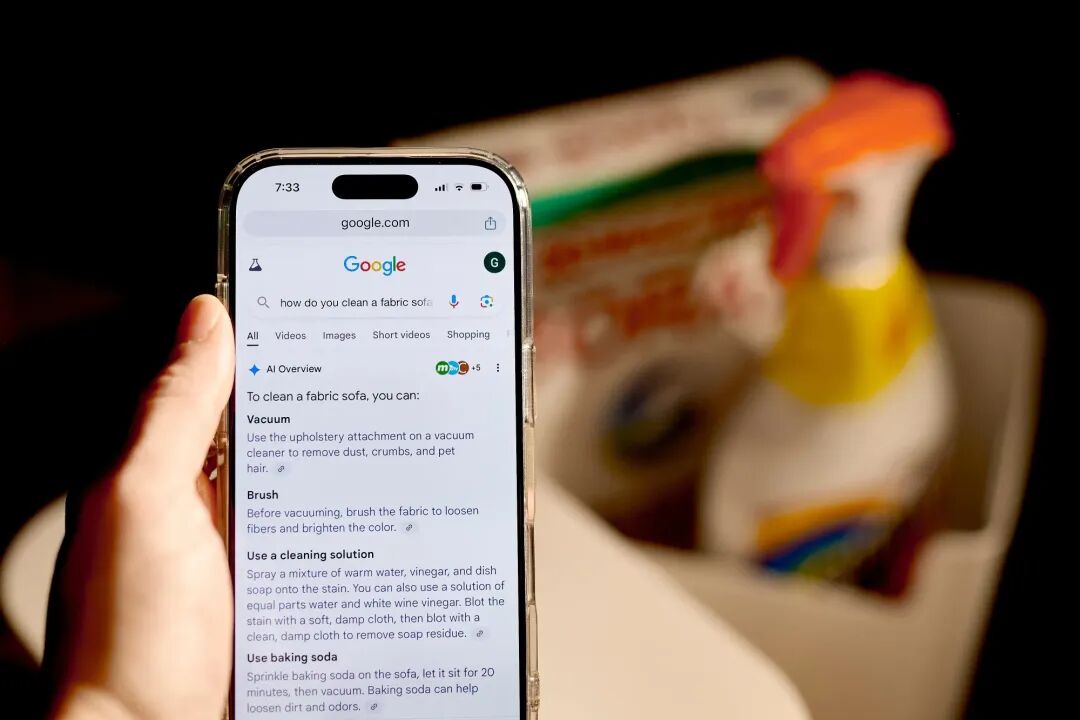 The situation AI faces now is much like the early internet. User numbers are skyrocketing, but revenue can’t keep up. Subscriptions are still slowly educating the market, and enterprise payment cycles are long. There’s a widening deficit between ideals and reality. So, selling ads has become a lifeline at the AI table. Whoever feels the most pressure has to reach out first. But whoever is the first to brazenly stuff ads into conversations might be the first to send the most sensitive and picky users fleeing to other models. That’s the prisoner’s dilemma in a nutshell. As long as at least one player insists on not adding ads, others will hesitate, fearing they'll become the first to be abandoned. But once several do it at once, the concern disappears, and no one needs to pretend innocence anymore.
 In fact, Google has already taken the lead this week, testing a so-called personalized discount ad in the Gemini chat interface.
The core logic: when a user asks Gemini "which suitcase has the best value," the system detects a strong purchase intent and will automatically embed a limited-time discount code from Samsonite in the response.

Ads are no longer triggered by keywords, but by AI's real-time judgment that "this person is about to place an order." Of course, Google has given it a nice name, calling it a "new model that goes beyond traditional search advertising."
Of course, from a business logic perspective, we shouldn't blame OpenAI. In the face of sky-high GPU electricity bills, any non-profit idealism seems extravagant. Data doesn't lie: OpenAI's annualized revenue is about $12 billion, which sounds impressive, but the burn rate may be three times the public numbers. Pretraining burns money, and every inference after deployment burns money, too. The cost of inference is dropping, but as the Jevons paradox proves, as compute gets cheaper, users just run more complex models, forcing companies to buy more GPUs and watch electricity bills snowball. In short, the unit cost goes down, but the total bill doesn’t. According to OpenAI's stats as of July this year, ChatGPT had about 35 million paid users, accounting for 5% of weekly active users. Meanwhile, subscription revenue makes up the bulk for most AI companies like OpenAI. Against this backdrop, all AI companies face a simple, brutal question: Where does the money come from? The most direct answer is stuffing ads into AI. Ads are considered an original sin because the internet lacked other effective business models. The same is true in the AI era—without innovative models, ads remain the only way to cover the bulk of user costs. Of course, simply copying the money-making methods of the previous era is clearly a lack of imagination. Traditional internet has already proven: When all you have is a hammer, every problem looks like a nail. When all you know is advertising, every product becomes an ad slot.
 ChatGPT ads face the same challenge: as of June this year, only 2.1% of queries involved shopping. To address this, OpenAI has integrated Stripe payments, Shopify, Zillow real estate, and DoorDash delivery to both cultivate shopping habits and gather data for ad targeting.
The revenue model determines the product form, and user experience is usually the variable sacrificed. AI was highly anticipated as a chance to escape the mire of the old era,but after all our efforts, we find ourselves stuck in the same mud. The AI that knows you best is now selling to you Traditional internet advertising essentially boils down to selling attention with eye-catching spots, most typically early search engine ads. Pages looked like search results, but the top entries were all paid placements. Looking back now, the accidents and controversies of that era are chilling. Placing ads in AI can be even more dangerous. We, as experienced internet users, are naturally wary of web ads and know to compare multiple search results, aware that the top ones are likely ads. But with empathetic, human-like AIs, the trap is that we might forget a sales team could be behind the screen.You treat AI as a teacher, but it regards you as a potential customer to be converted. Looking back at history, Su Dongpo once wrote, "Delicate hands twist dough to a jade-like sheen; green oil fries them to a golden hue," for a snack vendor, drawing crowds. People weren't buying the snack—they were buying the trust of a celebrity. Today, AI is, in many scenarios, that default-trusted Su Dongpo for ordinary users.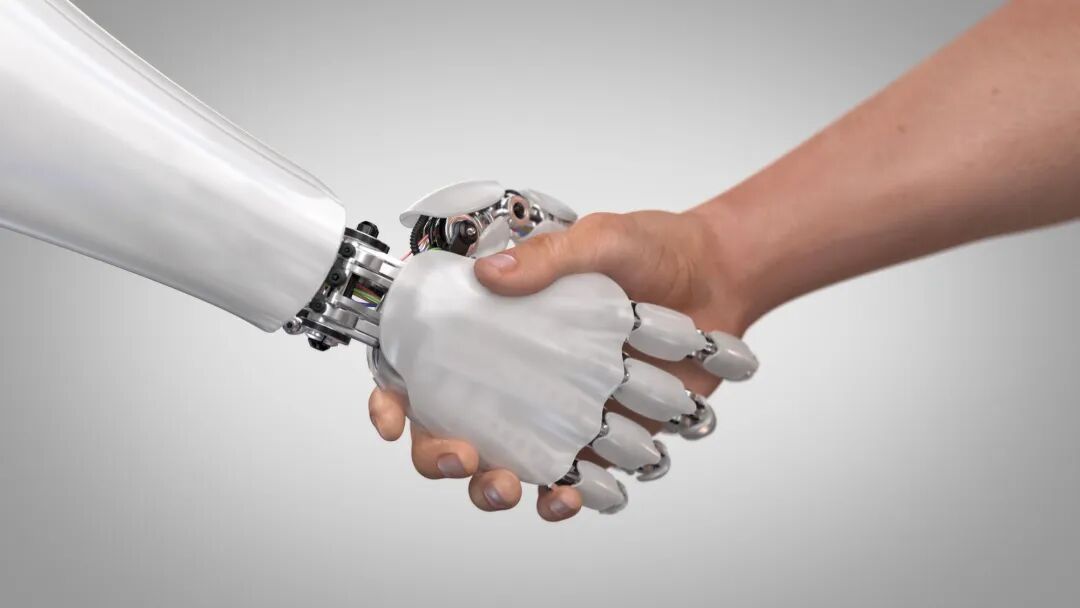 An especially dangerous point is that now, beyond simple ad placement, some are using GEO to "poison" content. GEO stands for Generative Engine Optimization; its purpose is to make a webpage or article the prioritized reference for AI engines like ChatGPT, Gemini, and Perplexity. Imagine this scenario: certain companies or stakeholders pre-publish a large number of optimized web articles, written authoritatively and completely about a product or service, with structured tags, SEO metadata, and keyword prompts. Their aim isn't to help but to ensure that when users ask related questions in AI, their content is output first. Then, the AI incorporates this into its answers. For users, this is "authoritative advice + neutral information." But in reality, it might be commercial promotion/poisoning disguised as expert advice.
  This is more frightening than traditional ads or advertorials because it’s hidden in the "answer" itself, not in an obvious ad slot, but in the advice or conclusions users trust most. Every few paragraphs, we have to ask: is this AI advice really for me, or is it helping to sell something? Even hiding an ad in a sentence is dangerous enough. More importantly, AI is planning the next step—moving itself upstream of all apps, essentially taking over "who gets to advertise to you." In the traditional internet era, every super app wanted to be the gateway. They built their own walled gardens. Users opened them directly, and the apps controlled what content, services, and ads you saw. Super apps spent a decade building walled gardens, but now, the red-hot AI Agent wants to flatten them overnight. In theory, it can operate across different apps and help you complete tasks like "open an app, search, compare prices, autofill forms, place orders" without you clicking around or even remembering app entrances. This means that in the future, real AI Agents will become the default web entry point for most people. Apps that once made money from ads will either pay protection money to the AI or fade into the background as an interface without brand presence. News sites have already gone through this. According to media company Raptive, Google's new AI Overview feature will ultimately cause many publisher sites to lose 25% of traffic. While the impact isn’t at its worst yet, as AI Overview expands, the effect will intensify. With aggregator platforms, they slowly transitioned from being reader-facing to content suppliers. Now it's consumer apps' turn. When all apps have to serve the AI butler, it’s the butler itself that most needs scrutiny. On the one hand, the goal of ads was to persuade individuals: fight for attention, insert content into human timelines. In a world run by AI Agents, advertisers must first persuade the Agent making decisions for people.
  On the other hand, this means that in the future, most ad teams will need to seriously consider:When users no longer browse apps themselves but let Agents do it, whom should I target with my ads? How do I advertise? Yes, if an AI Agent is also an ad platform, it possesses two types of power at once. It decides where you go and what you see. It can choose hotels, flights, insurance, and doctors for you—and can embed its own commissions and ad logic behind each choice. Especially, AI assistants can deeply understand a user's current needs and intentions, inserting highly relevant ad recommendations—going far beyond keyword-based targeting on traditional web pages, potentially achieving the effectiveness of a real human advisor. And the AI assistant’s interaction accumulates massive amounts of personal privacy data—including user preferences, habits, location, social relationships, etc. If these are used for ad targeting, the precision will be unprecedented.
 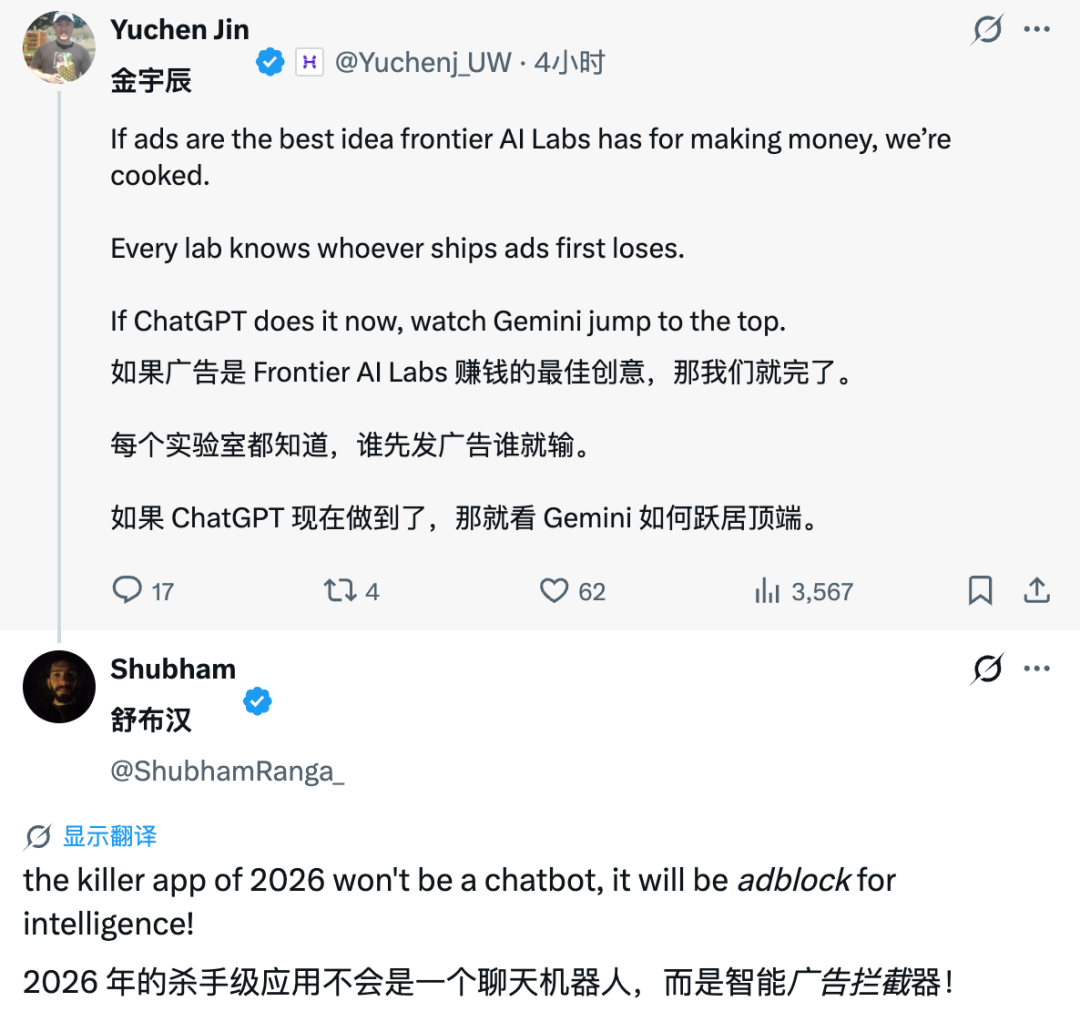 The killer app of 2026 may not be a chatbot, but an ad blocker. Every generation of new technology claims to be different, yet all end up finding their home in advertising. .
 So, in the face of the coming "e-commerce version" of ChatGPT, there’s no need to panic, but we must not let our guard down.
Now that ads are a foregone conclusion, what we can do is quickly complete the "demystification" of AI. Don’t treat it as an omniscient god—treat it as a tool trying to please you, sometimes slipping in its own agenda.
In an era where AI can handle all our tedious processes, the one thing we must never outsource is our own judgment. Use the tool well, but don’t become a tool yourself.
By Zhang Wuji Welcome to join the APPSO AI community to chat about AI products and get#AIUsefulWork, unlocking more new AI knowledge👇
Disclaimer: The content of this article solely reflects the author's opinion and does not represent the platform in any capacity. This article is not intended to serve as a reference for making investment decisions.
You may also like

Solana DEX Jupiter Unveils JupUSD, Returning Native Treasury Yield to Users
From $3.5K to $12K? Here’s why BMNR’s Ethereum forecast makes sense
Trending news
MoreCrypto prices
More






