
News
Stay up to date on the latest crypto trends with our expert, in-depth coverage.

1Bitget Daily Digest (Jan.16)|CME to Launch ADA, LINK and XLM Futures on Feb 9; Bitmine Purchases 24,068 ETH; Polygon Lays Off 30% to Pivot Toward Stablecoin Payments2Atomic Wallet raises red flags in viral $479k Monero loss claim3Bitcoin Sheds 30% of Open Interest: Is a Rebound Imminent?

Urgent: US Senator Demands PancakeSwap Investigation Over Trump Ties and Price Manipulation
Bitcoinworld·2025/12/16 18:27
How Luminar’s doomed Volvo deal helped drag the company into bankruptcy
TechCrunch·2025/12/16 18:27

OpenAI continues on its ‘code red’ warpath with new image generation model
TechCrunch·2025/12/16 18:27
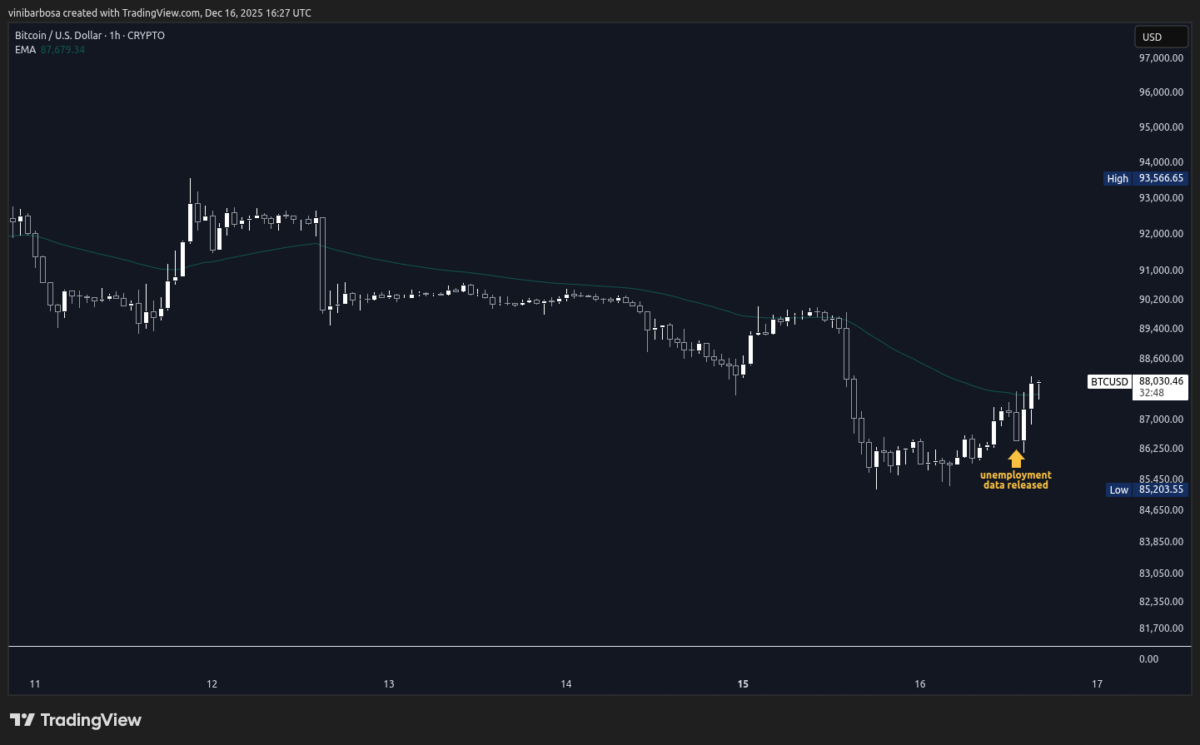
US Unemployment Jumps to 4.6%, Crypto Analysts Expect Bitcoin Bull Run
Coinspeaker·2025/12/16 18:18
'DeFi will win,' Aave CEO says after SEC ends years-long probe
The Block·2025/12/16 18:15
Crypto Payments Russia: Finance Chair Delivers Defiant Ban on Digital Currency Use
Bitcoinworld·2025/12/16 18:12
Ripple (XRP) Is Running Trials With NASDAQ
·2025/12/16 18:06
Flash
02:58
Injective Highlights How Tokenization Could Unlock $30 Trillion in Asset MarketsInjective has published new research that positions its blockchain as a full-stack platform for regulated real-world asset tokenization.
The adoption is increasing, with growing tokenized RWA volumes and consistent on-chain activity throughout Injective’s ecosystem.
Injective has released new research outlining how its blockchain is structured to support real-world asset tokenization at an institutional level. The report frames tokenization as a direct evolution of traditional securitization, where ownership claims on assets such as equities, bonds, treasuries, real estate, and fiat instruments are moved onto programmable blockchain rails.
According to the research, tokenization is a more advanced version of conventional securitization models that integrates programmability with faster settlement and near-instant settlement, while reducing the need for intermediaries. As a result, issuers can automate corporate action and compliance logic on-chain. Investors, in turn, benefit from immutable records and transparent settlement flows.
In addition, Injective brings back the structural benefit of liquidity. Fractional ownership allows for smaller capital investments, and 24/7 trading eliminates time zone restrictions that are prevalent in traditional markets.
According to the report, these features enable the more efficient circulation of assets without compromising overviews by auditors and regulators. Injective argues that these features solve real frictions that have existed in the capital markets for a long time, rather than merely putting existing systems on blockchain rails.
Permissioned Token Standards Embed Compliance At Issuance
As per the report, the permissioned token standard is at the heart of the Injective model because the standard inherently inscribes access rules within smart contracts. Issuers are able to implement allowlists and transfer restrictions without off-chain enforcement. The study observes that such a strategy has multiple asset classes and is flexible across jurisdictions.
Injective also provides direct integration with custody and compliance providers. That design choice is meant to minimize onboarding friction for banks, asset managers, and other regulated entities entering tokenization markets.
Once issued, assets can flow into different liquidity environments. Public liquidity networks utilize automated smart contracts, whereas institutional networks employ professional market makers that facilitate greater volume trading.
Tokenized Asset Demand Rises
Injective’s research cites its operational history as a sign of institutional readiness. Injective has processed over 1.1 billion transactions since the mainnet launch in 2021 and has yet to experience downtime or security breaches. In 2024, the ecosystem broadened with more stablecoin integrations and tokenized financial products., which the report views as indicators of institutional readiness.
According to Securitize, tokenized real-world assets have passed the $20 billion mark for cumulative asset value. Excluding stablecoins, the sector grew to $18.2 billion by the end of 2025, up from about $5.5 billion at the start of the year. Tokenized treasuries went from $4 billion to $9 billion in the same period.
Source: Securitize
Separately, Messari reported that Injective hit $6 billion in perpetual real-world asset trading volume. As of press time, INJ is trading at around $5.64, up 9.74% in the last 24 hours and 2% in the last seven days.
02:58
COTI Integrates Programmable Privacy Into Zoniqx’s RWA Tokenization PlatformCOTI has partnered with real-world asset tokenization platform Zoniqx to integrate its programmable privacy technology into its infrastructure.
The joint initiative will enable compliant, privacy-preserving real-world asset issuance and settlement on-chain.
COTI has partnered with Silicon Valley-based fintech Zoniqx to embed its programmable privacy technology into the latter’s tokenization infrastructure. The partnership will facilitate privacy-protecting and regulatory tokenization of real-world assets (RWAs), a developing field in institutional finance.
Zoniqx provides a complete RWA tokenization infrastructure with support for equity, debt, real estate, funds, and energy assets. The platform integrates regulatory standards within smart contracts. This enables enforcing KYC, KYB, and jurisdiction-specific regulations on a token basis. It is also useful in ensuring regulatory conformity across chains and jurisdictions.
https://t.co/FfiLkXvFBF
— COTI Foundation (@COTInetwork) January 12, 2026
COTI will implement its Garbled Circuits (GC) privacy layer in the platform of Zoniqx. The GC Layer, as a result, will ensure that sensitive financial information is secured without compromising institutional compliance. In addition, it is EVM compatible and is 3,000 times faster than rivals. It also saves on resources, hence it can be scaled to large enterprise use.
Together, both firms aim to launch the first privacy-enabled RWA tokens on public blockchains. The initial phase includes a pilot program. This will later expand to onboard institutional users and enterprises that require confidential asset workflows.
COTI Targets Institutions With Privacy Tools and Network Upgrades
According to the COTI Foundation, the integration is part of its bigger objective of offering a scalable and compliant privacy infrastructure. As we reported earlier, the foundation will be updating the COTI Treasury, with Node V2 coming online in 2026. This upgrade will make the network’s governance decentralized and community-based.
Zoniqx has established its position as the leading platform powering institutional-grade tokenization. It enables users to issue tokens, distribute them and gives access to secondary markets through broker-dealers, DeFi platforms and regulated exchanges. Fiat-to-crypto settlement functionality is also provided on the platform.
With the integration of the privacy layer of COTI, Zoniqx will provide an end-to-end encrypted issuance of assets, transfers, and settlements. The system enables selective disclosure, which enables the issuers and investors to comply with the requirements of the regulations without exposing sensitive information.
As part of its roadmap, the network completed the Helium mainnet upgrade recently. As CNF detailed, the upgrade boosts confidential computing capabilities across the network.
After dipping 7% in the past week, COTI has gained 0.9% in the past day to trade at
$0.02102
.
02:58
Sei Network Surpasses 1.5M Daily Active Addresses as Adoption Soars Across DeFi, Gaming, and Consumer AppsActive addresses on SEI just hit a new all-time high above 1.5 million.
In total 19 apps on the SEI blockchain have surpassed 100,000 monthly active addresses.
The SEI blockchain is recording a massive jump in its daily active addresses. According to a new post on X from Jan. 13, SEI is seeing a daily address count of over 1.5 million. This growth is visible in different areas, including DeFi and gaming.
Sei Bags New Milestone in Daily Active Addresses
The Sei team disclosed that the recent spike in daily active addresses is a historic high for the network. In the past 4 months, the Sei active daily average addresses surged to more than 1.5 million.
The increase suggests strong organic growth, which could translate into other positives for the network. It implies that more users are interacting with the Sei blockchain, which is recording increased adoption and usage.
In its post, the Sei team emphasized that the recent network growth is compounding and not from a single app. They pointed out that user activity has increased across payments, DeFi, gaming, and consumer.
Based on the available data, 19 apps have surpassed 100,000 monthly active addresses, a sign of broad user adoption.
One of the top leaders is Kindred Labs, whose platform hosts more than 100,000 daily active addresses. Kindred is a consumer-facing project building artificial intelligence (AI)-powered companions. Achieving over 100,000 daily users puts it ahead in non-financial consumer and Web3 entertainment apps.
SEI Network Growth Showcase | Source: SEI on X
Takara Lend emerged as the second most active EVM lending app by daily addresses, surpassed only by the Aave protocol.
Furthermore, Yei Finance, another major lending market on Sei, ranks as the top 5 EVM chain by total transaction count. This achievement highlights massive on-chain volume and usage in the Sei DeFi sector.
In the Sei gaming sector, 11 games have surpassed 300,000 monthly active addresses. As regards payments, peer-to-peer (P2P) stablecoin supply rose 155% in just 6 months. Also, weekly stablecoin volume surged 104% over 3 months to approximately $1.5 billion.
SEI Price Rally Amid Network Growth
Generally, increased network adoption leads to a spike in price as more addresses become active and demand grows.
As of press time, the SEI price exchanged at $0.1240, representing a 1.8% increase in the last 24 hours.
Some market participants maintained that the Sei Network will experience further price growth to match the spike in daily active addresses.
The chart indicates that SEI might experience a potential 500% increase, which could see its price rise to as high as $ 1.80.
Meanwhile, the rising user adoption of Sei coincides with an upcoming network upgrade, Giga. Sei Giga introduces multiple concurrent proposers and new MEV patterns backed by formal research from Sei Labs.
In a recent update, we covered how Sei Giga introduces multiple concurrent proposers and new MEV patterns. Besides this upgrade, Sei recently integrated with Allora to strengthen its network on-chain market capabilities.
News