
Bitcoin’s Abrupt Price Swings in Late 2025: Major Economic Drivers and the Strength of Institutional Players
- Bitcoin's late 2025 volatility stemmed from Fed rate-cut expectations and Trump-era tariff uncertainty, triggering a $16B liquidation event. - Institutional investors maintained BTC holdings, leveraging ETFs and regulatory clarity to navigate market turbulence. - Regulatory tailwinds, including ETF approvals and tokenized structures, bolstered strategic positioning in crypto-related equities and hedging tools. - Corporate entities increased BTC allocations by 8.4% amid reaccumulation phases, contrasting
Understanding Bitcoin's Volatility in Late 2025
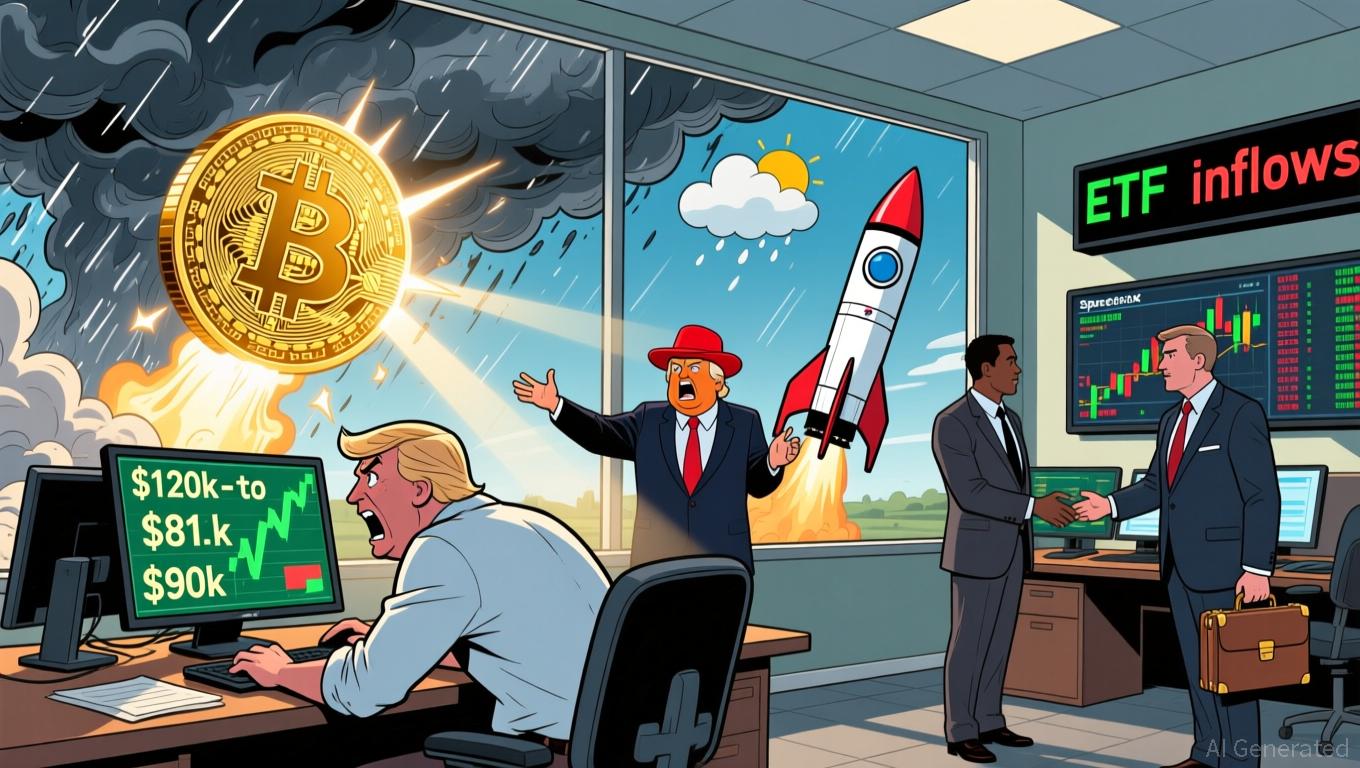
In the latter part of 2025, Bitcoin experienced significant price swings, driven not by random chance but by a mix of global economic developments and shifting institutional strategies. As the Federal Reserve's anticipated interest rate cuts intersected with unpredictable trade policies from the Trump administration, the crypto market saw a dramatic $16 billion in liquidations in early October. Despite this turmoil, large-scale investors remained composed. This overview explores the main factors behind Bitcoin's instability and highlights key strategies for investors navigating these changing conditions.
Key Economic Drivers: Federal Reserve Actions and Trade Policy Shifts
Throughout most of 2025, Bitcoin's price was largely contained between $100,000 and $110,000, influenced by the Federal Reserve's restrictive monetary stance. However, as expectations grew for a 25 basis point rate reduction at the late October meeting—an outcome considered highly likely by the market—volatility in Bitcoin derivatives surged. This was further complicated by inconsistent signals regarding U.S. trade policy. A brief easing of tariff threats temporarily boosted market confidence, but renewed concerns over a potential 100% tariff on Chinese imports quickly reversed sentiment, leading to the massive liquidation event mentioned earlier.

Retail investors responded to these macroeconomic uncertainties with increased caution, mirroring the pessimism seen during the "Liberation Day" tariffs earlier in the year. In contrast, institutional players demonstrated resilience, increasing their Bitcoin holdings by 8.4% in the month leading up to October. This accumulation phase signaled growing confidence among corporate investors despite broader market anxiety.
Institutional Confidence: Stability in Uncertain Times
While many individual investors exited the market, institutions continued to view Bitcoin as a valuable part of their portfolios. The introduction of Bitcoin ETFs in early 2024 and the passage of the GENIUS Act in July 2025 provided much-needed regulatory certainty. Nearly half of institutional investors cited these changes as reasons for boosting their digital asset exposure. BlackRock's IBIT ETF, managing $50 billion in assets, became a preferred choice due to its efficiency and regulatory approval.
Bitcoin's reputation as a safeguard against currency depreciation and inflation also gained traction. Major financial firms like Fidelity and Vanguard began incorporating Bitcoin into diversified investment strategies, while new products such as CME Group's Bitcoin Friday futures enabled more advanced hedging techniques. The launch of ETFs that directly compare Bitcoin to gold, such as those from Tidal Financial Group, further highlighted the growing institutional interest in using Bitcoin as a macroeconomic hedge.
Investment Strategies: Crypto Equities and Advanced Hedging
For those looking to benefit from Bitcoin's volatility, attention is shifting toward crypto-related stocks and sophisticated hedging instruments. The introduction of institutional-grade perpetual futures by SGX Derivatives offers investors new ways to manage exposure to crypto equities. Additionally, spot ETFs like those from Canary Capital, focused on assets such as XRP and HBAR, provide straightforward access to core blockchain investments, making portfolio diversification easier.
Supportive regulatory changes in the final quarter of 2025 are expected to accelerate these trends. The SEC's relaxation of rules for exchange-traded products is likely to lead to a surge in new crypto ETF offerings. Meanwhile, tokenised fund structures are attracting significant interest from hedge funds due to their operational benefits. With Bitcoin entering a renewed accumulation phase, investors are encouraged to focus on ETFs, futures, and tokenised assets to both protect against economic headwinds and take advantage of institutional momentum.
Summary
The volatility seen in Bitcoin during late 2025 reflects broader economic and regulatory shifts. Although short-term instability remains, the steadfastness of institutional investors and clearer regulatory frameworks offer strong reasons for strategic investment. By focusing on crypto-related equities and advanced hedging tools, investors can better manage uncertainty and position themselves to benefit from Bitcoin's evolving status as a digital asset of value.
Disclaimer: The content of this article solely reflects the author's opinion and does not represent the platform in any capacity. This article is not intended to serve as a reference for making investment decisions.
You may also like
The 2025 Bitcoin Collapse: Underlying Factors and Tactical Considerations for Cryptocurrency Investors
- The 2025 Bitcoin crash erased $1.2 trillion in value, driven by macroeconomic tightening, leverage, and geopolitical tensions. - Financialization linked crypto to traditional markets, exposing systemic risks through institutional entanglements and fragile liquidity. - Regulatory divergence between U.S. pro-blockchain policies and EU MiCAR rules created jurisdictional conflicts and operational misalignment. - Investors must prioritize diversification, monitor regulatory shifts, and prepare for prolonged v

Blockchain’s $6.8 Billion Bet: Will Advancements Outpace Its Security Risks?
- Terminal Finance's collapse exposed blockchain fintech vulnerabilities from delayed tech adoption and security flaws, triggering sector-wide scrutiny. - Naver-Upbit's $6.8B AI-blockchain merger faces challenges after Upbit's $36M Solana breach, mirroring 2019 North Korean-linked attacks. - Balancer's $116M hack revealed systemic DeFi risks, with debates over audit efficacy despite 11 prior security reviews. - Binance's legal troubles and BNB's price slump highlight market skepticism, while initiatives li

Bitcoin News Update: Krugman Links Bitcoin's Decline to Waning 'Trump Trade' Hype
- Bitcoin's 30% drop from October peak linked to fading "Trump trade" speculation, per Nobel laureate Paul Krugman, who frames it as speculative rather than stable value. - BlackRock's IBIT ETF regained $3.2B profit post-$90K rebound, while SpaceX's $105M BTC transfer sparks custodial strategy debates amid market volatility. - Naver's $10B Dunamu acquisition and corporate Bitcoin treasury moves highlight institutional crypto integration, despite $19B industry selloff and regulatory challenges. - Prediction
Bitcoin News Today: "Conflicting Whale Strategies Cast Uncertainty on Bitcoin's Path to $100K"
- Bitcoin's drop below $100,000 coincided with mixed whale strategies, including accumulation, shorting, and exchange deposits, signaling uncertain market direction. - Ethereum whales used 16.08 million DAI to buy 5,343 ETH at $3,010, while Bitcoin whales deposited 9,000 BTC, potentially signaling selling preparation. - Derivatives markets showed conflicting bets, with a $91M BTC short and $36.4M long flip, while ETF inflows ($84M total) hinted at institutional confidence amid macroeconomic risks. - Analys

Trending news
MoreCrypto prices
More





