
News
Stay up to date on the latest crypto trends with our expert, in-depth coverage.

Although on-chain metrics show overheated signals, the significant downside risk is limited due to institutional buying pressure outweighing retail buying pressure. A pullback may occur in the short term, but the likelihood of a trend reversal is low.
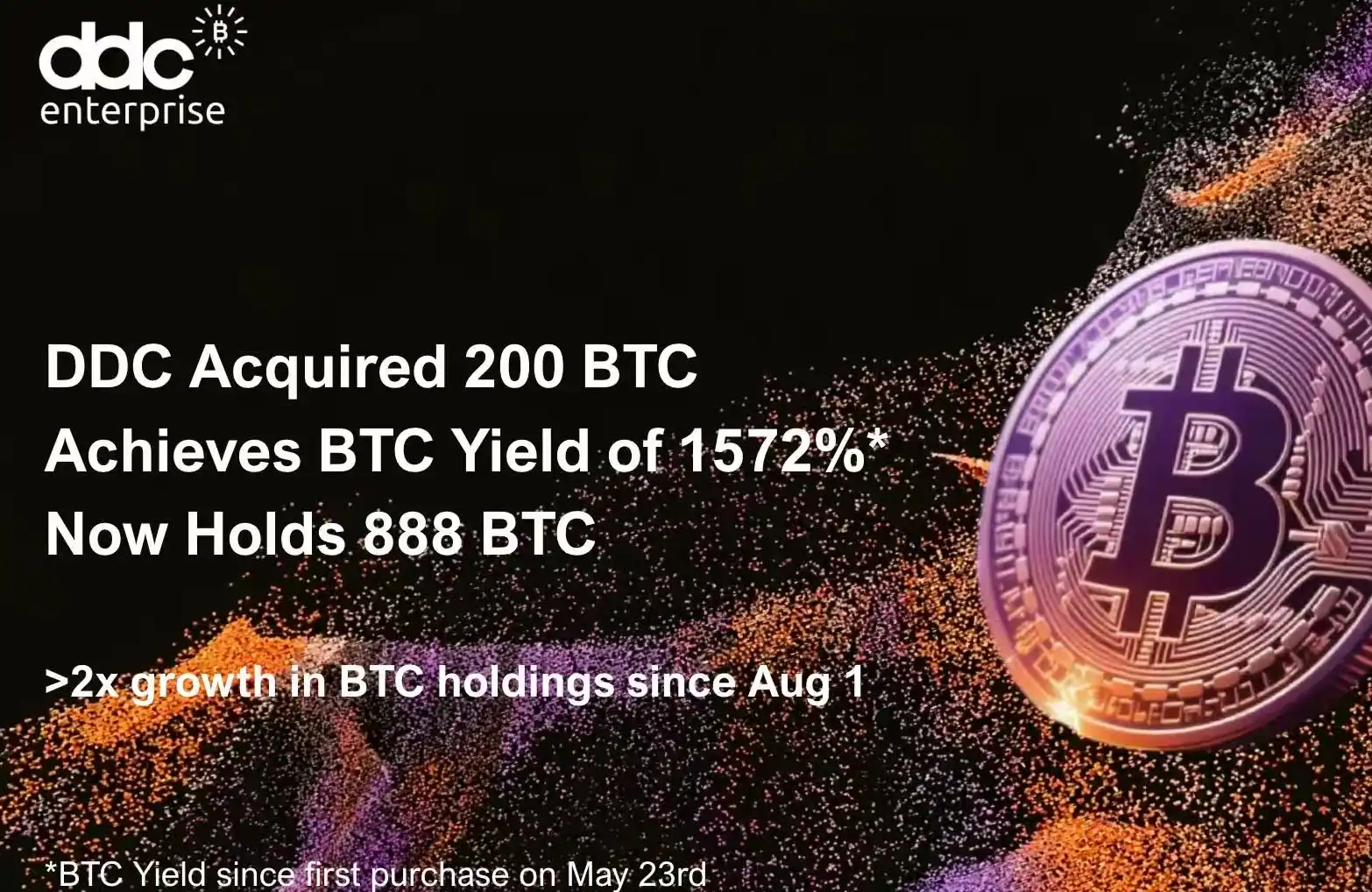
DDC Enterprise Limited announced today that it has completed its fourth Bitcoin purchase in August, acquiring an additional 200 BTC. With this purchase, the company's total holdings have reached 888 BTC, representing a growth of over double since the beginning of the month, when it held 368 BTC.

The US GENIUS Act gives stablecoins clear rules, setting the stage for explosive growth, new web3 apps, and rising venture capital interest.

Stellar’s price action looks fragile despite market rallies. With social dominance falling and a bearish crossover nearing, XLM risks deeper losses if support fails.
Share link:In this post: U.S. futures fell after Friday’s rally as markets await Nvidia’s earnings. Bitcoin and Ether erased weekend gains after Powell’s rate cut hint triggered massive liquidations. Asian stocks surged, led by tech in Hong Kong and Taiwan, while Europe slipped.

Share link:In this post: Five large UK data center projects have asked National Gas about connecting directly to its transmission pipelines to build on-site gas power stations. The projects would need about 2.5GW of capacity in total. Developers in the US are increasingly using gas-fired turbines as a stopgap before securing grid connections as AI-driven demand strains global power supply.
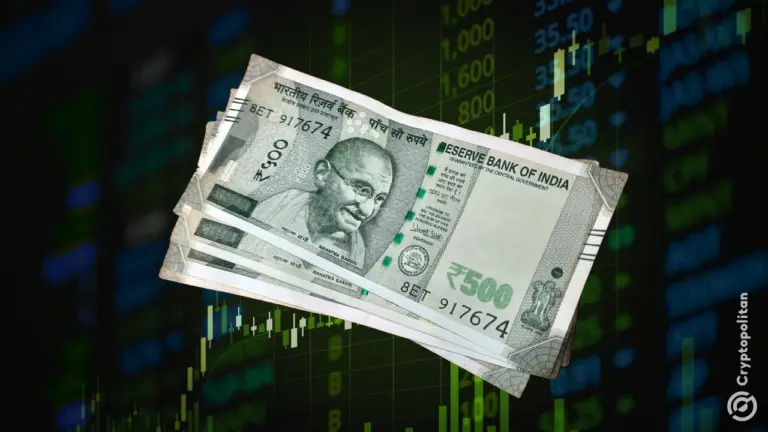
Share link:In this post: The Indian government, through its Statistics Ministry, has disclosed plans to integrate Amazon and Flipkart price data into its inflation gauge starting early next year. A HCES (Household Consumption Expenditure Survey) poll revealed that e-commerce is growing in popularity among households. The RBI recently reported that the FIT (Flexible Inflation Targeting) framework had performed well and met the country’s needs since its introduction.

Share link:In this post: Media companies are preparing for how to deal with a possible “Google Zero” situation. Enders says half of media companies saw a drop in traffic in the last year. Google’s total organic clicks from Search have held steady over the past year.

What RWA truly needs is a predictable, measurable, and settleable liquidity highway.
- 05:14Moonbirds announces the launch of the BIRB token in Q1 next yearAccording to ChainCatcher, Moonbirds will issue the BIRB token on Solana in the first quarter of 2026.
- 04:41Berachain liquid staking protocol Infrared announces token airdrop claim will open on December 17On December 14, according to the official announcement, Berachain's liquid staking protocol Infrared has announced details of the IR token airdrop. The airdrop targets early community members, Boyco pre-deposit event participants, and users who have participated in community activities. Users can claim the airdrop in advance through the centralized exchange pre-deposit process. The pre-deposit period is from December 13, 12:00 UTC to December 15, 17:00 UTC. Users need to start the process on the official Infrared website, select an exchange, and submit their user ID. The IR token has three main functions: staking to obtain sIR for governance voting rights; profit sharing through a buyback mechanism, with a portion of protocol fees flowing into the "Red Fund" for IR token buybacks; and token issuance to optimize protocol efficiency and revenue. Key milestones: IR token will be listed at 8:00 UTC on December 17, and all claims will be permanently closed at 00:00 UTC on January 12, 2026. Non-exchange claims will open on the day of the token generation event. Previously, it was reported that Infrared, the first liquid staking protocol in the Berachain ecosystem, completed a $14 million Series A funding round led by Framework Ventures.
- 03:50Ethereum consensus layer client Prysm releases post-mortem analysis report on Fusaka mainnet incidentChainCatcher news, the Ethereum consensus layer client Prysm team has released a post-mortem analysis report on the Fusaka mainnet incident. During the event, almost all Prysm nodes experienced resource exhaustion when processing specific attestations, resulting in their inability to respond to validator requests in a timely manner. The impact range was from epoch 411439 to 411480, with 248 blocks lost over 42 epochs, a missing rate of 18.5%. The network participation rate dropped to a minimum of 75%, and validators lost approximately 382 ETH in attestation rewards. The root cause of the failure was that Prysm beacon nodes received attestations possibly sent by unsynchronized nodes, which referenced block roots from previous rounds. To verify these attestations, Prysm attempted to reconstruct compatible states, leading to repeated processing of past round blocks and costly round transition recalculations. The team temporarily resolved the issue by guiding users to use the --disable-last-epoch-target parameter, and subsequent versions v7.1 and v7.1.0 include long-term fixes.